A species
The dugong
The large, shy grazer of the sheltered inshore shallows — a plant-eater staked entirely on the seagrass meadow, and undone the moment clouded water kills the pasture it cannot live without.
- On the gradient
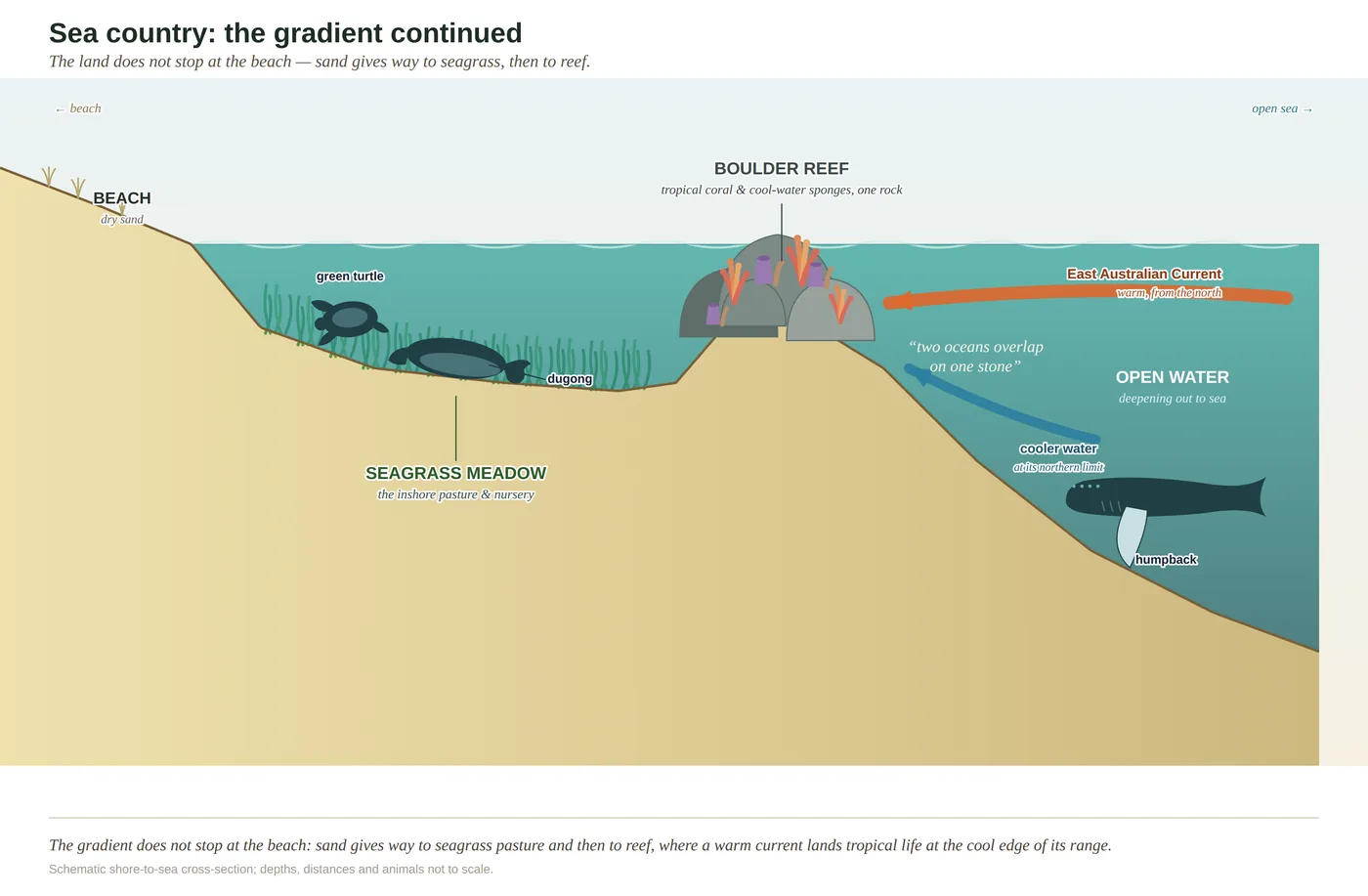
- The inshore sea floor — sheltered seagrass shallows at the seaward foot of the gradient
- Rock
- Sheltered soft-sediment shallows of the Pumicestone Passage and the wider Moreton Bay
- Soil
- Soft sand and mud carrying seagrass meadows (Halophila / Halodule)
The dugong is a big, slow, shy sea mammal that eats almost nothing but seagrass, ploughing furrows through the underwater meadows like a cow in a paddock. The sheltered waters of this coast — Moreton Bay and the Pumicestone Passage on its southern doorstep — carry a nationally important number of them, though how many depends on the season and they are never easy to count. Its whole living rests on the meadow. Cloud the water so the seagrass dies, and the dugong has nothing to eat.
Somewhere in the sheltered green shallows off this coast, a large grey animal is moving slowly over a meadow, cropping it. The dugong is one of the strangest things the region keeps out of sight: a warm-blooded, air-breathing mammal the size of a small cow that spends its entire life underwater eating a flowering plant, ploughing slow furrows through the seagrass beds as it grazes. It is a vegetarian relative of nothing obvious — the manatees are its cousins, the elephants its distant kin — and most people who live here have never laid eyes on one, and would be amazed to learn that the sheltered waters on the coast’s southern doorstep, Moreton Bay and the Pumicestone Passage, carry a nationally important number of them.
Everything about the dugong comes back to the meadow. It is a specialist cut from the same cloth as the koala: a big animal that has bet its whole living on one narrow resource, and is exactly as fragile as that bet is bold. The seagrass it depends on is a true flowering plant, not a weed, rooted in the soft sand of the sheltered shallows wherever the water stays clear enough for light to reach the bottom — and that requirement is the dugong’s weakness in disguise. Seagrass needs light, light needs clear water, and so anything that clouds the water, a flood carrying silt off the land or a hot still spell that cooks the beds, shades the meadow out and kills it. When the meadow dies, the animal that eats nothing else has nothing left. You do not lose one plant; you pull the floor out from under the grazer standing on it.
It is tempting to put a firm number on a herd like this, and you will hear the bay’s dugong called the largest gathering living close to any major city. Keep the superlative loose and the count looser, because the truth is a range, not a figure. When Janet Lanyon flew her surveys over Moreton Bay in 1995 she found the population swinging with the seasons — of the order of several hundred animals in the cold months, climbing toward a thousand in the warm — as the dugong wandered the bay after the seagrass and the temperature. So the honest reading is “nationally significant, strongly seasonal, several hundred to around a thousand,” and never a single confident tally. The animals move, the meadows they follow shift, and a herd that looks fine in a good year can be hollowed out in a bad one.
And that is the sharp end of it. Because the dugong lives and dies by the meadow, it is hostage to everything the meadow is hostage to — and seagrass is undone in a hurry by a big flood or a marine heatwave, a single wet summer that buries the beds in silt or a run of hot still days that boils them. When that happens the dugong cannot switch to something else, because there is nothing else; they lose condition, breeding stalls, and animals quietly die, a die-off that shows up months after the water cleared and kilometres from where the harm was done. Read the dugong and you are really reading the seagrass, and reading the seagrass you are reading the clarity of the water over it. Keep the water clean and the light getting down to the sand, and the improbable giant goes on grazing offshore. Foul it, and the meadow goes — and the dugong goes with it.
In depth — the mechanism
The dugong is one of those animals that sounds invented. It is a large, slow, air-breathing mammal that spends its whole life underwater grazing a flowering plant — a vegetarian the size of a small cow, related to nothing you would guess (its nearest living cousins are the manatees, and, further back, the elephants), ploughing slow furrows through the seagrass beds as it crops them. Most people who live on this coast have never seen one, and would be startled to learn that the sheltered waters on their southern doorstep hold a nationally significant population of them, grazing quietly a few hundred metres offshore.
Its whole existence is staked on one thing: the seagrass meadow (see seagrass-meadows). That is what makes the dugong worth reading closely — it is a specialist in exactly the koala's mould (see species-dependence), a large animal that has bet its entire living on a single, narrow resource, and is as fragile as that bet is bold. Seagrass is not seaweed but a true flowering plant returned to the sea, rooted in the soft sand of the sheltered shallows wherever the water is clear enough for light to reach the bottom. That last clause is the dugong's weakness written into the meadow's requirement. Seagrass needs light; light needs clear water; so anything that clouds the water — a flood dumping silt off the land, run-off, dredging, a run of hot still days — shades the meadow out and kills it. And when the meadow dies, the animal that eats nothing else simply starves. You do not lose one plant. You pull the floor out from under the grazer standing on it.
The numbers, kept honest. It is tempting to pin a population like this to a tidy figure, and you will hear the bay's dugong called the largest herd living this close to a major city. Treat the superlative gently and the count more gently still, because the honest answer is a range, not a number. Janet Lanyon's aerial surveys of Moreton Bay in 1995 found the population swinging with the seasons — of the order of several hundred animals in the colder months and climbing toward a thousand in the warmer ones — as the dugong move about the bay after the seagrass and the temperature (Lanyon 1995). So the safe reading is "nationally significant, strongly seasonal, several hundred to around a thousand," and never a single confident figure. The animals move; the meadows they follow shift; and a herd that looks healthy in a good year can be gutted in a bad one.
Which is the last and sharpest point. Because the dugong depends utterly on the meadow, it is hostage to whatever the meadow is hostage to, and seagrass is undone in a hurry by a big flood or a marine heatwave — a single wet summer that buries the beds in silt, or a hot still spell that cooks them, can strip a region's meadows in weeks. When that happens the dugong do not adapt or move on to something else; there is nothing else. They lose condition, breeding stalls, and animals die — a slow, quiet die-off that plays out months after the water cleared, kilometres from where the damage was done. Read the dugong and you are really reading the seagrass, and reading the seagrass you are reading the clarity of the water above it. Keep the water clean and the light getting down to the sand, and the improbable grazing giant offshore keeps its pasture; foul it, and the meadow goes, and the dugong goes with it (McPhee 2017).
Concepts this teaches — follow a thread
Seagrass meadows (the inshore pasture and nursery)Species dependence (a life is a bundle of needs)
Sources for this guide — followable
- Dugong: Moreton Bay supports a nationally significant, strongly seasonal population — Lanyon's 1995 bi-monthly aerial surveys ranged from ~503 (July) to ~1,019 (January) (Wildlife Research). Correction: earlier drafts attributed this to "Lawler/Marsh ~600–800"; the Moreton Bay survey authority is Janet Lanyon (Lawler/Marsh lead northern/GBR dugong work). Cite the seasonal range or "several hundred to ~1,000," not a fixed 600–800. — Moreton Bay aerial surveys — a strongly seasonal dugong population, ~503 (July) to ~1,019 (January); cite the range or 'several hundred to ~1,000,' never a fixed figure.
- McPhee, D. (2017). Environmental History and Ecology of Moreton Bay. CSIRO Publishing. — Bay-region dugong and seagrass ecology; the grazer's total dependence on the meadow, and the meadow's dependence on clear water.
Test yourself →
After a major flood, or a marine heatwave, dugong in a region sometimes suffer a die-off over the following months — losing condition, breeding failing, animals dying. Of the real threats dugong face, which one best explains why a flood or heatwave in particular hits them so hard?
The trick is that all four name real dugong threats — entanglement, vessel strike and hunting all genuinely kill dugong — but only one is triggered by a flood or a heatwave, and it is the dependence, not a collision or a net. The dugong is a specialist staked almost entirely on seagrass, and seagrass needs clear, unclouded water and tolerable temperatures. A flood buries the meadows in silt and shades out their light; a marine heatwave cooks them. Either way the pasture dies, and the grazer that eats nothing else slowly starves — which is why the deaths show up months after the water cleared. Nets, boats and hunting are real, but they do not spike because a river flooded or the sea warmed; the seagrass die-off does. (Ch 8; Ch 14.)
Cited · traceable Last checked 2026-07. Deep-tier claims rest on, and were checked against, Lanyon 1995 (Wildlife Research) Moreton Bay aerial surveys — seasonal ~503–1,019, so 'several hundred to ~1,000' kept qualitative (numbers deliberately not pinned); McPhee 2017, Environmental History and Ecology of Moreton Bay; Ch 8 & Ch 14 Notes (nationally significant seasonal population, Pumicestone Passage haunt, seagrass dependence, seagrass killed by clouded water/flood/heat — verified July 2026). Survey authority is Lanyon, not Lawler/Marsh. — every source is listed below and followable. Grounded in Same Sky, Different Ground.