A species
Dune pioneers
Spinifex, pigface and goat's-foot — the tough pioneer crew that colonises bare, mobile sand and pins it down, building and anchoring the foredune that shelters the wallum and everything behind it: the coast's first and cheapest sea defence.
On the bare, shifting sand behind the beach almost nothing can grow — except a small, tough crew of pioneers. The sprawling coastal spinifex grass, the fat-leaved pigface and the purple-flowered goat's-foot vine send runners across the open sand, trap the wind-blown grains, and build a dune around themselves. That vegetated foredune is the coast's first and cheapest sea wall, and it is held together by plants most beachgoers step straight over.
Start at the front, on the bare sand behind the beach, where the whole system begins and the conditions are, if anything, harsher than the wallum behind: shifting sand, salt spray, furnace heat, and no soil to speak of. Almost nothing can grow there — except a small, tough crew of pioneers whose entire job is to hold the sand still long enough for anything else to follow.
The chief of these is spinifex, not the spiky desert spinifex of the inland but a sprawling coastal grass that sends long runners across the open sand, pinning it down and catching wind-blown grains until a dune begins to build around it. Alongside it grow the pigface, with its fat, water-storing leaves and improbable magenta flowers, and the goat’s-foot, a beach morning-glory that throws purple-flowered vines metres across the bare sand like rope flung across a deck. These plants are doing something quietly heroic: they are building and anchoring the dune that protects everything, and everyone, behind it.
The vegetated foredune is the coast’s first and cheapest sea defence, and it is held together by a handful of plants most beachgoers step over without a glance. Strip them off, with too many feet or too many vehicles, and the dune begins to walk inland with the next big wind. Behind the shifting front, where the pioneers have done their work and the sand has settled, the vegetation thickens into dune scrub and then, on the older and more stable sand further back, into the wallum proper — the poorest, brightest heath on the coast, standing safe behind a wall its pioneers built for it.
In depth — the mechanism
The foredune is the harshest ground on the whole coast — shifting sand, salt spray, furnace heat and, to begin with, no soil at all — and almost nothing can live there. What can is a small crew of pioneers whose entire job is to hold the sand still long enough for anything else to follow. The chief of them is spinifex (not the spiky desert spinifex of the inland, confusingly, but a sprawling coastal grass), which throws long runners out across the open sand, pinning it and catching wind-blown grains until a dune begins to build around it. With it grow pigface, its fat leaves storing water against the drought and salt and throwing improbable magenta flowers across the bare sand, and goat's-foot, a beach morning-glory that flings purple-flowered vines metres across the surface like rope thrown across a deck.
Every one of them survives the front on the same economy the hard country runs on everywhere (see sclerophylly): tough, thrifty, well-defended foliage — leathery leaves, water-storing tissue, a low surface to the sun and salt — built to endure rather than to grow fast and soft. And in surviving there they do something the whole coast depends on. The vegetated foredune they build and anchor is the coast's first and cheapest sea defence, a wall of held sand standing between the ocean and everything behind it. Strip the pioneers off, with too many feet or too many vehicles, and the sand is loosed: the dune blows out and begins to walk inland with the next big wind, a moving sandblow that buries the scrub in its path (Cooloola carries some spectacular examples of sand on the move).
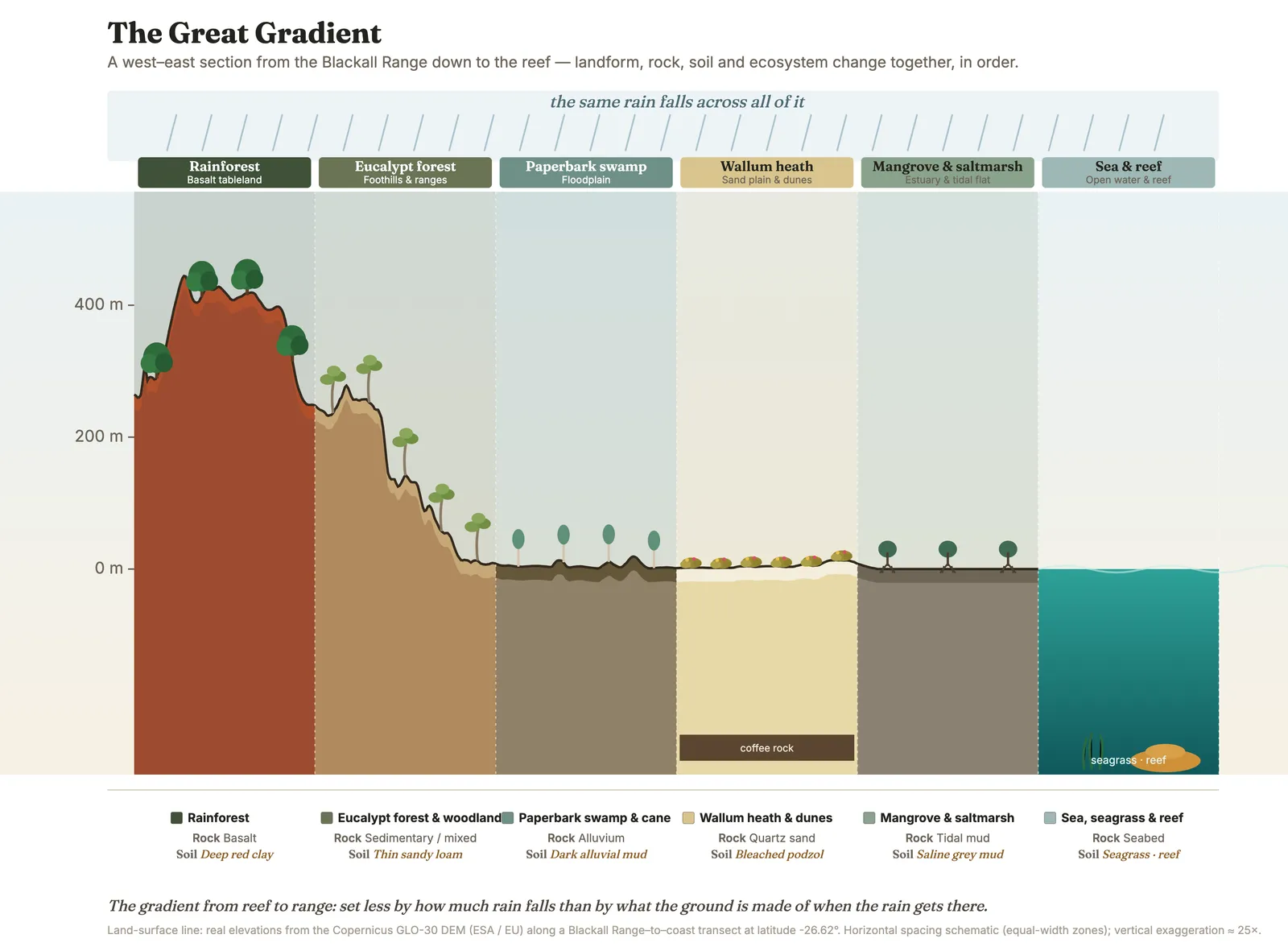
Behind the shifting front, where the pioneers have done their work and the sand has settled, the vegetation thickens into dune scrub and then, on the older, stable sand further back, into the low, hard-leaved heath of the wallum — some of the poorest, most species-rich country in Australia. So the sequence reads outward from the sea as a hand-off: the pioneers make the ground stand still; the scrub and the heath move in behind the shelter they build. Note what the pioneers do not do — they do not enrich the sand, which stays as poor as ever; their gift is stability, not fertility. It is the cheapest and least celebrated engineering on the coast, done for free by a handful of plants nobody looks at twice.
Concepts this teaches — follow a thread
Sources for this guide — followable
- Leiper, G. et al. (2022). Mangroves to Mountains (3rd ed.). Native Plants Queensland. — Coastal dune-pioneer flora — spinifex, pigface and goat's-foot — as the sand-binding builders of the vegetated foredune, ahead of dune scrub and wallum heath.
Test yourself →
On the bare, mobile sand behind the beach, the first plants to get a footing are spinifex, pigface and goat's-foot. What do these pioneers do for everything growing behind them?
The pioneers' gift is stability, not fertility. Spinifex runners, and the sprawling pigface and goat's-foot, catch and hold wind-blown grains until a foredune builds and settles around them — the coast's cheapest sea wall, sheltering the dune scrub and the wallum heath behind it. They endure the brutal front (salt, heat, drought, no soil) on tough, thrifty, well-defended foliage, the same hard-leaf economy the rest of the sand country runs on (sclerophylly) — but the sand stays poor, so they do not enrich it for richer forest, they do not exist to shade it, and the heath's nectar comes from the banksias, not them. Strip the pioneers with too many feet or vehicles and the sand is loosed to blow out and march inland. (Ch 9.)
Cited · traceable Last checked 2026-07. Deep-tier claims rest on, and were checked against, Leiper et al. 2022, Mangroves to Mountains (3rd ed.); Ch 9 ('Holding the line: the dunes' — spinifex runners, pigface, goat's-foot; the vegetated foredune as the coast's first/cheapest sea defence; blowout on stripping; succession to dune scrub then wallum) — verified July 2026. — every source is listed below and followable. Grounded in Same Sky, Different Ground.