A species
Paperbark
Melaleuca — the pale, spongy-barked tree that names the swamps: built to stand in airless, acid, waterlogged ground, insulated against swamp-edge fire, and pouring out the nectar that turns a flowering swamp into one of the coast's biggest free meals.
The paperbark is the tree that gives the swamps their name — pale-trunked, with thick, soft, papery bark you can peel off in handfuls, standing with its feet underwater for months on end. It thrives where an ordinary tree would drown, and when a whole swamp flowers at once it lays on one of the biggest free meals in the landscape for lorikeets, honeyeaters and flying-foxes.
The paperbark is one of the most recognisable trees on the coast, and once you know it you will see it everywhere the ground goes soggy. Its trademark is the bark: thick, soft, spongy and pale, peeling away from the trunk in papery sheets you can lift off in handfuls, layer on layer like the pages of a sodden old book. The great swamp-former here is the broad-leaved paperbark, which gathers into dense, pale-trunked stands in the wettest lowland hollows, often with its boots underwater for months at a time.
Living with permanently wet feet is, for a tree, nearly as hard as living in salt, and for the same reason: waterlogged soil is airless soil, and roots need to breathe. The paperbark copes where an ordinary tree would drown, riding out long floods and the swing between drought and inundation that rules a floodplain. That famous spongy bark is more than decoration — it insulates the trunk against the fires that run the swamp edges in dry years, and it sheds and regrows freely. The tree is built, in short, for a world that is flooded one season and parched the next, which is exactly the world the lowland swamps offer.
You do not fully appreciate it, though, until you are standing beneath one when it blooms. A paperbark in flower is smothered in creamy, bottlebrush-like spikes dripping with nectar, and when a whole swamp comes into blossom at once it lays on one of the largest free meals in the landscape. Lorikeets pour in by the screeching, tumbling flock; honeyeaters work the spikes from first light; and after dark the flying-foxes arrive to drink, ferrying pollen from tree to tree and carrying the seed of the rainforest fruits they also feed on from one patch of forest to the next. The humble paperbark, it turns out, also runs a roadhouse — and the tree that names the swamp is the same one that builds and feeds it.
In depth — the mechanism
The broad-leaved paperbark (Melaleuca quinquenervia) is the great swamp-former of the coastal lowlands, and it is a specialist in a job most trees cannot do: living with its feet permanently wet. Waterlogged soil is airless soil, and roots need to breathe, so standing in a swamp is nearly as hard a trick for a tree as standing in salt. The paperbark manages it, riding out months of flooding and the violent swing between drought and inundation that defines a floodplain — it is built for instability, for a world drowned one season and parched the next.
Its trademark bark is part of the kit. Thick, soft, spongy and pale, peeling in papery sheets, it insulates the living trunk against the fires that run the swamp margins in dry years, and it sheds and regrows freely — a tree that expects to be flooded, burnt and dried by turns and is armoured for all three. On the sand masses the ground it stands in is acid, tannin-stained blackwater (see blackwater-acidity), leached from the peaty sand around it, and the paperbark is one of the few trees at home in water closer to weak tea than to a garden pond.
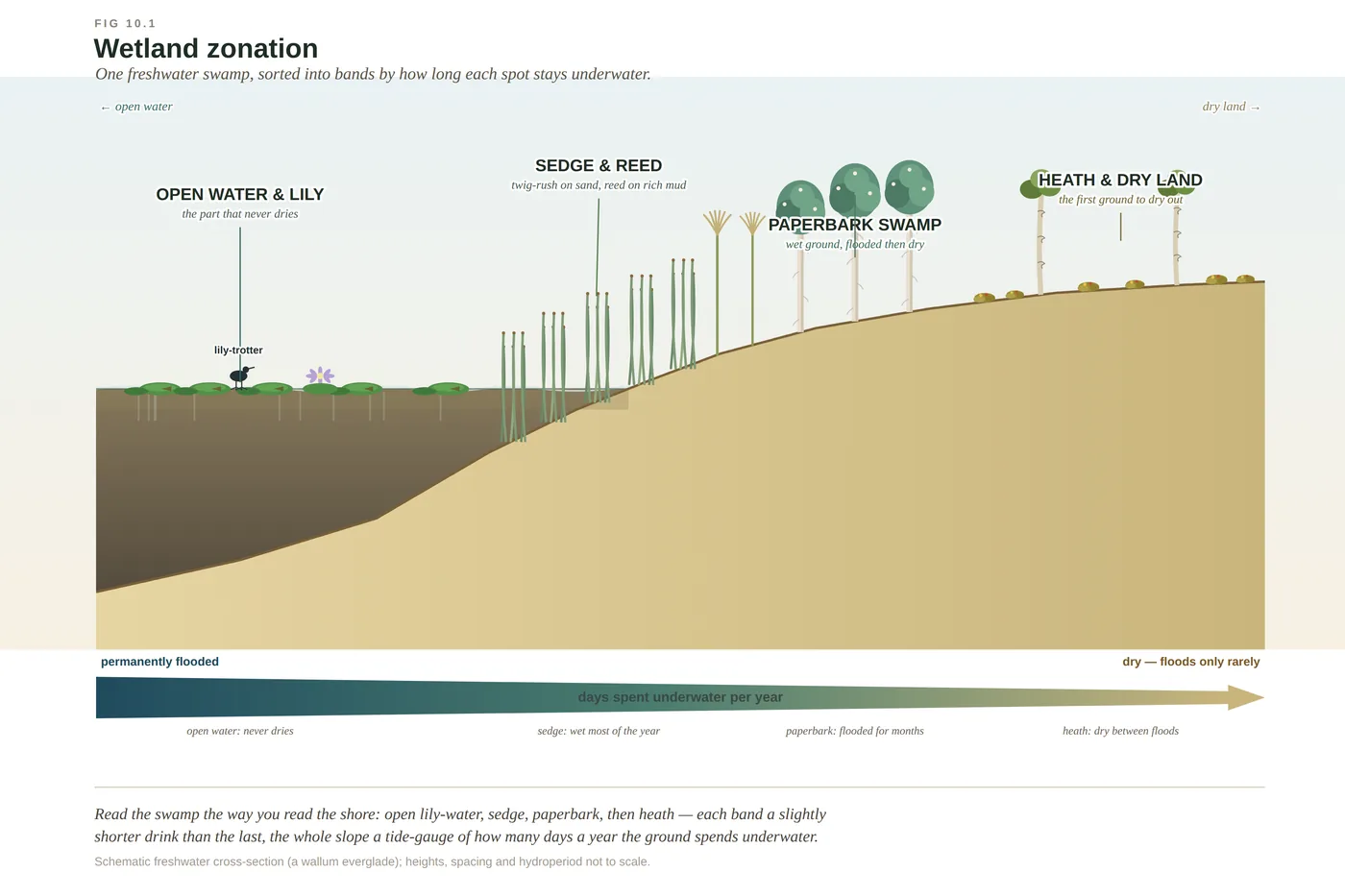
It earns its place in the swamp by hydroperiod. Behind the open lily-water and the sedge, on ground that is wet but no longer permanently flooded, the paperbark forest takes over (see wetland-zonation), each band tuned to a slightly shorter drink than the last. And when the rains come and the swamp detonates into life, the paperbark joins the feast: a tree in flower is smothered in creamy, bottlebrush-like spikes dripping with nectar, and a whole swamp in blossom lays on one of the largest free meals in the landscape. Lorikeets pour in by the screeching flock, honeyeaters work the spikes from first light, and after dark the flying-foxes arrive to drink, ferrying pollen tree to tree — and carrying the seed of the rainforest fruits they also eat from one patch of forest to the next. It is the kind of mass nectar flow the melaleucas are famous for.
The deeper point is that the paperbark is the engineer of the wet lowlands. The swamp it builds is the coast's hardest-working and least-thanked organ — a giant shallow sponge that swallows floods and lets them go slowly, combs sediment and nutrient out of the water passing through, and banks carbon as peat in its airless mud — and on the sand country the whole system leans on an unseen, groundwater-fed water table (Dyring et al. 2025) that can be pulled out from under it by drainage without anything visibly changing at the surface until it is too late. One honest shadow over its future: as the sea rises and salt pushes up the floodplains, the lowest freshwater paperbark stands are expected to give way to mangrove and saltmarsh — a change already watched in northern Australia, where advancing salt has killed whole stands of freshwater Melaleuca.
Concepts this teaches — follow a thread
Wetland zonation (the swamp reads like a tide-gauge)Blackwater and acid water (the colour of tea)
Sources for this guide — followable
- Leiper, G. et al. (2022). Mangroves to Mountains (3rd ed.). Native Plants Queensland. — Melaleuca quinquenervia as the dominant lowland swamp-former: papery bark, waterlogging/flood/fire tolerance, and mass nectar flows for lorikeets, honeyeaters and flying-foxes.
- Dyring, M. et al. (2025). A hydrogeochemical approach to coastal groundwater-dependent ecosystem conservation: the Cooloola Sand Mass. Science of the Total Environment 958: 177892. [PubMed 39647209] (The GDE dependence-mapping paper — e-pub 7 Dec 2024, vol 958 carries a 2025 date; cite as 2025. A separate Dyring et al. 2024, Groundwater 62(2), doi:10.1111/gwat.13352 covers GDE policy gaps — do not conflate.) — Groundwater-dependent ecosystems of the Cooloola sand mass — the unseen water table the sand-country paperbark swamps lean on.
- Meyer, E.A., Franklin, C.E. & Cramp, R.L. (2020). Acid tolerance in Litoria cooloolensis larvae. J. Comp. Physiol. B 190: 691–706. [PubMed] (Larvae hold salt balance to ~pH 3.5.) — Frog-larva acid tolerance: wallum sedge-frog larvae (Litoria cooloolensis) hold salt balance down to ~pH 3.5 — how an acid-water specialist endures the blackwater's sourness.
Cited · traceable Last checked 2026-07. Deep-tier claims rest on, and were checked against, Leiper et al. 2022, Mangroves to Mountains (3rd ed.); Dyring et al. 2025 (Cooloola sand-mass groundwater-dependent ecosystems); Ch 10 (paperbark waterlogging/fire tolerance, spongy bark, mass nectar; wetland zonation by hydroperiod; sea-level-rise/Melaleuca-dieback framed as projected, evidence from northern Australia) — verified June 2026. — every source is listed below and followable. Grounded in Same Sky, Different Ground.