A species
Scribbly gum
The pale gum whose smooth bark is covered in looping 'scribbles' — the feeding trails of a tiny moth — and a quiet masterclass in nutrient thrift: a tall tree living on some of the poorest sand on the coast by renting its nitrogen from fungi.
The scribbly gum is the smooth, pale-barked gum tree covered in those looping doodles that look as though a child got at it with a pen. The scribbles are real animal tracks: the winding tunnels of a tiny moth's caterpillar, revealed when the tree sheds its old skin. The bigger wonder is underground. This gum grows tall on bleached, hungry sand with almost nothing in it, and it manages that not by finding rich soil but by being extraordinarily thrifty — striking a deal with fungi at its roots that lets it scrape scarce nitrogen from ground its fertile-country cousins would starve on.
Some trees you know by their leaves or their shape; the scribbly gum you know by its handwriting. Come up off the open dunes into the sandy country behind, and among the low heath stand pale, smooth-barked gums covered in looping, doubling lines that look for all the world as though someone let a child loose on them with a biro. The lines are real, and they are alive, or were: each is the feeding tunnel of the caterpillar of a tiny native moth, which mines the soft layer between the tree’s old bark and its new, wandering and turning back on itself as it goes, and each summer, when the gum sheds its old skin to stand smooth and fresh, the scribbles are unveiled on the surface like a signature the tree did not sign.
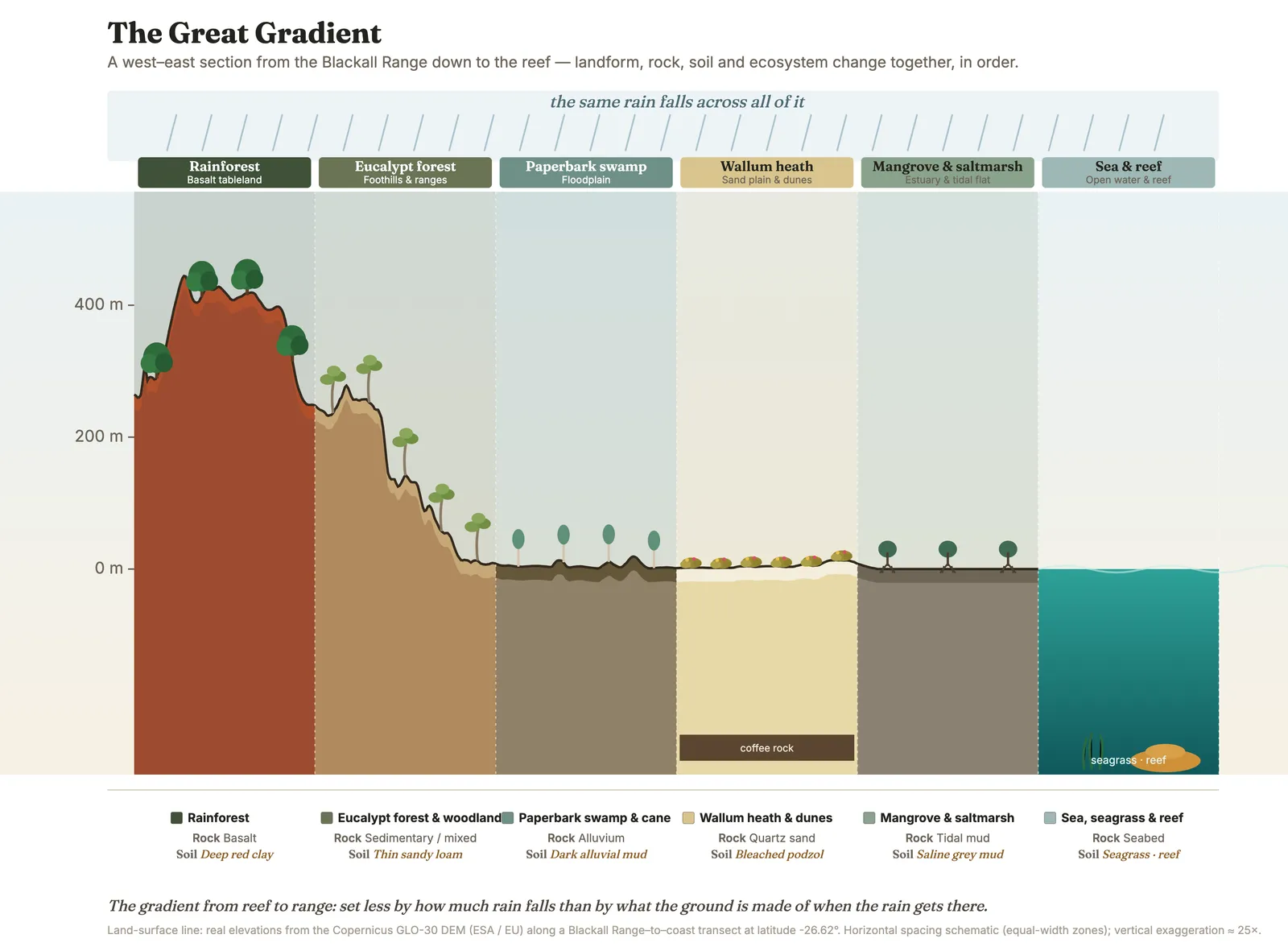
The pretty bark, though, is the least of it. The real story of the scribbly gum is that it has no business being as big as it is. It grows on the bleached, leached sand behind the beaches, ground so stripped of phosphorus and so short of nitrogen that by any sensible reckoning there is not enough in it to raise a shrub, let alone a tree you can stand a ladder against. And yet here it is, full-sized, throwing shade. The secret is not that it has found some hidden seam of rich soil down in the sand. There isn’t one. The secret is thrift — a frugality so complete it reaches all the way down into the tree’s dealings with the ground.
Like almost every plant on this coast, the scribbly gum runs its roots in partnership with fungi, trading sugar for minerals it could never reach alone. What sets it apart is how well it does it. Careful local work comparing the wallum scribbly gum with a cousin from fat, fertile country found the poor-ground tree capturing nitrogen far more efficiently — squeezing a living out of scraps that would leave the rich-soil relative starving. The gum you are looking at is really the tip of a plant-and-fungus economy tuned, root and branch, to living on nothing. Its hard, leathery, long-lasting leaves tell the same tale: a plant this poor cannot afford to grow a soft leaf and shed it, so it builds tough ones and keeps them for years. Read the scribbly gum properly and the doodled bark is the charm, but the lesson is underground — a tall tree standing on bad sand, kept up not by wealth but by the oldest trick in the wallum’s book, which is to spend almost nothing and to share the little there is.
In depth — the mechanism
On the coast the scribbly gum is Eucalyptus racemosa, and it is one of those plants that carries its story on the outside. Each summer it sheds its old bark to stand smooth and pale, and across that fresh surface run the "scribbles" — looping, doubling-back lines that give the tree its name. They are not decoration and not disease but feeding trails: the tunnels of the caterpillars of tiny native scribbly-gum moths (Ogmograptis), which mine the soft layer between old and new bark, turn back on their own tracks, and leave their winding signature to be unveiled when the outer bark peels away. It is a small, elegant partnership of a different kind — a tree and an insect that has made a living in the millimetre of space between its skins.
The deeper marvel is out of sight, and it is the reason a full-sized tree stands here at all. The scribbly gum's country is the leached sand behind the beaches — the wallum and the sandy lowlands — where the phosphorus has all but gone and nitrogen is desperately scarce (see np-asymmetry). By any ordinary accounting there is not enough in this sand to build a tree, yet the scribbly gum grows tall on it, and the trick is not hidden riches but sheer economy. Like nearly every plant on the coast it runs its roots in partnership with fungi (see plant-partnerships), but local work has shown the wallum scribbly gum doing so with unusual efficiency: it leans on ectomycorrhizal fungi that thread the poor sand and feed it nitrogen far more frugally and effectively than its pampered, fertile-country relatives manage (Schmidt et al. 2006, comparing E. racemosa with the rich-soil E. grandis). The gum is really the visible half of a plant-and-fungus economy tuned to poverty, and its nitrogen is rented, not owned.
The leaves keep the same accounts. They are hard, tough and long-lived — the sclerophyll leaf of a plant too poor to build a soft one and lose it — because on ground this starved every scrap of nutrient locked into a leaf is too expensive to throw away each season. So read the scribbly gum as thrift made into a tree: a frugal, fungal-fed, hard-leaved economy that turns some of the poorest sand in the country into a standing forest. It is the wallum's lesson — that poverty is answered by partnership, not by wealth — written large enough to lean against.
Concepts this teaches — follow a thread
Plant partnerships (the deals for poor ground)The nitrogen–phosphorus asymmetrySclerophylly (the tough-leaf economy)
Sources for this guide — followable
- Schmidt, S., Handley, L.L. & Sangtiean, T. (2006). Ectomycorrhizal N use, E. racemosa vs E. grandis. Functional Plant Biology. [PubMed] — Ectomycorrhizal nitrogen use in the wallum scribbly gum (E. racemosa) vs the fertile-country E. grandis — the scribbly gum captures scarce N far more efficiently on poor sand.
- Leiper, G. et al. (2022). Mangroves to Mountains (3rd ed.). Native Plants Queensland. — Eucalyptus racemosa as the coastal scribbly gum of wallum and sandy lowland country; smooth deciduous bark bearing the scribble-moth trails.
Test yourself →
A full-sized scribbly gum stands on the bleached, leached sand behind the beaches — ground so stripped of phosphorus and short of nitrogen that, on paper, there is not enough in it to raise a shrub. Yet here is a tall tree. How does it manage it?
The scribbly gum (*Eucalyptus racemosa*) does not solve poverty by finding wealth; it solves it by spending almost nothing. Local work found the wallum scribbly gum using ectomycorrhizal fungi to capture scarce nitrogen far more efficiently than its fertile-country relative *E. grandis* (Schmidt et al. 2006) — the tree is really the visible half of a plant-and-fungus economy tuned to poor ground (plant-partnerships), on soil where nitrogen and phosphorus are both desperately scarce (np-asymmetry). Its hard, leathery, long-lived sclerophyll leaves are the same thrift: too poor to build a soft leaf and shed it, it holds each one for years. The calibrated near-miss — 'its roots reach hidden rich soil below' — is the intuitive wrong answer: there is no rich layer down there; the whole sand mass is leached, and the tree's trick is economy, not a buried treasure. Nitrogen-fixing nodules are a real strategy, but a wattle's, not a gum's — eucalypts don't fix nitrogen. And the tree plainly does reach full size, which is exactly what makes it worth explaining. (Ch 15; Ch 9.)
Cited · traceable Last checked 2026-07. Deep-tier claims rest on, and were checked against, Schmidt, Handley & Sangtiean 2006, Functional Plant Biology (E. racemosa ectomycorrhizal N-use efficiency vs E. grandis); Leiper et al. 2022, Mangroves to Mountains (3rd ed.); Ch 15 (scribbly gum's fungal N-capture on poor sand) and Ch 9 (wallum poverty, sclerophylly) Notes, verified July 2026. The scribble-moth (Ogmograptis) origin of the bark trails is well-documented Australian natural history, not from the two cited sources — presented factually, no invented detail. — every source is listed below and followable. Grounded in Same Sky, Different Ground.