The season
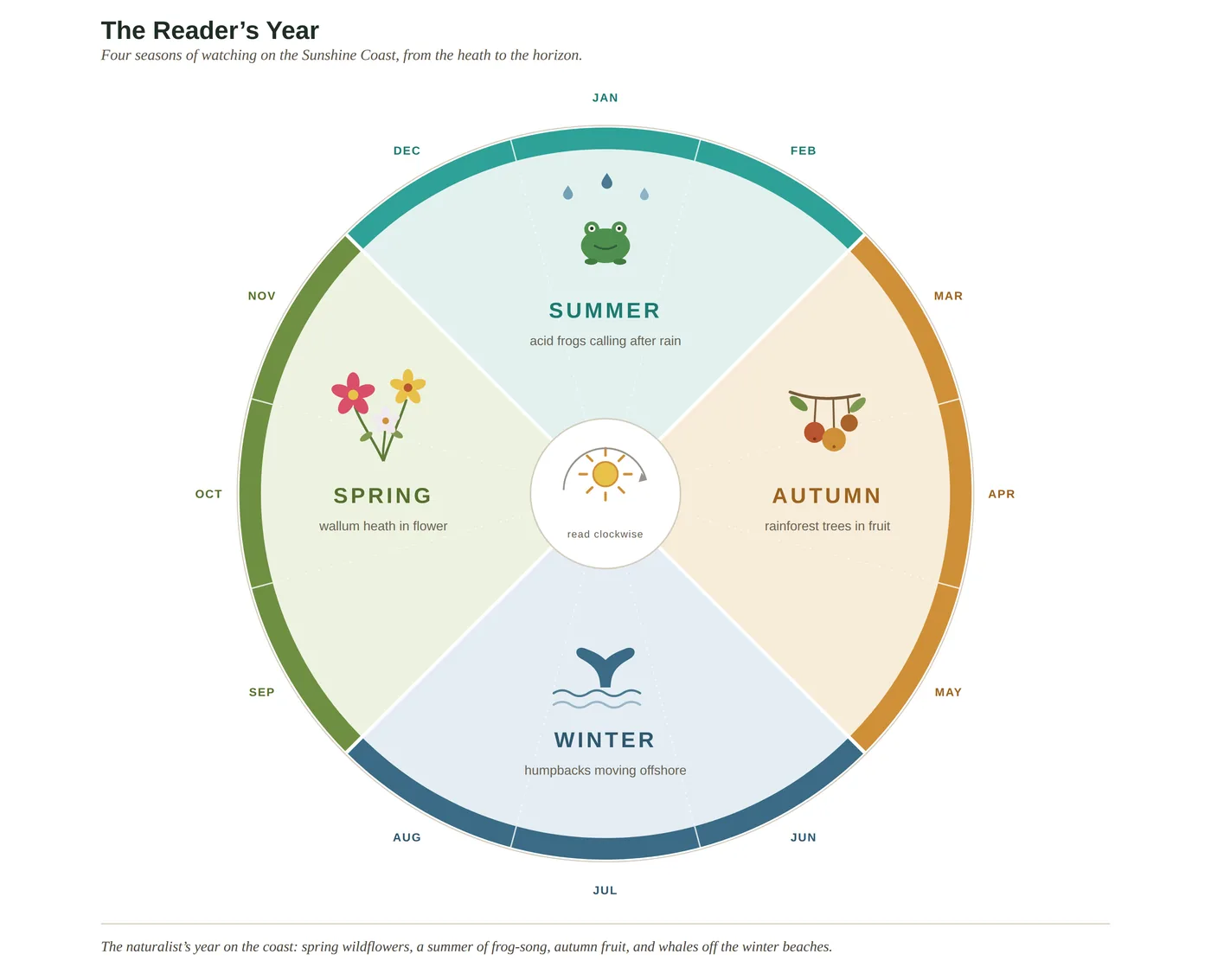
The naturalist's year
The coast keeps its own calendar — spring wildflowers, a summer of frog-song, autumn fruit and nectar, winter whales and wattle — and it runs on the weather, not the date. Reading the year is the same skill as reading the country, turned from place to time.
- Cool, still, clear days — the comfortable, dry end of the year
- Ironbarks and coast banksias in bud and early blossom, loud with honeyeaters
- Rainforest quiet, swamps silent at night (no frog chorus)
- Whales moving steadily north, offshore
The Sunshine Coast doesn't have a summer and a winter so much as four different jobs the country does through the year: the wallum blazes into flower in spring, the swamps roar with frogs in the summer wet, the rainforest fruits in autumn, and in the cold dry winter the whales pass the headlands while the ironbarks and wattles carry the blossom. Learn the four and you always know roughly what to go and look for.
The Sunshine Coast has seasons, but not the four you were taught at school. Up here they are pinned less to the calendar than to the weather, and they announce themselves not by temperature on a thermometer but by what the country is doing — where the flowers are, what is calling at night, what is passing offshore. Learn to read them and the coast becomes a place you can time as well as read: you know, roughly, that if it is September the wallum will be on fire with flower, and that if the nights have turned warm and wet the frogs will be deafening.
Think of it as four jobs the country works through in turn. In spring the sand country does the thing it is most famous for: the low heath, growing on the poorest ground on the coast, erupts into the richest flowering display it offers all year, banksias and peas and boronias and ground orchids all at once, worked over by honeyeaters. In summer the rain arrives, and on the first warm, wet nights the swamps and wallum go up in a frog chorus you can hear across a paddock; the same rain quietly refills the freshwater sponge inside the sand that the whole dry season will draw on. In autumn the wet eases and the country fruits: the rainforest hangs heavy with figs and laurels, drawing in the fruit-doves by day and the flying-foxes by night. And in winter — the cool, dry, clear-skied season that is the best walking of the year — the humpbacks stream north past the headlands, and the ironbarks and wattles and swamp mahogany carry blossom through the cold, feeding the birds at the hungriest time.
The one rule that governs the lot is that none of it keeps an appointment. This country runs on weather, not dates. A late or failed wet holds the frogs silent; a dry spring makes for a thin flowering; a fire through the heath one year fills a hillside with flowering grass-trees the next. So the calendar in this book, and the wheel on the page opposite, are a guide to what to expect and roughly when — cues to watch for, not a timetable to trust. Reading the season, in the end, is the same trick as reading the country: you gather several signs, you check them against one another, and you let them tell you where in the great turning cycle the coast has got to. Do it for a year or two and you stop visiting the coast and start keeping time with it.
In depth — the mechanism
The coast's calendar is driven by two things pulling in different directions: temperature, which peaks in the summer wet and bottoms out in the winter dry, and rainfall, which is strongly summer-weighted (warm, storm-fed months December to March) with a cool, comparatively dry winter. Most of the region's living events are timed to one or the other, and a few sit deliberately against the grain.
Spring (Sep–Nov) is the wallum's great show: the heath and sand country come into flower as the days lengthen and warm ahead of the wet, the richest floral display on the poorest ground (see poverty–diversity), loud with honeyeaters working the banksias. Migratory shorebirds return to the flats from the northern hemisphere; the last humpbacks pass south with calves. Summer (Dec–Feb) is the wet: warm storm nights set off the frog chorus in the wallum swamps and floodplains, and the rain recharges the sand-mass aquifer that keeps the blackwater flowing through the following dry (Dyring et al. 2025 on the Cooloola groundwater-dependent ecosystems). Autumn (Mar–May) is the fruiting and the turn: the rainforest at its lushest, figs and laurels drawing fruit-doves and flying-foxes, the she-oaks flushing rusty with pollen, and the first cool-season nectar trees opening. Winter (Jun–Aug) is the dry: the humpback highway runs north close past the headlands, honeyeaters and lorikeets crowd the cool-season blossom of the ironbarks and swamp mahogany at the leanest time of year, and the dry, safe walking season is also the main season for planned and cultural burning in the fire-country.
The load-bearing caution is that all of this runs on weather, not the calendar. A late wet holds the frogs off; a good burn brings a hillside of grass-trees into spear the next spring; a dry spring flowers thin. So the naturalist's year is a set of cues, not a timetable — the same interpretive move as the gradient rule, read forward in time instead of across the ground: several signs cross- checked against each other to place where in the cycle the country has got to.
Concepts this teaches — follow a thread
Sources for this guide — followable
- Dyring, M. et al. (2025). A hydrogeochemical approach to coastal groundwater-dependent ecosystem conservation: the Cooloola Sand Mass. Science of the Total Environment 958: 177892. [PubMed 39647209] (The GDE dependence-mapping paper — e-pub 7 Dec 2024, vol 958 carries a 2025 date; cite as 2025. A separate Dyring et al. 2024, Groundwater 62(2), doi:10.1111/gwat.13352 covers GDE policy gaps — do not conflate.) — Summer rain recharges the Cooloola sand-mass aquifer that feeds the wallum's swamps and blackwater through the dry.
- Tangalooma whaling station, Moreton Island, 1952–1962 (6,277 humpbacks taken — verified); east-Australian humpback population driven to a few hundred, protected from 1963, since recovered to ~40,000 and now at/above pre-whaling levels (DCCEEW eastern-Australia humpback assessment). — The eastern humpback population — hunted to a few hundred, now recovered — whose winter migration defines the cool season offshore.
Test yourself →
You arrive on the coast on a run of cool, still, cloudless days. Wattlebirds and lorikeets are noisy high in the crowns of the ironbarks and coast banksias, which are in bud and early blossom; the rainforest is quiet and the swamps are silent at night; and from the headland you watch a couple of dark backs and a blow move steadily north, well offshore. What season is it — and what is the country doing?
Cues: Cool, still, clear days — the comfortable, dry end of the year · Ironbarks and coast banksias in bud and early blossom, loud with honeyeaters · Rainforest quiet, swamps silent at night (no frog chorus) · Whales moving steadily north, offshore
Read the cues together and only one season fits. Whales heading *north* is the winter signature — the eastern humpbacks run north to breed through the cold months and only drift south, with calves, as spring warms (the population recovered from near-extinction after the Tangalooma whaling closed in 1962). Cool, clear, still days are the dry season, not the storm-fed summer wet. The silent swamps rule out summer, whose warm wet nights would have the frogs roaring. And the birds crowding blossom on the ironbarks and coast banksias is the tell that clinches it: a handful of trees flower deliberately through the cold, laying on nectar at the leanest time of year, which is why a quiet winter forest can suddenly be loud high in a flowering crown. Spring would show the wallum in full flower; autumn would show the rainforest fruiting. Reading the season is the same move as reading the country — several signs cross-checked, not one trusted alone.
Cited · traceable Last checked 2026-07. Deep-tier claims rest on, and were checked against, Ch 19 'A reader's calendar' and seasonal notes; this-month.html / in-flower.html seasonal record; Dyring et al. 2025 (Cooloola GDEs); DCCEEW eastern-Australia humpback assessment — every source is listed below and followable. Grounded in Same Sky, Different Ground.