The season
Autumn — the fruiting and the turn
Autumn is the coast's turn toward the dry: the summer wet eases, the rainforest hangs heavy with figs and laurels for the fruit-doves and flying-foxes, the she-oaks flush rusty with pollen, and the first ironbark and swamp-mahogany buds open the winter nectar — while the drying ground opens the safest walking and the main burning season.
- Cooler, drier, settling days — the summer storms winding down
- Figs and laurels dropping fruit; wompoo fruit-doves calling in the canopy
- Black she-oaks flushed rusty with pollen; the first ironbark and swamp-mahogany buds
- Flying-foxes busy at dusk, ferrying rainforest fruit between patches
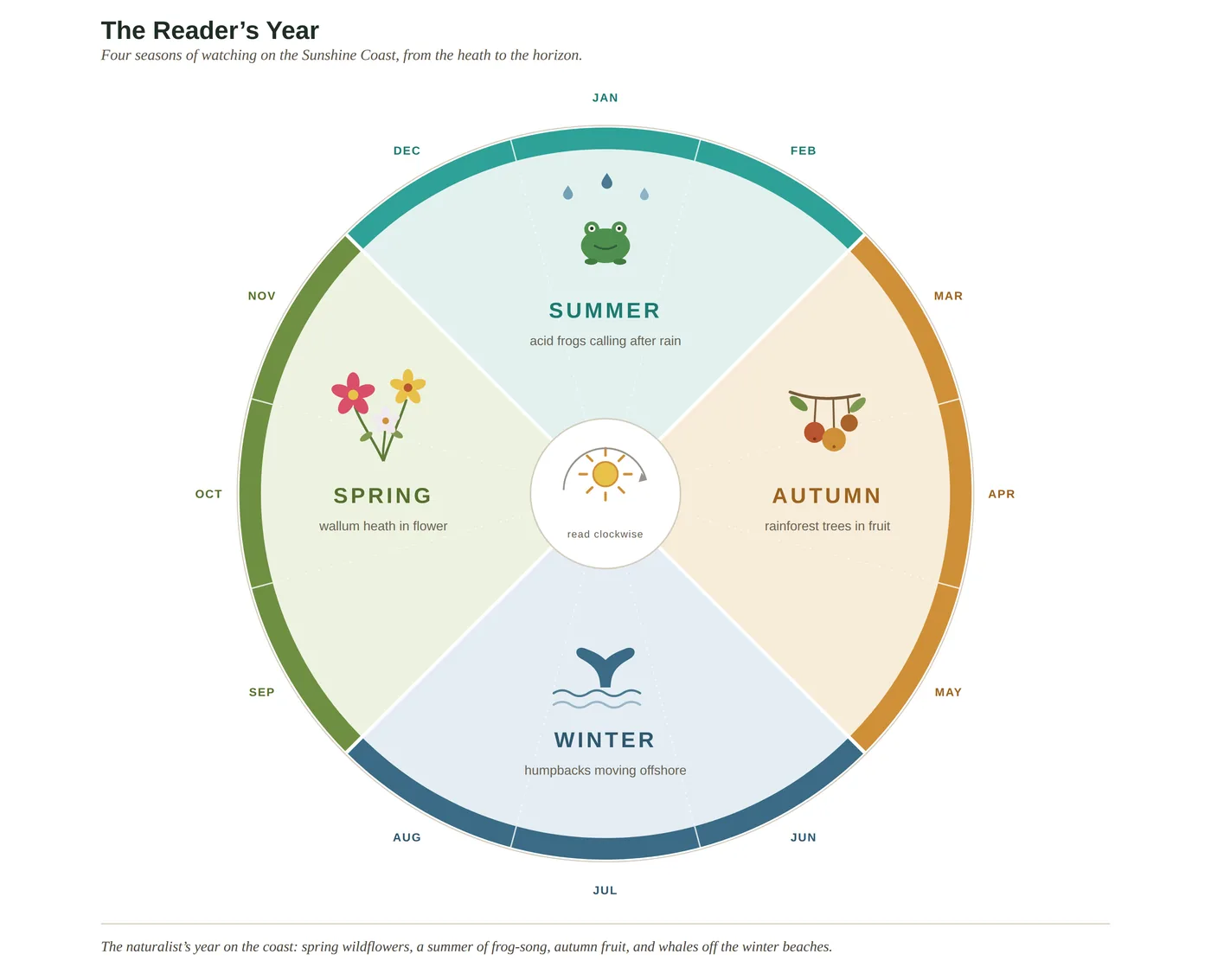
Autumn is when the coast turns. The summer storms ease off, and the rainforest — at its lushest after the wet — comes into fruit: figs and laurels drawing wompoo fruit-doves and topknot pigeons by day, and flying-foxes ferrying seed between the scrub patches by night. On the dry ridges the black she-oaks flush rusty with pollen and the first ironbark and swamp-mahogany buds appear, the opening of the cold-season nectar to come. As the ground dries and firms, autumn also opens the safest walking of the year and the main season for planned and cultural burning.
For most of the year the coast’s seasons announce themselves loudly — flowers, frogs, whales — but autumn arrives as a change of pace rather than a spectacle. The summer storms lose their steam, the humidity slackens, and the rainforest, gorged on the wet, quietly comes into fruit. Walk a hinterland gully in March or April and the canopy is heavy overhead: figs, laurels and palms hanging their crops, and the birds that live on them noisy in the leaves. The wompoo fruit-doves — improbable green-and-plum pigeons the size of a small chicken — and the topknot pigeons work the fruit by day, and when the light goes the flying-foxes take the night shift, wheeling out from their camps to strip the same trees and carry the seed away in the dark.
Step out of the scrub onto a dry ridge and autumn is doing something else entirely. Here the black she-oaks flush a whole crown rusty-orange as the males shed pollen, and if you stand still you may hear the wailing creak of the glossy black-cockatoo prising apart their woody cones — a bird that lives on almost nothing else. Nearby the ironbarks and, down on the swamp margins, the swamp mahogany are setting the buds that will open into the cold: the first hint of the winter nectar flow that keeps the honeyeaters, lorikeets and gliders fed through the leanest weeks to come. It is the coast’s habit of reading differently from one patch of ground to the next, turned onto the calendar — the same autumn fruiting in the rainforest, flushing on the ridge, and merely budding on the swamp edge, all in the same week.
Two quieter turns run underneath. The storms that spent the summer soaking into the sand are ending, and the country now begins to live off the freshwater it banked — the hidden aquifer that will keep the swamps wet and the blackwater flowing all the way through the dry. And as the ground firms and the tracks drain, autumn opens the best and safest walking of the year, and the first planned and cultural burns go into the fire-country. None of it keeps an appointment, though. A late, heavy wet holds the fruit on the trees and the water on the tracks and pushes the whole turn back by weeks; a dry autumn brings it forward. The season opens when the rain actually stops — read the country, not the calendar, and it will tell you when the turn has come.
In depth — the mechanism
Autumn (roughly March–May) is the hinge of the coast's year — the wet easing into the dry — and its living events are the summer's growth being cashed out. The rainforest, fattened through the warm wet months, fruits heavily: figs (including the strangler figs), laurels and palms hang their crops just as the frugivores need them, and the mutualism runs both ways. Wompoo fruit-doves and topknot pigeons work the canopy by day; after dark the flying-foxes take over, and because a flying-fox will cross tens of kilometres in a night and pass seed through its gut in flight, they are among the most important long-distance dispersers the rainforest has — the animals that carry a fig's seed from one isolated scrub patch to the next. Read across the gradient at the same moment and autumn is doing different jobs in different country: fruiting in the rainforest, flushing pollen on the dry she-oak ridges (where the glossy black-cockatoo works the ripening cones), and just beginning to flower on the ironbark and swamp-mahogany that will carry the birds through winter.
That first cool-season nectar is not an accident of timing. A run of trees — ironbark, swamp mahogany, later the coast banksia — flower deliberately against the cold, laying on nectar at the leanest end of the year, and autumn is when the buds set for it. The other quiet turn is in the ground: the summer storms that recharged the sand-mass aquifer are ending, and the country now begins living off that stored, groundwater-fed water — the reserve that will keep the wallum swamps and blackwater streams alive right through the coming dry (Dyring et al. 2025, on the Cooloola groundwater-dependent ecosystems). And as the soil dries and firms, the practical calendar turns with it: autumn opens the best and safest walking of the year, and the first planned and cultural burns go into the fire-country as the season allows.
The load-bearing caution is the same as for the whole naturalist's year: it runs on the weather, not the date. A late or heavy wet holds the fruiting on, keeps the tracks sodden and pushes the burning window back; a dry, early autumn brings the turn forward. Autumn "opens" when the storms actually stop, not when the calendar says March.
Concepts this teaches — follow a thread
Sources for this guide — followable
- Dyring, M. et al. (2025). A hydrogeochemical approach to coastal groundwater-dependent ecosystem conservation: the Cooloola Sand Mass. Science of the Total Environment 958: 177892. [PubMed 39647209] (The GDE dependence-mapping paper — e-pub 7 Dec 2024, vol 958 carries a 2025 date; cite as 2025. A separate Dyring et al. 2024, Groundwater 62(2), doi:10.1111/gwat.13352 covers GDE policy gaps — do not conflate.) — As the summer wet eases, the country turns to living off the recharged Cooloola sand-mass aquifer — the groundwater-dependent ecosystems that carry the swamps and blackwater through the dry.
Test yourself →
You come to the coast after a run of cooler, drier, settling days — the summer storms clearly winding down. In a hinterland gully the figs and laurels are dropping fruit and the canopy is loud with wompoo fruit-doves; on the dry ridge above, the black she-oaks have flushed rusty with pollen and the first ironbark and swamp-mahogany buds are showing; and at dusk the flying-foxes stream out to work the fruiting trees. What season is it — and what is the country doing?
Cues: Cooler, drier, settling days — the summer storms winding down · Figs and laurels dropping fruit; wompoo fruit-doves calling in the canopy · Black she-oaks flushed rusty with pollen; the first ironbark and swamp-mahogany buds · Flying-foxes busy at dusk, ferrying rainforest fruit between patches
Read the cues together and only autumn fits. Fruit — not flowers — is the tell: the rainforest fattened by the summer wet is cashing out its growth as figs and laurels, feeding the fruit-doves by day and the flying-foxes by night, which is the autumn signature, not the spring one (spring's show is the wallum in flower). The storms winding down into cooler, drier days rule out the summer wet, whose warm storm nights would have the frogs roaring. And the she-oaks flushing rusty and the *first* ironbark and swamp-mahogany buds place it precisely at the turn: winter is when those trees are in full cool-season blossom, but autumn is when they are only setting the buds for it — the nectar to come, not yet arrived. So the country is turning toward the dry: the wet easing, the rainforest fruiting, and the cold-season nectar just beginning. Reading the season is the same move as reading the country — several signs cross-checked, not one trusted alone. (Ch 13; Ch 19; this-month record.)
Cited · traceable Last checked 2026-07. Deep-tier claims rest on, and were checked against, Ch 19 seasonal calendar and Ch 13 (rainforest fruiting; fruit-doves, topknot pigeons, flying-fox dispersal); this-month.html Mar–May entries (figs/laurels, she-oak pollen flush, glossy black-cockatoo, cool-season nectar beginning, burning season); Dyring et al. 2025 (Cooloola GDEs) — every source is listed below and followable. Grounded in Same Sky, Different Ground.