A place
Carlo Sandblow
A great walking dune of coloured sand above Rainbow Beach — a bare parabolic blowout on the move, burying forest at its advancing edge and releasing it behind, and time-zero of the whole podzol story.
- On the gradient
- Sand coast — the youngest, mobile front end of the dune chronosequence
- Rock
- Active parabolic dune of Quaternary coastal (coloured) sand — Cooloola sand mass
- Soil
- None — bare, mobile, unweathered dune sand (soil development reset to zero)
- A wide sheet of bare, sometimes coloured, sand with no plants on it
- Wind ripples, the surface streaming grain over grain
- No soil at all — raw, loose sand
- A wall of sand advancing over living forest, tree crowns and trunks protruding from its edge
The Carlo Sandblow is a huge sheet of bare, wind-driven sand on the cliff-top above Rainbow Beach. It is a dune on the move: the wind pushes it slowly inland, so it swallows the forest at its front edge and uncovers old ground behind it. This is fresh, young sand — the very start of the long story that ends, far inland, in giant bleached podzols and dune lakes.
Walk up through the forest behind Rainbow Beach and you climb out of the trees into something that looks less like a dune than a desert someone parked on top of the coast: the Carlo Sandblow, a vast open sheet of bare, blinding sand spilling over the cliff-tops, hundreds of metres across, with the sea on one side and, on the other, the forest it is quietly eating. On a windy day you can watch the surface itself streaming, grain over grain, and understand what you are actually looking at. This is not a beach that wandered uphill. It is a dune on the move.
The wind off the sea keeps a sandblow bare and pushes it steadily inland, and a dune that walks does two things at its two ends. At the front — the advancing edge — it simply buries whatever stands in its way, so the leading slope is a slow-motion drowning: you can see the tops of trees and the bleached poles of dead trunks sticking up out of the sand where the blow has climbed over a living forest and smothered it. And behind, on the trailing edge, the sand marches away and uncovers the ground it crossed a generation or two ago, sometimes releasing the dark, organic-stained floor of a forest that was buried and is now let back into the light. The blow carries its own history with it, burying at the bow and exposing at the stern.
Then look at the colour, because Rainbow Beach earns its name honestly: the old sand cliffs below run in bands of red and orange and yellow, dune sands stained over long ages by iron and aluminium oxides. It is worth reading that against the bright bare sand of the blow itself, because the two are the same substance at opposite ends of time. The sand under your feet is brand new — pale, raw, barely weathered, without a trace of soil. Let a blow like this finally stop, vegetate, and hold still, and the slow theft begins: rain and acid start stripping the grains, and over tens of thousands of years this very sand becomes the deep bleached podzol, the dark coffee rock, and the tea-coloured dune lakes of the ancient country inland. A sandblow is the whole sand story with the clock set back to zero — the raw beginning of everything Cooloola eventually turns its sand into.
In depth — the mechanism
Carlo Sandblow is an active transgressive (parabolic) dune — a "sandblow," a great open sheet of unvegetated sand kept bare and mobile by the onshore wind, which drives it slowly inland across the top of the coloured cliffs at Rainbow Beach, on the northern edge of the Cooloola sand mass (Willmott 2007; the same wind-and-sea dune system dated by Ellerton et al. 2020). A blow like this is a dune caught in the act of walking: on its advancing (downwind) slip face the sand buries whatever stands in its path — you can see the crowns and bleached trunks of drowned forest protruding from the leading edge — while on its trailing edge the sand marches off and releases the ground it crossed decades before, sometimes exposing the buried, organic-stained floors of vanished forests.
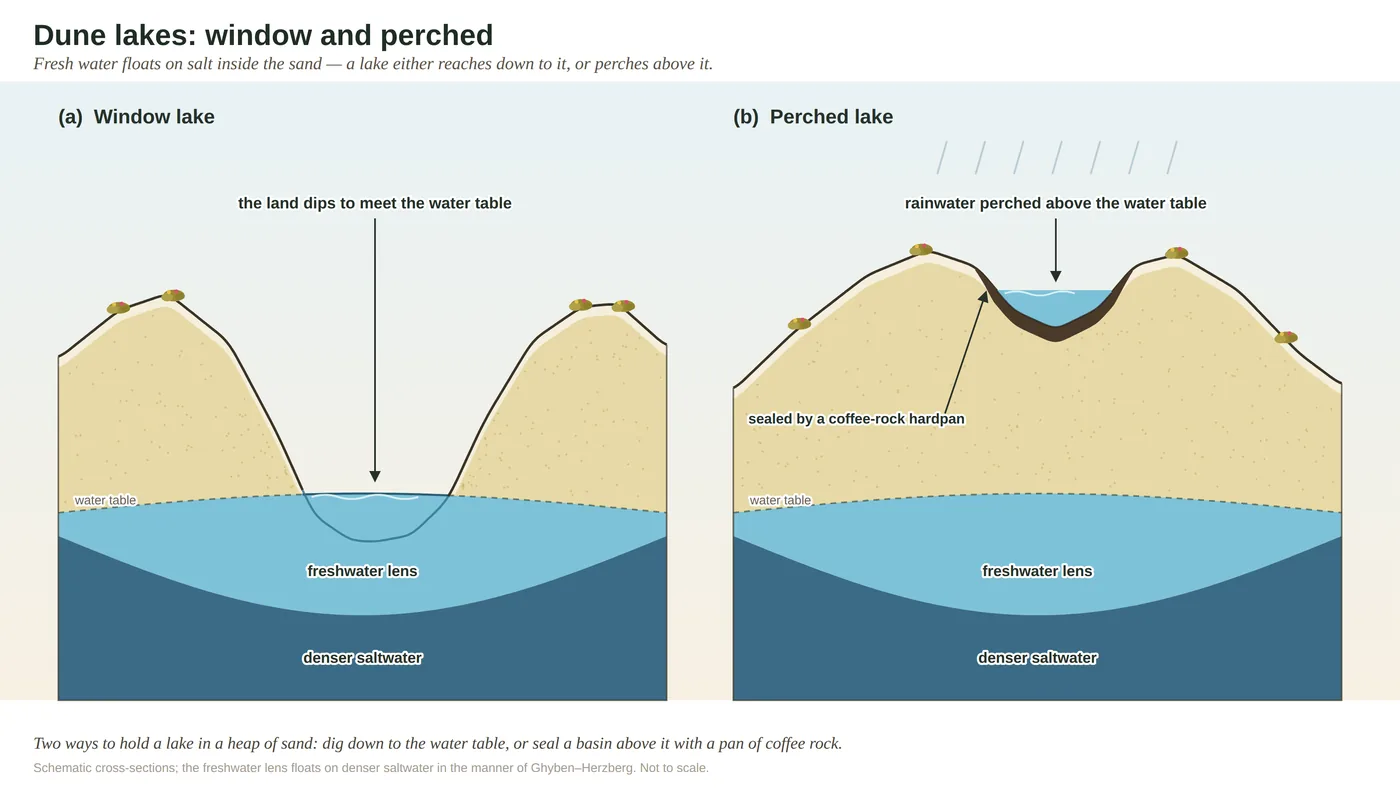
Two readings hang on it. First, podzolisation, at time zero. The sand here is fresh, pale and barely weathered, unsorted by tens of thousands of years of rain — the raw material at the very start of the chronosequence whose far end is the 20-metre bleached podzol and the coffee rock inland (see podzolisation). Stop a blow, let it vegetate and hold still, and the slow larceny of leaching begins; the sandblow is the clock before it has started ticking. Second, the famous coloured sands of the Rainbow Beach cliffs are old dune sands stained in bands of red, orange and yellow by iron and aluminium oxides — the same weathering chemistry that elsewhere strips iron out of the surface to leave bleached quartz over dark coffee rock, here showing as colour rather than bleach (Willmott 2007; the pigment-as-oxide reading is a regional geological one, not a site geochemical assay, and is flagged as such). And where an advancing blow buries organic-rich forest floors, it helps lay down exactly the kind of buried organic hardpan that, elsewhere in this sand country, seals the floor of a perched dune lake. One landform, then, that carries the whole sand story in compressed form: raw sand at the front, buried time behind, and, a long way inland, the podzols and lakes it is all destined to become.
Concepts this teaches — follow a thread
Podzolisation (how sand goes bankrupt)Dune lakes (perched and window)
Sources for this guide — followable
- Willmott, W. (2007). Rocks and Landscapes of the Sunshine Coast (2nd ed.). Geological Society of Australia. (Local basement = Amamoor & Booloumba Beds; North Arm Volcanics; Landsborough Sandstone. NB: Neranleigh–Fernvale Beds are the Gold Coast/Brisbane equivalent, not the Sunshine Coast basement.) — Sandblows / transgressive coastal dunes and the coloured (iron/aluminium-oxide-stained) sands of Rainbow Beach; Cooloola sand-mass context.
- Ellerton, D., Rittenour, T., Shulmeister, J. et al. (2020). An 800-kyr record of dune emplacement in relationship to high sea-level forcing, Cooloola Sand Mass. Geomorphology 354: 106999. (Oldest dunes ~700–800 ka, single-grain OSL.) — Wind-and-sea dune emplacement in the Cooloola Sand Mass (the dune system this blow belongs to).
Test yourself →
You've walked out of forest onto a vast open sheet of bare sand high above the coast. The surface is rippled and streaming in the wind, there is no soil and almost nothing growing, and along one edge a wall of sand is climbing over living trees — their crowns and bare trunks sticking up out of it. What are you standing on, and what is it doing?
Cues: A wide sheet of bare, sometimes coloured, sand with no plants on it · Wind ripples, the surface streaming grain over grain · No soil at all — raw, loose sand · A wall of sand advancing over living forest, tree crowns and trunks protruding from its edge
Bare, mobile, streaming sand with no soil and no plants is an active sandblow — a transgressive (parabolic) dune kept bare by the wind and pushed slowly inland. The tell that it is walking, not just sitting, is the wall of sand burying living trees at its advancing edge (behind, it uncovers the ground it crossed years ago). And the total absence of soil tells you this sand is young: it is the raw start of the whole dune story, before leaching has begun. Let it stop and vegetate, and over tens of thousands of years this same sand becomes the deep bleached podzol, coffee rock and dune lakes of the ancient country inland. (Ch 4; Ch 9.)
Cited · traceable Last checked 2026-07. Deep-tier claims rest on, and were checked against, Willmott 2007, Rocks and Landscapes of the Sunshine Coast (2nd ed.), sandblows & Rainbow Beach coloured sands; Ellerton et al. 2020, Geomorphology 354:106999 (Cooloola dune emplacement); coloured-sand pigment reading flagged as regional geology, not a site assay — every source is listed below and followable. Grounded in Same Sky, Different Ground.