An ecosystem
Eucalypt forest and woodland
The gum forests and woodlands — the fire-shaped, hard-leaved working middle of the gradient, where richer, wetter ground grows tall forest and poorer, drier ground opens into grassy woodland, and fire decides the line between them.
- Open, spaced canopy you can see a long way through
- Hard, grey-green leaves that hang vertically
- Deep-furrowed near-black (ironbark) or fibrous reddish bark
- A grassy, sometimes flowering understorey rather than a shrubby or dim one
- Old fire-scars (black 'cat-faces') at the base of trunks
This is the bush you already picture when you think 'Australia': grey-green gums, dappled light, the smell of eucalyptus on a hot afternoon. It is the largest ecosystem on the coast and the one we notice least — the backdrop we drive through to get somewhere else. What made it, and what keeps it, is fire. Take the flame away and it slowly stops being itself.
Picture the Australian bush. Whatever came to mind — the tall straight trunks, the hanging grey-green leaves, the smell of eucalyptus, the laugh of a kookaburra — you have just pictured the stretch of the Sunshine Coast that looks Australian to the bone. It is also the country we notice least. The rainforest is dramatic, the wallum is curious, the beach is the beach; the gum forest is merely there, the green-grey backdrop we drive through on the way somewhere else. But the backdrop is the stage: the largest and most fiercely contested ecosystem on the whole gradient.
The first thing to learn is that it is not one forest but two, and the difference is written, as ever, in the ground. Give a eucalypt forest more water and nutrient and it grows tall, dense and shrubby — the towering wet sclerophyll of the foothills and gully floors, blackbutt and flooded gum rising clear for many metres over a soft, almost rainforest-like understorey. Starve it on the harder, drier ridges and it opens out into grassy woodland — spotted gum and ironbark over a sunlit floor that, counter-intuitively, holds far more small plants than the grand forest above it. Same family of trees, the richness of the soil turned up or down, two quite different worlds.
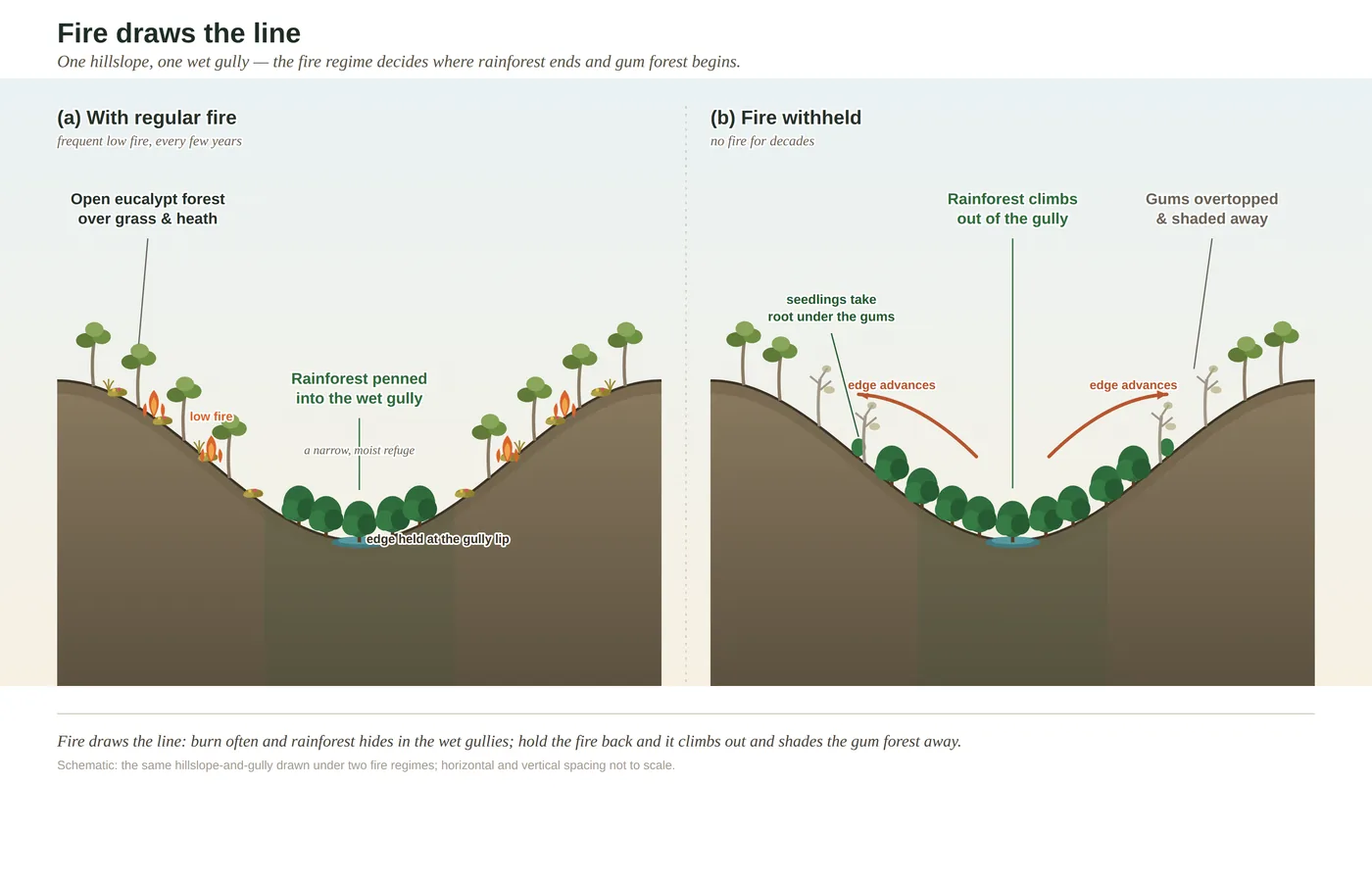
Running through both, holding them in place and deciding the boundaries, is fire. These are trees that have made themselves flammable — oily leaves, litter that will not rot, bark that carries flame into the crown — and armoured themselves to survive the blaze they encourage. The tall wet forest lives a curiously double life: its giants cannot reproduce in their own shade, so without fire reaching up the gullies to hold the rainforest back, they are the last gum generation of a forest already turning into rainforest. The dry woodland tells the same story lower down, in its floor: a cool burn every few years keeps it open and flowering, and take the fire away and it thickens over with woody scrub and loses the ground-layer riches that made it worth the walk.
So fire here is not a disaster that befalls the bush but a dial the bush is built around — and a dial with no single correct setting. Too little, and the woodland closes over; too much or too fierce, and the slow growers and the old, hollow-riddled veterans are killed outright, and those you do not get back in any human lifetime. Read the floor and you have read the fire: grassy and in flower means the flame came through recently and gently; dim, shrubby and litter-deep, thick with black she-oak, means a very old conversation has lapsed.
In depth — the mechanism
The gum forest is not one thing but two, split by the same lever that runs the whole gradient: how much water and nutrient the ground can offer (the gradient rule). On the better, moister soils — foothills, gully floors, the lower slopes with a little richness — grows wet sclerophyll forest: tall, open, straight- trunked eucalypts (blackbutt, tallowwood, flooded gum) standing over a soft, shrubby, almost rainforest-like understorey. On the poorer, drier, free-draining ground grows dry sclerophyll forest and woodland: lower and more open, spotted gum and ironbark over a grassy, sunlit floor that can hold a startling number of small plants. Same tribe of trees, the soil dialled up or down, two different worlds — and the tough, long-lived sclerophyll leaf is the tax that scarce phosphorus levies on nearly every plant in both (Walker & Syers 1976).
Fire is the force that holds the whole thing in place, and the eucalypts are no innocent bystanders: oily leaves, slow-rotting litter and ribbons of loose bark make them flammable more or less on purpose, and thick bark, hidden epicormic buds and lignotubers let them walk away from the blaze they encourage. Two regimes matter. In the tall wet forest, the giant eucalypts cannot regenerate in their own shade, so without fire reaching up the gullies every few decades to knock back the rainforest and open the soil, the tall forest is slowly shaded out and becomes rainforest — a strong tendency, though contingent on a nearby rainforest seed-source and no drought or severe fire cutting across the process first. In the dry woodland, regular cool fire keeps the floor open; withhold it and woody shrubs (black she-oak, wattles, rainforest pioneers, exotic lantana) thicken the mid-storey and shade the flowering ground layer out — woody thickening, one of the commonest ways an Australian woodland loses its diversity without losing a tree to the chainsaw.
The catch, proven in hard local data, is that fire is a dial with no single right setting. The long-term Peachester burning experiment (running since 1969) shows that frequent fire keeps the open, herb-rich understorey but draws down topsoil carbon, while long-unburnt woodland closes over into a canopy of black she-oak (Dooley, Lewis & Schmidt 2023) — and too much or too severe fire is its own kind of harm, killing the slow growers and the old veterans outright (Furlaud et al. 2021). Fuel, meanwhile, is not stored indefinitely: it accumulates then plateaus a decade or two after a burn (Dixon et al. 2018), which is the physical truth behind skipping the small fires only to bank the fuel for one large one. None of this was discovered by science — it was known and worked, as a fine-grained mosaic, for tens of thousands of years of deliberate Aboriginal burning (Bowman 1998). The forest's slowest-built asset is the hollow, a century or more in the making and an afternoon to fell, on which a whole cast of gliders, owls, parrots and the glossy black-cockatoo stake their breeding.
Concepts this teaches — follow a thread
The fire mosaic (no single right fire)Hollow dependence (the century-old apartment)Sclerophylly (the tough-leaf economy)The gradient rule (substrate writes the country)
Sources for this guide — followable
- Walker, T.W. & Syers, J.K. (1976). The fate of phosphorus during pedogenesis. Geoderma 15: 1–19. — Phosphorus scarcity as the driver of the sclerophyll leaf across both forests.
- Dooley, M., Lewis, T. & Schmidt, S. (2023). Fire frequency has a contrasting effect on vegetation and topsoil in subcoastal heathland, woodland and forest ecosystems, south-east Queensland. Austral Ecology 48(8). (Long-term Peachester burning experiment; regular fire maintains understorey diversity, with a topsoil-carbon cost. First author Madeline Dooley — initial confirmed "M." against the paper, July 2026.) — Peachester long-term burning experiment: frequent fire keeps the open, herb-rich floor (at a topsoil-carbon cost); long-unburnt woodland closes to black she-oak.
- Dixon, K.M., Cary, G.J., Worboys, G.L., Seddon, J. & Gibbons, P. (2018). A comparison of fuel hazard in recently burned and long-unburned forests and woodlands. International Journal of Wildland Fire 27(9): 609–622 (article WF18037). (Fuel hazard is highest 0.5–12 yr post-fire and lowest where fire has been absent ≥96 yr — fuel accumulates then falls. This is the WF18037 paper; earlier Notes mis-cited it as "Watson et al. 2018" — no such paper exists.) — Fuel/hazard accumulates then plateaus ~6–30 yr post-fire — the basis for the mosaic of ages, not unbounded build-up.
- Furlaud, J.M., Prior, L.D., Williamson, G.J. & Bowman, D.M.J.S. (2021). Fire risk and severity decline with stand development in Tasmanian giant Eucalyptus forest. Forest Ecology and Management 502: 119724. (Older stands grow moister with fewer ladder fuels; frequent/severe fire keeps forest flammable — supports "both fire suppression and too-frequent severe fire are degradation pathways," Ch 11. NB: concerns flammability/severity, not hollow-tree mortality.) — Too-frequent or too-severe fire as a degradation pathway; management stakes for the old veterans.
- Bowman, D.M.J.S. (1998). The impact of Aboriginal landscape burning on the Australian biota. New Phytologist 140: 385–410. — Aboriginal landscape burning as the fine-grained mosaic that shaped this vegetation.
Test yourself →
You're standing in open, sunny forest: the trees are well spaced with a grassy floor you can see a long way through, the leaves overhead are hard and grey-green and hang down, one trunk wears deep-furrowed near-black bark and another a fibrous reddish coat, and here and there a trunk carries a healed black scar at its base. What country are you reading — and what has shaped it?
Cues: Open, spaced canopy you can see a long way through · Hard, grey-green leaves that hang vertically · Deep-furrowed near-black (ironbark) or fibrous reddish bark · A grassy, sometimes flowering understorey rather than a shrubby or dim one · Old fire-scars (black 'cat-faces') at the base of trunks
Every cue points the same way. Hard, hanging grey-green leaves are the sclerophyll leaf — the tough, long-lived, well-defended leaf that scarce phosphorus forces on this flora, so the ground beneath is poor. The thick, furrowed ironbark and fibrous barks are fire armour: dead insulating coats that let the living tissue ride out a grass fire. And the open, grassy floor plus the healed fire-scars are the signature of regular cool burning — take the fire away and this floor thickens over with woody scrub and loses its diversity. Poor soil plus recurrent fire equals open gum forest. (Ch 4; Ch 6; Ch 11.)
A land manager decides to simplify: burn the whole reserve on exactly the same short interval, at the same intensity, everywhere, every time. Predict what this too-uniform fire regime does to the diversity of the country — and why.
The coast is a gradient, not one place, and each world along it wants a different flame: the rainforest none, the wet forest a little, the dry woodland a cool burn every few years, the wallum a burn often enough to crack its seed. Fire also sorts a landscape into a mosaic of ages — burnt beside long-unburnt — and diversity rides on having all those stages at once. Impose one interval and one intensity everywhere and you erase the mosaic: the country settles onto a single point of the cycle, and every species adapted to a different frequency, intensity or patch-age is squeezed out. The long-term Peachester experiment shows fire frequency working as exactly this master switch, and there is no single setting that suits everything. (Ch 6; Ch 11.)
Cited · traceable Last checked 2026-07. Deep-tier claims rest on, and were checked against, Dooley, Lewis & Schmidt 2023, Austral Ecology 48(8) (Peachester); Dixon et al. 2018, Int. J. Wildland Fire WF18037; Furlaud et al. 2021; Bowman 1998, New Phytologist 140:385–410; wet-sclerophyll→rainforest succession hedged per Ch 11 Notes — every source is listed below and followable. Grounded in Same Sky, Different Ground.