A species
The flying-foxes
The keystone everyone has been taught to hate — big fruit- and nectar-eating bats that range tens of kilometres a night, carrying pollen between eucalypts and paperbarks and ferrying rainforest seed from one forest patch to the next, so that in a chopped-up landscape they are often the only thing still joining the fragments together.
- On the gradient
- Camps in riverside and paperbark-swamp forest, foraging out across the whole gradient by night
- Rock
- Alluvial river flats and paperbark-swamp margins
- Soil
- Riverine and swamp soils carrying paperbark and riverside forest — camp country
Flying-foxes are big bats that feed on blossom and fruit, and they do a job almost nothing else on the coast can. Ranging tens of kilometres in a single night, they carry pollen between distant gum trees and paperbarks and swallow rainforest fruit in one patch of forest to drop the seed, still alive, in another. In a landscape cut into islands, they are often the only courier still linking the pieces. They are noisy, they smell, and they roost in great camps near towns, which has earned them a bad name they do not deserve — and they are increasingly killed in their thousands by extreme heat.
The most important animal in this whole cast may be the one most people would happily be rid of: the flying-fox. These big fruit- and nectar-eating bats are noisy, they smell, they roost in great, obvious camps near towns, and they carry a couple of serious viruses — at very low risk, and only to those who handle them or are bitten or scratched. All of which has earned them a thoroughly bad press. It is one of the great misjudgements of the coast, in the same family as our old contempt for the mangrove and the swamp, and it gets the animal exactly backwards.
Because the flying-fox is a keystone. Ranging tens of kilometres in a single night — up to about fifty — and crossing the landscape in ways almost nothing else can, flying-foxes are among the most prolific long-distance pollinators and seed-dispersers in eastern Australia. They carry pollen between eucalypts and paperbarks as they work the blossom, and they swallow the fruit of rainforest trees in one fragment of forest and drop the living seed in another, far off. That is precisely the long-range delivery service the rainforest cannot regenerate without. In a country chopped into isolated patches, the flying-fox is often the only thing still physically joining them, gene by gene and seed by seed. Remove it and the forests it quietly services begin, slowly, to wink out.
And here is the cruel turn: the flying-foxes are themselves in growing trouble. They lose feeding habitat as the forests shrink; they meet conflict wherever their camps butt up against expanding towns; and, more and more, they are killed by heat. On a searing afternoon a camp can collapse into mass mortality — when the air climbs past the low forties the bats simply cannot shed enough body heat, and they drop from the branches in their thousands. One catastrophic heat event across eastern Australia in January 2014 is thought to have killed at least forty-five thousand flying-foxes in a single day, and such days are forecast to come more often as the century warms.
So the maligned bat streaming out at dusk turns out to be the linchpin holding the fragmented forests together, hated for all the wrong reasons — and one of the animals most exposed to a heating climate besides. We would miss the flying-foxes far more than we imagine, and mostly in ways we would never think to connect back to the bats we drove away.
In depth — the mechanism
The most important animal in the gum-forest cast may be the one most people would happily be rid of. Flying-foxes are big fruit- and nectar-eating bats; on this coast the resident species are the grey-headed flying-fox (Pteropus poliocephalus) and the black flying-fox (P. alecto), joined at times by the nomadic little red (P. scapulatus) when the eucalypts flower heavily. They are noisy, they smell, they roost in great, obvious camps near towns, and they carry a couple of serious viruses — at very low and easily-managed risk, since the bat lyssavirus passes only by a bite or scratch and Hendra only through a horse intermediary, never by casual proximity or an overflight. All of which has earned them a thoroughly bad press, and it is one of the great misjudgements of the coast, in the same family as our old contempt for the mangrove and the swamp.
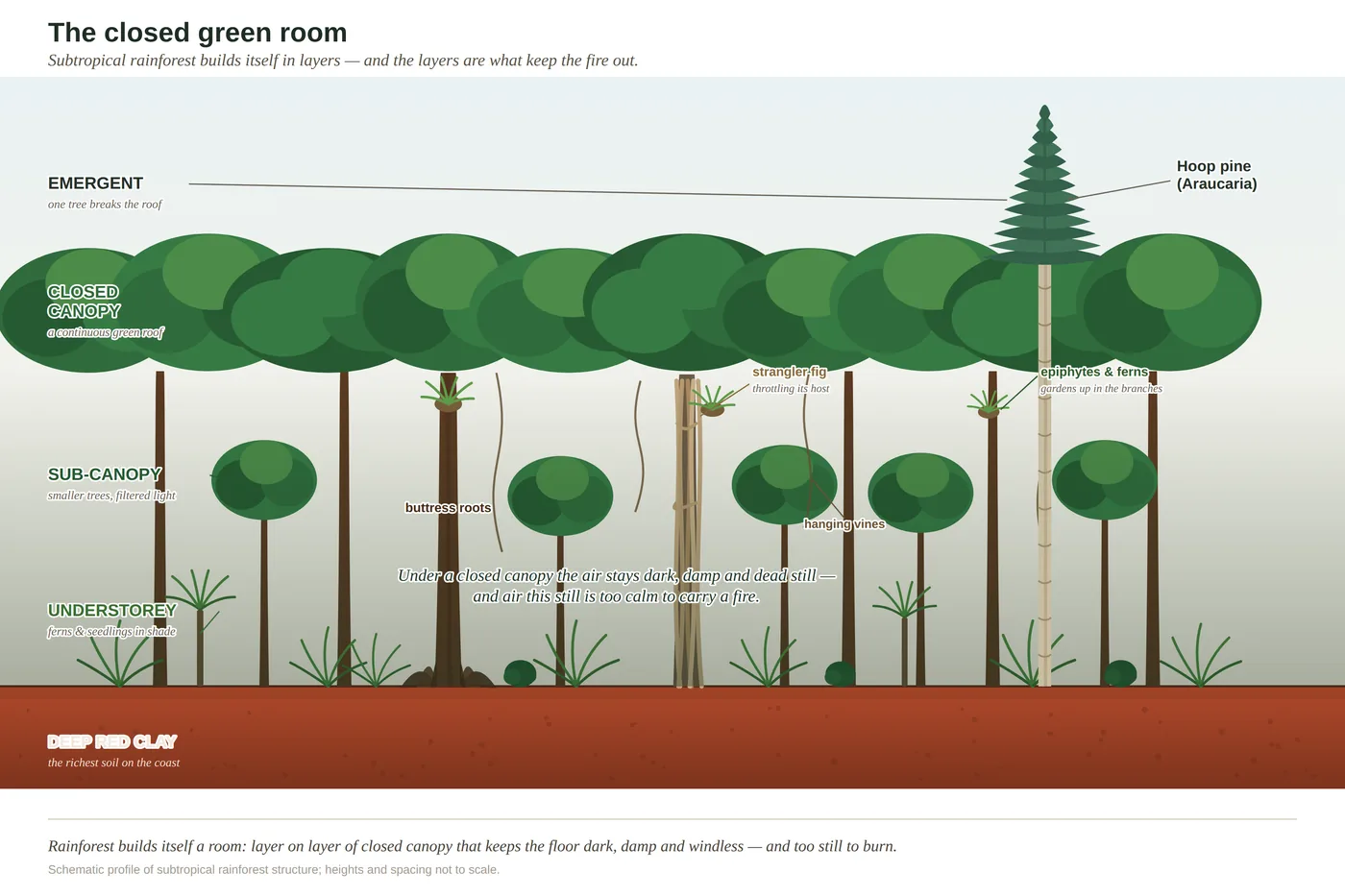
Because the flying-fox is a keystone. Ranging up to around fifty kilometres in a single night and crossing country in ways almost no other animal can, they are among the most prolific long-distance pollinators and seed-dispersers in eastern Australia — carrying pollen between eucalypts and paperbarks as they work the blossom, and swallowing the fruit of rainforest trees in one patch of forest to void the living seed in another (see plant-partnerships). That long-range delivery service is exactly what the rainforest cannot regenerate without: a forest that loses its big-seeded couriers slowly loses its ability to move, and a cleared paddock stays a paddock because the seed never arrives (see rainforest-structure). In a landscape chopped into isolated fragments, the flying-fox is often the only thing still physically joining them — gene by gene and seed by seed — which makes it a linchpin of a kind that is invisible until it is gone. Remove it and the forests it services begin, slowly, to wink out, in a way scarcely anyone would trace back to the maligned bats they drove away (see species-dependence).
And the flying-foxes are themselves under mounting pressure — from the loss of the feeding habitat they depend on, from conflict where their camps meet expanding towns, and, increasingly and brutally, from extreme heat. On a scorching day a camp can suffer mass mortality: when the air pushes past the low forties the bats can no longer shed enough body heat, and they fall from the branches in their thousands. A single catastrophic heat event across eastern Australia in January 2014 is estimated to have killed at least 45,500 flying-foxes in a day, and days like it are forecast to grow more common as the century warms. So the coast's most valuable ecological courier is also one of its most heat-exposed animals — a keystone we have spent a long time resenting, and would miss far more than we imagine, mostly in ways we would never connect back to the bats.
Concepts this teaches — follow a thread
Species dependence (a life is a bundle of needs)Plant partnerships (the deals for poor ground)Rainforest structure (the layered forest)
Test yourself →
Flying-foxes are disliked as noisy, smelly neighbours, and it is easy to think losing them would cost the coast little. But their disappearance would hurt the rainforest far beyond the bats themselves. Why?
The point is reach. Flying-foxes forage up to around fifty kilometres in a night and cross country in ways almost no other animal can, swallowing rainforest fruit in one patch of forest and voiding the living seed in another, far off, and carrying pollen between distant trees as they work the blossom (plant-partnerships). In a landscape chopped into isolated fragments, they are often the only thing still physically joining the pieces — gene by gene and seed by seed — so their loss is a loss of connection, felt across every patch they used to link, not just in the bats (species-dependence). The distractors each name a real animal role, which is what makes them tempting, but none is the flying-fox's job: eating insect pests is what the insectivorous bats and birds do (flying-foxes eat fruit and nectar); fertilising with droppings is a minor side-effect, not why they matter; and fig pollination is the work of tiny species-specific fig-wasps, not bats. The flying-fox's irreplaceable service is long-distance dispersal — the courier run between forests. (Ch 15; Ch 16.)
Cited · traceable Last checked 2026-07. Deep-tier claims rest on, and were checked against, Ch 16 (Animals and their dependencies) — 'The keystone everyone has been taught to hate', and Ch 15 (pollination and seed dispersal), verified July 2026: resident grey-headed Pteropus poliocephalus and black P. alecto (nomadic little red P. scapulatus) on the Sunshine Coast; keystone long-distance pollinators/dispersers (forage up to ~50 km/night, 100+ tree species); heat-stress mass mortality (>=45,500 died in a single day, Jan 2014; risk rises sharply above ~42 C); disease risk LOW and correctly framed (ABLV via bite/scratch only; Hendra via a horse intermediate). No standalone author-year key exists for these facts; grounded in the chapters per the brief. — every source is listed below and followable. Grounded in Same Sky, Different Ground.