A place
Mary Cairncross Reserve
A surviving fragment of the big scrub on the Blackall Range — subtropical rainforest kept whole on the deep red basalt, so you can still read what the whole range once was.
- On the gradient
- Range crest — high-rainfall top of the reef-to-range climb
- Rock
- Maleny basalt (Blackall Range)
- Soil
- Deep red Ferrosol (krasnozem), inferred from the range's basalt geology
- Deep red soil underfoot
- A closed, dark canopy — the floor dim at midday
- Big trunks flaring into broad buttress roots
- A range crest catching heavy rain
- Strangler figs and layered tiers of trees, palms and ferns
Mary Cairncross is a small remnant of the great rainforest — the 'big scrub' — that once cloaked the Blackall Range, saved on the deep red basalt soil above Maleny. Walk in and you step straight into the closed, dim, layered forest the settlers cleared almost everywhere else on this rich ground: buttressed booyongs, strangler figs, piccabeen palms, and a tame colony of red-legged pademelons browsing the edges.
Come into one of the survivors: Mary Cairncross, on the crest of the Blackall Range above Maleny, a fragment of the old big scrub kept whole on the deep red basalt where so much of the coast’s story begins. Step off the mown edge into the trees and the change is instant. The light drops by half; the air cools, dampens and goes still; the glare and the traffic fall away behind you; and the sounds that replace them are water dripping from leaf to leaf, the crack of a whipbird, and the sudden clatter of an unseen pigeon leaving a branch. You have walked out of the Queensland sun and into a green room, and it is worth knowing that a room like this once ran the whole length of the range.
Look, while your eyes adjust, at what the rich ground grows. The massive grey trunks that flare into great thin fins of wood at the base are the booyongs, the buttressed signature trees of the subtropical scrub, bracing themselves sideways because they root shallowly rather than driving deep. Here and there a strangler fig stands as a hollow woven cylinder where another tree used to be — a fig that began life as a seed dropped high in a fork, let roots down to the ground, and slowly sheathed and killed its host. The shaded floor is crowded with young piccabeen palms, and at dusk the red-legged pademelons come out to browse the edges — the reserve’s habituated colony has long since stopped bothering to run from walkers.
What makes the place matter is not that it is grand — it is small, a remnant of perhaps fifty-odd hectares in the care of the Sunshine Coast Council — but that it is legible. This is the same forest, on the same deep red basalt, that once cloaked the Blackall Range from end to end, and that was felled within a few decades: the cedar-getters first, cutting out the prized red timber, then the clearing proper for dairy pasture on the richest soil in the region. A stand of rainforest was two prizes to a settler at once, valuable timber above and the best farmland on the coast below, and the forest that could shrug off any fire had no answer to that. Mary Cairncross is what was kept back — a window, deliberately left open, onto the country the range used to be.
In depth — the mechanism
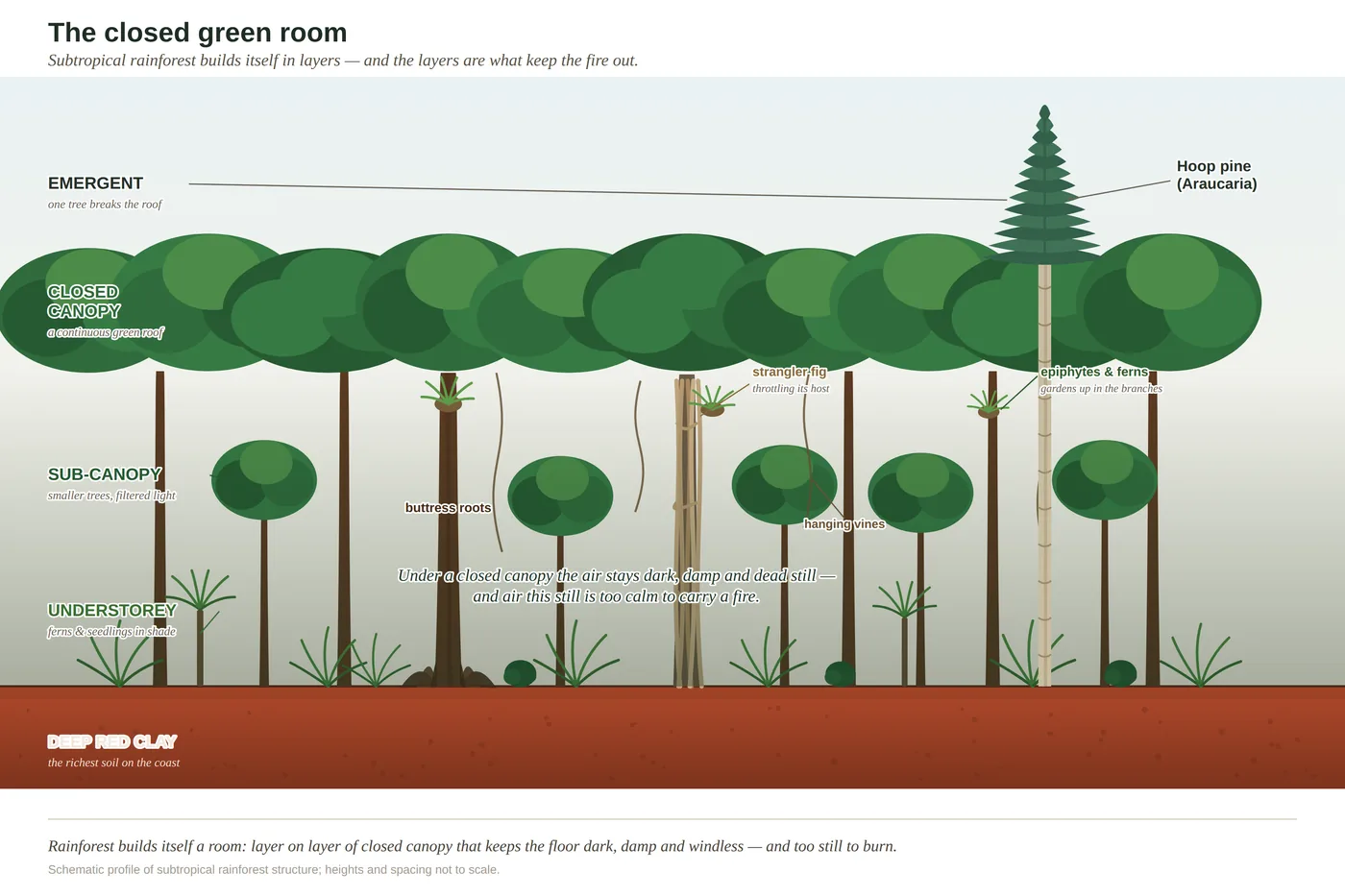
Mary Cairncross reads as a worked example of why rainforest sits where it does. It rides the crest of the Blackall Range at Maleny, on basalt that has weathered to a deep red Ferrosol — the old "krasnozem," the richest soil in the region (see basalt-fertility) — where the range also catches the heaviest rain. Rich rock, rich soil, most rain: the wet, fertile top of the gradient rule, and exactly the ground the subtropical rainforest wants. The forest itself is the classic complex vine forest of the SE Queensland uplands, layered in the way rainforest always is (see rainforest-structure): emergent hoop pines above a closed canopy of buttressed booyongs (Argyrodendron), strangler figs, red cedar in the understorey record, and piccabeen palms crowding the shaded floor.
Two honest caveats, carried from the book's own Notes. (1) The reserve is a modest remnant — of order fifty-odd hectares, managed by Sunshine Coast Council — not a wilderness; its value is as a legible survivor of a forest cleared almost everywhere else on this soil, kept so we can still see what the range once was. (2) The "deep red krasnozem" is attributed from the Blackall Range's basalt geology, not from a reserve-specific soil survey — a sound regional inference, and flagged as one. What is not in doubt is the pattern the place makes plain: this is the same forest, on the same rich basalt, that once ran the length of the range and was felled within a few decades for its cedar first and its dairy pasture after. A forest that defends itself so cleverly against fire had no defence at all against the axe.
Concepts this teaches — follow a thread
Basalt fertility (why red ground grows rainforest)Rainforest structure (the layered forest)
Sources for this guide — followable
- Willmott, W. (2007). Rocks and Landscapes of the Sunshine Coast (2nd ed.). Geological Society of Australia. (Local basement = Amamoor & Booloumba Beds; North Arm Volcanics; Landsborough Sandstone. NB: Neranleigh–Fernvale Beds are the Gold Coast/Brisbane equivalent, not the Sunshine Coast basement.) — Blackall Range basalt weathers to deep red Ferrosol/krasnozem (regional geology basis for the soil inference).
- Leiper, G. et al. (2022). Mangroves to Mountains (3rd ed.). Native Plants Queensland. — Complex notophyll vine forest structure and flora of the SE Qld uplands (Mangroves to Mountains).
Test yourself →
You've climbed to the crest of a high range in heavy rain, onto deep red soil, and stepped into a forest so closed the floor is dark at midday — tall trunks flaring into broad buttresses, a strangler fig standing hollow where a tree once was. What country are you reading, and why does it sit here and not on the sand below?
Cues: Deep red soil underfoot · A closed, dark canopy — the floor dim at midday · Big trunks flaring into broad buttress roots · A range crest catching heavy rain · Strangler figs and layered tiers of trees, palms and ferns
Deep red soil on a wet range crest is the tell. Basalt weathers to a deep red Ferrosol (krasnozem) that holds water and nutrients better than any other soil in the region, and the range that carries it wrings the most rain from the sky — the wet, fertile top of the gradient. That is the one ground rich and sheltered enough to grow rainforest, and its closed canopy, buttressed giants and strangler figs are the structural signature. It sits here and not on the sand because the sand is leached and phosphorus-poor (it grows heath), while the basalt is fresh, mineral-rich rock — and because the closed forest keeps itself too damp to burn, which fire-prone sand country never manages. (Ch 4; Ch 13.)
Subtropical rainforest grows on the deep red basalt of the range crest, but never out on the bleached coastal sand a few kilometres away — even though both get plenty of rain. What best explains why the rainforest sits here and not there?
Two things put the rainforest on the basalt and keep it off the sand, and neither is rainfall. First, soil: basalt is young, mineral-rich rock that weathers to a deep red Ferrosol holding water and nutrients, while the coastal sand has been leached of its phosphorus over hundreds of thousands of years and grows only hard-leaved heath. Second, fire: the closed rainforest keeps its own floor dark and damp and so excludes fire, whereas the open, fire-prone sand country burns freely — and rainforest cannot establish where fire runs. Rich rock plus fire exclusion, not more rain, is the answer. (Ch 4; Ch 6; Ch 13.)
Cited · traceable Last checked 2026-07. Deep-tier claims rest on, and were checked against, Willmott 2007, Rocks and Landscapes of the Sunshine Coast (2nd ed.); Leiper et al. 2022, Mangroves to Mountains (3rd ed.); Ch 13 Notes (Mary Cairncross ~55 ha, council-managed, red-legged pademelon; krasnozem inferred from Blackall Range basalt, verified July 2026) — every source is listed below and followable. Grounded in Same Sky, Different Ground.