A place
Mudjimba Island (Old Woman Island)
A small continental island and its fringing boulder reef off the Maroochy coast — a two-oceans reef where warm current and cool south share the rock, and a nesting refuge whose surrounding water is a moat against the mainland's foxes and cats.
- On the gradient
- Offshore rock island and fringing reef — the two-oceans overlap made into a predator-free refuge
- Rock
- Small continental (rock) island with a fringing boulder reef, ~2 km off the Maroochy coast
- Soil
- Rock and thin skeletal island soil; hard-bottom boulder reef around the island (no seagrass on the reef)
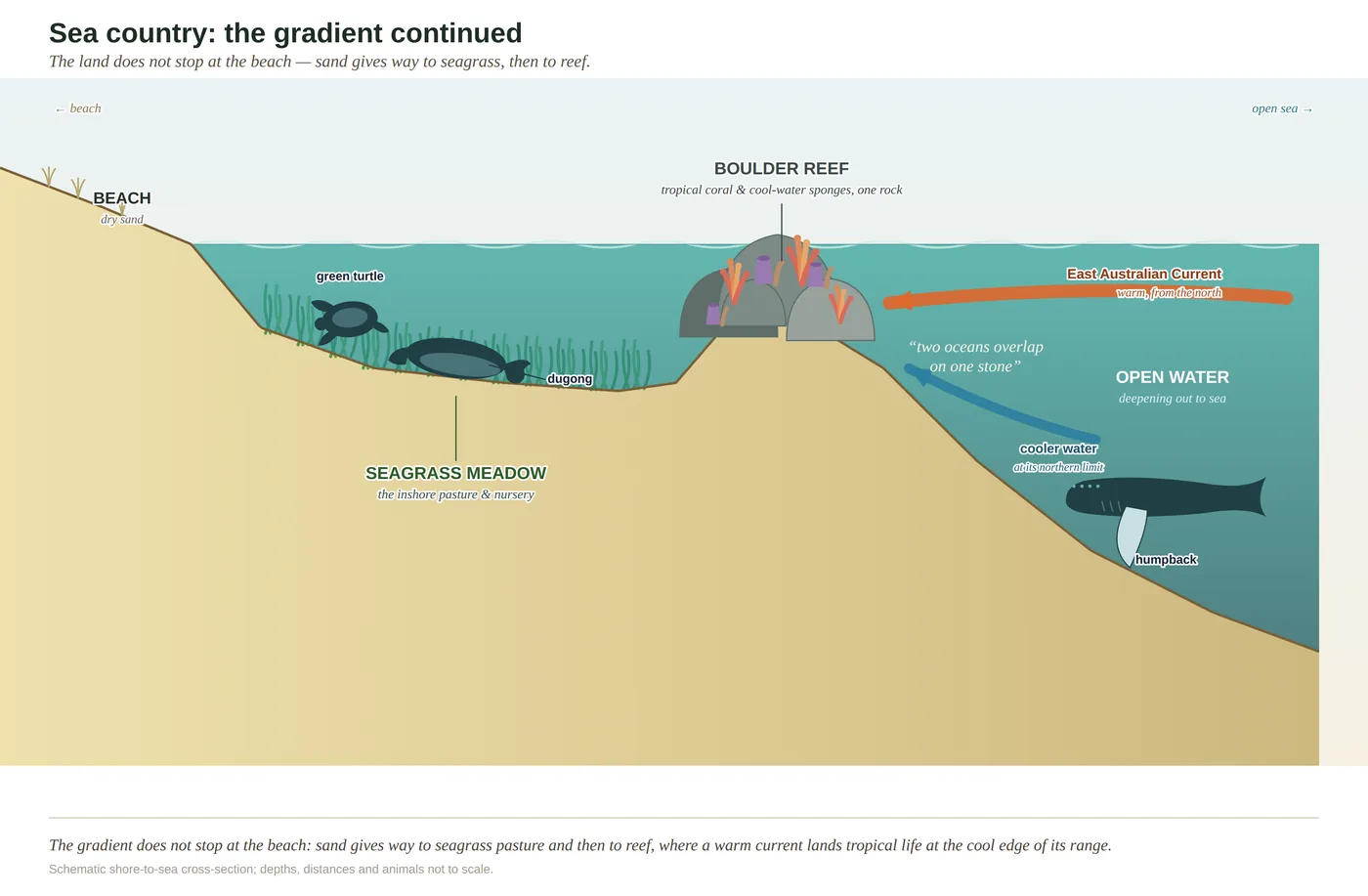
Mudjimba Island — older maps call it Old Woman Island — is a small rocky island a couple of kilometres off the Maroochy coast, ringed by a boulder reef. Like the headland reefs, it sits in the two-oceans overlap, where the warm current lays tropical life against the sponges and seaweeds of the cooler south. The island's other value is what the water keeps out: foxes and cats have emptied much of the mainland of its small animals and ground-nesting birds, but they cannot easily reach an island, so the sea around Mudjimba acts as a moat, leaving it a refuge for seabirds and other creatures that struggle to survive ashore.
A couple of kilometres off the Maroochy shore, small and rocky and easy to overlook, sits Mudjimba Island — Old Woman Island on the older charts. A boulder reef rings it, and that reef, like the shoals off the headlands nearby, lives in the two-oceans overlap: the warm East Australian Current drops tropical fish and coral onto the rock at the southern edge of where they can survive, and they share it with the sponges and seaweeds of the cooler south. Snorkel the fringe and you get the coast’s signature trick — two oceans on one stone — gathered neatly around a single island.
The island’s other gift is harder to see, because it is really an absence. On the mainland just across the water, two imported hunters have quietly emptied the country of much of its smaller life: the fox and the feral cat, which fall hardest on exactly the ground-dwelling animals and low-nesting birds that never evolved any defence against them. Neither predator crosses open sea willingly. And so an island turns into a fortress by doing nothing at all — the strip of water is a moat, and the creatures that get picked off ashore hang on out here, not because the island feeds them better (its rock and thin soil usually feed them worse) but because the thing that kills them cannot reach them.
That is worth carrying in your head as a way of reading the coast. Dependence is not always about a special food or a particular tree; sometimes what an animal most depends on is the absence of an enemy, and a place that happens to supply it. Mudjimba is exactly that place — reef on the outside, refuge on the inside — and it stays one only as long as the moat is respected. Carry a fox or a cat across, by boat or by causeway, and the fortress falls in a single season. Left alone, with the water doing its quiet work, it goes on being a small ark off a crowded shore.
In depth — the mechanism
Mudjimba Island is a small continental island — rock, not a sand cay — lying a couple of kilometres off the Maroochy coast, the little island older maps call Old Woman Island. A boulder reef fringes it, and that reef sits squarely in the two-oceans overlap (see two-oceans-overlap). The East Australian Current runs warm tropical water and tropical larvae down the coast, and here they settle near the southern edge of where warm-water species can live, sharing the rock with the sponges and seaweeds of the cool south — the same improbable mixing that makes the headland reefs so rich, gathered around a single island (McPhee 2017; Davie 1998).
But the island's deepest lesson is about the water, not the reef — and it is a lesson in dependence read backwards. Across the mainland, two introduced predators have done more damage than almost anything else: the European fox and the feral cat, which fell hardest on exactly the small and medium animals, and the ground- and low-nesting birds, that the country could least afford to lose (Ch 16; Ch 17). Those hunters swim badly and travel by land, and a strip of open sea is a barrier they mostly cannot cross. So an island becomes a refuge by simple subtraction: the same seabirds and small creatures that have been picked off the mainland persist offshore, not because the island offers more — its rock and thin soil usually offer less — but because the one thing killing them ashore cannot get to them across the water. Read this as species-dependence turned inside out: what these animals depend on here is not a richer place but the absence of a predator, and the moat that supplies it (see biological-invasion).
That is why a small, unremarkable-looking island off a built-up coast can matter out of all proportion to its size. It is a piece of the mainland's fauna kept alive by an accident of geography, and it stays a refuge only as long as the moat holds — which is to say, only as long as a fox or a cat is never carried across, by boat or on a causeway, into a place that has no defences ready for it. Reef on the outside, refuge on the inside: two reasons to leave the island, and the water around it, alone.
Concepts this teaches — follow a thread
Two oceans on one rock (the tropical–temperate overlap)Species dependence (a life is a bundle of needs)
Sources for this guide — followable
- McPhee, D. (2017). Environmental History and Ecology of Moreton Bay. CSIRO Publishing. — EAC-driven tropical–temperate reef overlap on the SE Queensland coast; the boulder reef around Mudjimba/Old Woman Island.
- Davie, P. (1998). Wild Guide to Moreton Bay. Queensland Museum. — Regional marine natural history of the offshore reefs and their fauna.
Test yourself →
On a small rocky island a couple of kilometres off a built-up coast, seabirds still nest and small ground-dwelling animals still hang on — species that have all but vanished from the mainland just across the water. The island is not lush: its rock and thin soil offer, if anything, less food and shelter than the mainland. So why do these animals persist out here when they have disappeared right next door?
The trap is to reach for resources — the near-miss 'richer soil and more food' — but the prompt rules it out: the island offers *less*, not more. What differs is not what the island gives but what it withholds. The fox and the feral cat, the two introduced predators that fell hardest on small ground-dwelling animals and low-nesting birds on the mainland, travel by land and swim badly, so a strip of open sea is a barrier they mostly cannot cross. The island persists as habitat by simple subtraction: the killer can't reach it. That is species-dependence read backwards — the animals depend on the *absence* of an enemy, supplied by the moat — and it is why the refuge lasts only as long as no fox or cat is ever carried across. Warmth and any innate 'preference' for islands are distractors; ground-nesters thrive on predator-free mainland too, when there is any. (Ch 16 — fox/cat impact on small fauna; Ch 17 — biological invasion; Ch 14 — the offshore islands.)
The grey nurse shark is a fish-eating shark of the headland reefs, critically endangered on the east coast. What most limits it locally — what does it most depend on?
The grey nurse does not depend on a particular food but on particular places: a small number of aggregation sites — rocky reefs and volcanic pinnacles with sheltered sandy gutters — where the sharks gather year after year. Wolf Rock, off Double Island Point, is the only known east-coast gestation site for pregnant females, so a large share of the breeding population funnels into one small patch of sea. Concentrate that much of a slow-breeding, critically endangered population on so few sites and losing or disturbing even one is a heavy blow — which is why Wolf Rock is now a no-take zone (Ch 14 Notes; east-coast Carcharias taurus listed Critically Endangered, EPBC). The distractors are other animals' dependencies wearing a shark costume: seagrass grazing belongs to the dugong and green turtle, tree hollows to the glossy black-cockatoo and gliders, and the grey nurse actually favours the warm-current reefs rather than being driven out by them. Read what this animal needs — the sites, plus a punishingly slow reproductive rate — and its fragility follows. (Ch 14.)
Cited · traceable Last checked 2026-07. Deep-tier claims rest on, and were checked against, McPhee 2017, Environmental History and Ecology of Moreton Bay; Davie 1998, Wild Guide to Moreton Bay. The reef facts ground in Ch 14 (sea country) — 'Down on the reef' names the boulder reef ringing Mudjimba Island (Old Woman Island) off Maroochydore as a two-oceans EAC overlap. The island-refuge argument grounds in Ch 16 (fox and feral cat fell hardest on small/medium mammals and ground-nesting birds) and Ch 17 ('The animals and plants we let loose' — acclimatisation/biological invasion), applied to an island via the standard predator-free-refuge principle; the specific seabird-roost claim is authored from the chapters (no standalone author-year key) and kept qualitative. Verified July 2026. — every source is listed below and followable. Grounded in Same Sky, Different Ground.