An ecosystem
Paperbark swamp and blackwater sedgeland
The wet, flat, tea-stained lowland behind the dunes — pale-barked swamp forest and sedge on peaty sand, run by a pulse of flood and dry-down, doing for free the flood-storage and water-cleaning we pay engineers to do worse.
- On the gradient
- Wet lowland — the flat, waterlogged ground between wallum sand and estuary
- Rock
- Quaternary coastal sand and floodplain alluvium
- Soil
- Peaty sand / organic Histosol (sand swamps) to river-laid mud (floodplain swamps)
- Tea-coloured but clear, mirror-still water
- Pale, papery-barked paperbarks standing with wet feet
- Sedges in the shallows, not reeds
- White sand banks
- Very low flow — the water barely moves
This is the soggy ground the water drains into after it leaves the wallum: flat, tea-coloured, and dense with pale, papery-barked trees standing with their feet underwater. It looks like waste ground fit only for draining. It is closer to the coast's hardest-working organ — a giant shallow sponge that swallows floods, filters the water on its way through, and shelters a crowd of frogs, fish and birds.
Follow the water downhill far enough and the gradient runs out of slope. The tea-dark water off the wallum, and the run-off from the ridges above, drains into the lowest, flattest, wettest ground there is, and gathers, and stands — too flat to run off, too wet to drain away. Where water sits like this, a particular and wonderful kind of forest takes hold: the paperbark swamp.
The paperbark is unmistakable once you know it. Its trademark is the bark — thick, soft, spongy, pale, peeling off the trunk in papery sheets like the pages of a sodden old book — and the great swamp-former here, the broad-leaved paperbark, gathers into dense, dim, pale-trunked stands in the wettest hollows, often with its boots underwater for months on end. Living with wet feet is nearly as hard a trick for a tree as living in salt, and for the same reason: waterlogged soil is airless soil, and roots need to breathe. The paperbark is built for a world that floods one season and parches the next, which is precisely the world the lowlands offer.
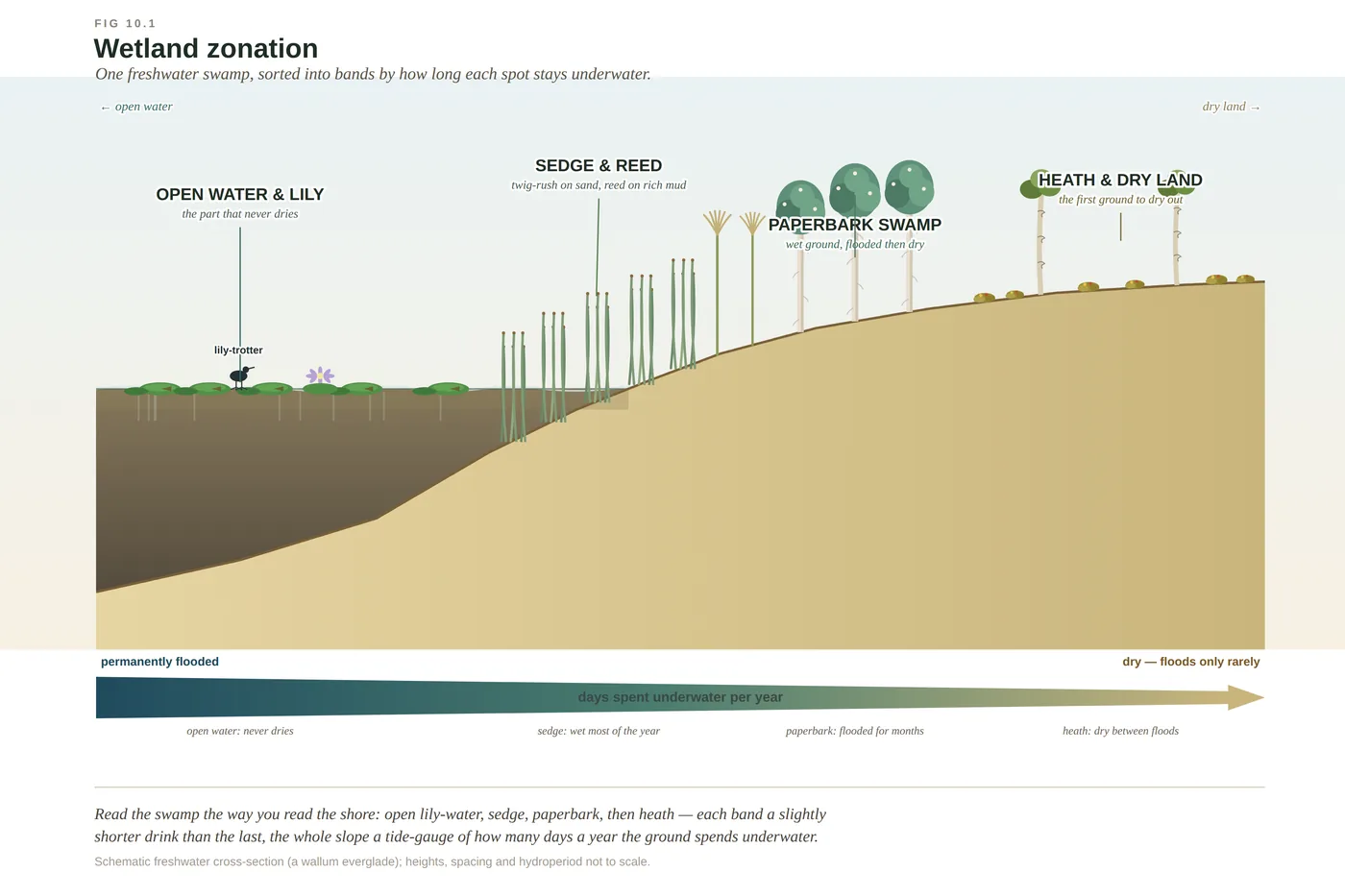
Because the thing that rules a swamp is not how high the ground is, nor how rich, but water — and above all how long each patch of it stays wet. That one number sorts the plants into bands and times the animals to their seasons, and the flood that fills the swamp and the dry that empties it are not interruptions to its life but the engine of it. When the rains come, and on this coast they come hard, the whole system detonates: the paperbarks smother themselves in creamy, nectar-dripping spikes and the lorikeets and flying-foxes pour in; the frogs erupt into a chorus loud enough to carry across the paddocks; the fish fan out over the drowned flats to feed and breed. Then the dry returns and the boom collapses back to the last permanent pools, and the nomad waterbirds lift off to find wherever the next rain has fallen.
And while it is at all of this, the swamp quietly does the work we are least willing to pay for. It swallows a flood — spreading the surge across a wide flat and letting it go slowly, shaving the dangerous peak off the water downstream. It cleans what runs through it, the sedges and paperbark roots combing out sediment and nutrient so that what seeps on is markedly clearer than what arrived. It banks carbon, piling up undecayed litter as peat in the airless mud. For two centuries we read all this as mosquito-ridden waste and drained it for cane and pasture, which is how the freshwater wetlands became among the most thoroughly destroyed country on the coast — and how we learned, too late and at great expense, that the swamp was the flood mitigation we then paid engineers to rebuild worse. It is no wasteland. It is closer to the coast’s hardest-working and least-thanked organ, and its boom-and-bust pulse is not a fault to engineer out with a drain and a weir but the very rhythm the frogs and fish and waterbirds breed and feed by. A wetland held forever at one fixed level is one with its engine switched off.
In depth — the mechanism
A paperbark swamp is what happens where the gradient runs out of downhill. The acid, tannin-stained water of the wallum, and the run-off from the slopes above, gathers in the lowest, flattest ground — the swales in the sand, the lagoon margins, the broad river floodplains — where it is too flat to run off and too wet to drain, and there a flood-tolerant forest takes over. The great swamp-former is the broad-leaved paperbark (Melaleuca quinquenervia), whose thick spongy bark insulates it against the fires that run the swamp edges in dry years and whose roots tolerate the airless, waterlogged mud that would drown an ordinary tree.
Keep two swamps apart, because they run on opposite chemistry. On the sand masses (Cooloola, the Noosa back-country) the swamps are fed by the same poor, acid, tannin-stained blackwater as the wallum: hungry, sedge-and-paperbark places on bottomless sand, slowly banking peat, and dominated by sedges — above all the grey twig-rush (Lepironia articulata) — not reeds. On the river floodplains (the Maroochy, the Mooloolah) the swamps sit on rich, river-laid mud and run to tall reedbeds (Phragmites, Typha): fat, productive, and a wholly different community doing the same job. Same green sheet from the bank; different soil, different plants, different fate.
The pulse is the engine, not a fault. What rules the swamp is not height or richness but hydroperiod — how many days a year each patch spends underwater — and that one number sorts the plants into bands and times the animals to their seasons (see wetland-zonation). Flood and dry-down are the machinery: the rains detonate a boom of frogs, fish and waterbirds; the dry contracts the system to its last pools and sends the nomads ranging. On the sand country the whole community leans on an unseen, groundwater-fed water table that keeps its streams and swamps alive through the dry — a groundwater-dependent ecosystem (Dyring et al. 2025) that can be undone by drainage or extraction that lowers the table, with nothing visibly changing at the surface until it is too late.
The unpaid work is real and specific. A swamp spreads a flood across a wide flat, shaving the peak off the surge downstream and feeding the rivers steadily for weeks after; the same slow passage strips sediment and nutrient, so the water that finally seeps on is cleaner than what arrived; and in the airless mud the undecayed litter piles up as carbon-rich peat. There is a sting in the tail unique to these lowlands: many of the waterlogged soils are loaded with iron sulfides that sit harmless while wet, but drain them and let the air in and they oxidise to sulfuric acid — the "acid sulfate soil" that the next big rain flushes into the waterways as a fish-killing slug. A swamp is storing water and carbon and keeping a chemical hazard asleep at the same time; wake it carelessly and the bill arrives, years later, as dead fish.
Concepts this teaches — follow a thread
Blackwater and acid water (the colour of tea)Wetland zonation (the swamp reads like a tide-gauge)The gradient rule (substrate writes the country)
Sources for this guide — followable
- Dyring, M. et al. (2025). A hydrogeochemical approach to coastal groundwater-dependent ecosystem conservation: the Cooloola Sand Mass. Science of the Total Environment 958: 177892. [PubMed 39647209] (The GDE dependence-mapping paper — e-pub 7 Dec 2024, vol 958 carries a 2025 date; cite as 2025. A separate Dyring et al. 2024, Groundwater 62(2), doi:10.1111/gwat.13352 covers GDE policy gaps — do not conflate.) — Groundwater-dependent ecosystems of the Cooloola sand mass — the water table beneath the sand swamps.
- Meyer, E.A., Franklin, C.E. & Cramp, R.L. (2020). Acid tolerance in Litoria cooloolensis larvae. J. Comp. Physiol. B 190: 691–706. [PubMed] (Larvae hold salt balance to ~pH 3.5.) — Frog-larva acid tolerance: wallum sedge-frog larvae (Litoria cooloolensis) hold salt balance down to ~pH 3.5 — how an acid-water specialist endures the blackwater's sourness.
- Walker, T.W. & Syers, J.K. (1976). The fate of phosphorus during pedogenesis. Geoderma 15: 1–19. — The phosphorus-leaching arc that makes the sand-country swamps permanently poor.
Test yourself →
You paddle into a low, flat reach of sand country and the river slows almost to a standstill. The water is clear but stained the colour of strong cold tea, so still it holds the pale, papery-barked trees upside down like a mirror; the banks are white sand, sedges stand in the shallows, and there is barely any flow. What are you reading — and why is the water this colour?
Cues: Tea-coloured but clear, mirror-still water · Pale, papery-barked paperbarks standing with wet feet · Sedges in the shallows, not reeds · White sand banks · Very low flow — the water barely moves
The tell is that the water is stained yet clear, and dead still. Muddy floodplain water is brown because it is carrying suspended clay; blackwater is brown because it is carrying dissolved tannin, leached from the peaty litter of the wallum and paperbark swamps, over sand too poor in clay and carbonate to soak it up or buffer it. That same lack of buffering leaves the water acid (around pH 3.5–4.5). Paperbarks with wet feet, sedge (not reed) in the shallows, white sand and near-zero flow all point the same way: a groundwater-fed blackwater swamp on poor sand — the Noosa Everglades being the grandest example. (Ch 5; Ch 10.)
Cited · traceable Last checked 2026-07. Deep-tier claims rest on, and were checked against, Dyring et al. 2025, groundwater-dependent ecosystems of the Cooloola sand mass; sand-swamp vs floodplain-swamp distinction and acid-sulfate-soil hazard per Ch 10 Notes (verified June 2026) — every source is listed below and followable. Grounded in Same Sky, Different Ground.