An ecosystem
Subtropical rainforest (the big scrub)
The tallest, oldest, most crowded forest on the coast — grown on the richest, best-watered ground, and kept alive by staying whole enough to shut fire out.
- On the gradient
- Range crest — the wet, fertile top of the reef-to-range climb
- Rock
- Cenozoic basalt (Blackall Range / Maleny)
- Soil
- Deep red Ferrosol (krasnozem) — the most fertile soil in the region
- Deep red soil underfoot
- A closed, dark canopy — the floor dim at midday
- Big trunks flaring into broad buttress roots
- A range crest catching heavy rain
- Strangler figs and layered tiers of trees, palms and ferns
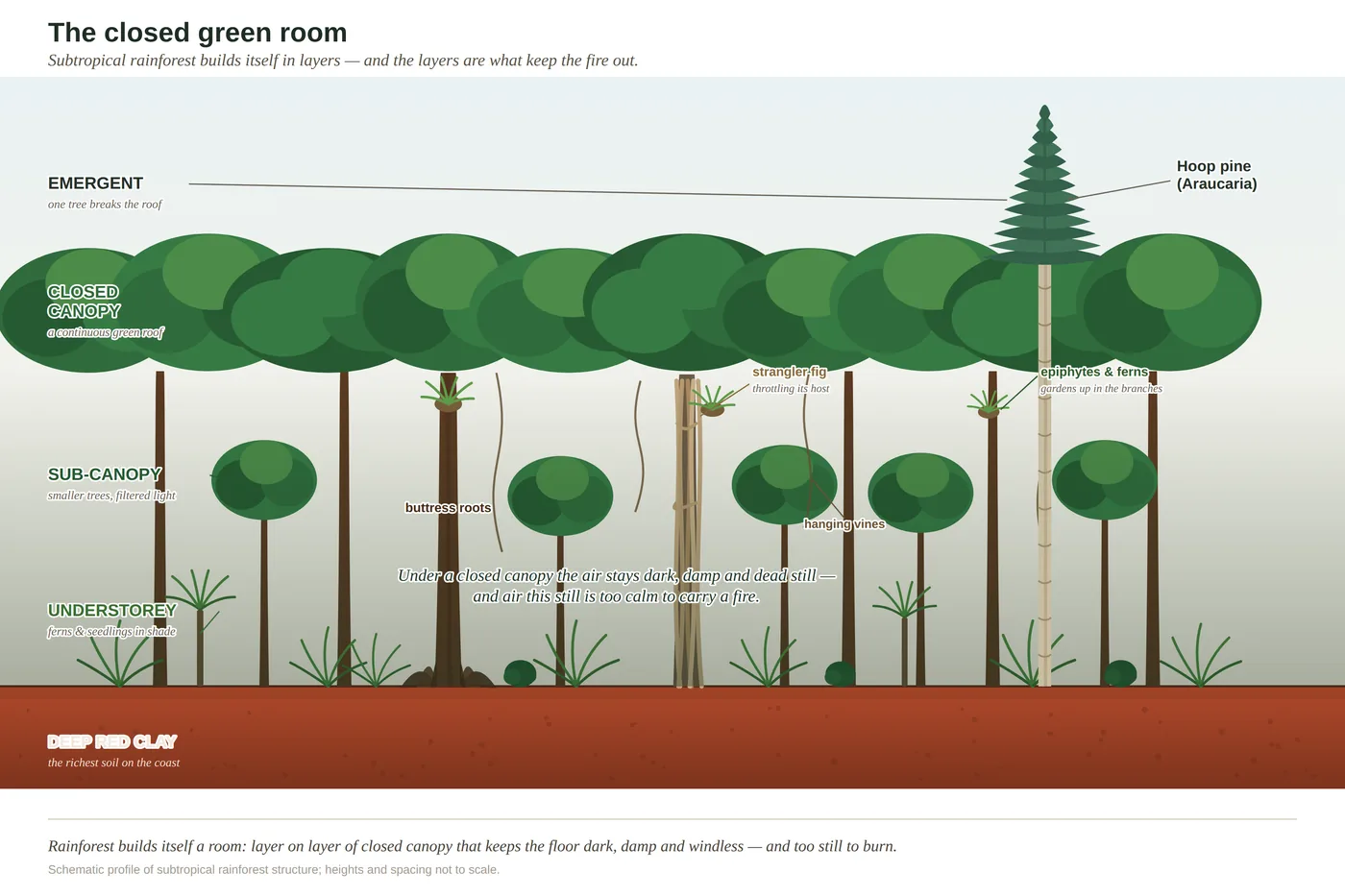
Rainforest sits at the very top of the climb, on the deep red basalt soils where the range wrings the most rain out of the sky. It is the richest ground on the coast, and it grows the tallest, densest forest — buttressed trunks, strangler figs, layered green closing overhead. And because that closed canopy keeps its own floor dark and damp, fire cannot get a hold: the forest survives flame by refusing to let it start.
At the top of the long climb up from the sea, on the richest soil and under the heaviest rain, sits the forest everyone agrees is glorious: the rainforest, the tallest and oldest and by a distance the most crowded forest on the coast. Step off a mown edge into one of the survivors and the change is instant and physical — the light drops by half, the air cools and dampens and goes still, and the Queensland glare falls away behind you as if a door had shut. You have walked out of the sun and into a green room, and the room is stacked in layers: giant trees emerging above a closed canopy, smaller trees and palms and ferns filling every level below, buttressed trunks braced like the flying buttresses of a cathedral, strangler figs standing as hollow woven cylinders where another tree used to be.
Hold it against the wallum and the logic snaps into focus, because the two are the poles of the whole gradient. The wallum grows on the poorest ground, in the open, demanding fire, and answers its poverty with a riot of small, hard-leaved specialists. The rainforest grows on the richest ground, in deep shelter, excluding fire, and answers its wealth with sheer mass and structure. Where the wallum is a crowded democracy of the poor, the rainforest is a towering aristocracy of the well-fed. Both are diverse, but at opposite ends of the same slope — and between them they bracket everything else on the coast.
The wealth is real, and it starts in the rock. Basalt rots down to a deep red clay that holds water and nutrients better than any other soil in the region, and the ranges that carry it are where the coast pulls the most rain out of the sky. Richest rock, richest soil, most rain: this is just the wet, fertile top corner of the gradient rule. But the forest keeps its fortune overhead, not in the ground — the roots and their fungi snatch each fallen leaf back almost before it lands, running the whole system on a tight, fast, hand-to-hand cycle — which is exactly why clearing does such lasting harm. Fell the forest and the wealth does not stay behind for the paddock; most of it walks away in the logs, and the rest washes off the bared red slope in the first summer storm.
The defining fact about rainforest, though, is how it handles fire, and it is the opposite of everything the fire-country plants do. It survives flame by refusing to let it start. The closed canopy keeps the interior dark, humid and still, the litter too damp to burn, so a fire tearing through the eucalypt forest next door arrives at the green wall and simply runs out of fuel. Where the forest is whole this works almost perfectly, which is why rainforest survives as islands in a sea of fire, holding the wet gullies and the range tops. But the defence is all-or-nothing. Break the canopy — clear it, fragment it, run a road through it, or let a single bad fire breach its edge — and it dries out and becomes, for the first time, able to burn, and a rainforest that burns does not come back as rainforest. It has no reverse gear. That is why so little of the old big scrub is left, and why the fragments that remain matter as much as they do.
In depth — the mechanism
Rainforest is the mirror image of the wallum, and holding the two side by side is the fastest way to understand either. The wallum grows on the poorest ground, in the open, demanding fire, and answers its poverty with a crowd of small, hard-leaved specialists. Rainforest grows on the richest ground — the deep red basalt-derived clay of the ranges (see basalt-fertility) — under the heaviest rain, in deep shelter, excluding fire, and answers its wealth with raw mass and structure: enormous trees stacked in layers (see rainforest-structure), broad soft leaves built to catch dim light, and a comparatively short cast of giants rather than a long list of strategists.
The two forces that put it here are soil and water, and they compound. Basalt weathers to a Ferrosol (the old "krasnozem") that holds water and nutrients far better than any other soil in the region, and the ranges that carry that basalt are also where the coast wrings the most rain from the sky. Richest rock, richest soil, most rain — this is simply the top corner of the gradient rule, the wet and fertile end of the reef-to-range transect.
One honest wrinkle about the soil. The basalt soil genuinely is fertile — it is why the dairy farmers wanted it — yet the forest runs its nourishment on a tight, fast, overhead cycle, roots and mycorrhizal fungi seizing each fallen leaf before the rain can wash it off the slope, barely letting the wealth touch the ground. So "rich soil" and "wealth banked in the living forest, not the soil" are both true at once, and clearing does lasting harm precisely because the wealth walks away in the logs and washes off the bared red slope.
The fire boundary is the fact that governs its whole fate (see the-fire-boundary). A closed rainforest keeps its interior dark, humid and still, its litter too damp to carry a flame, so a fire racing through the eucalypt forest next door reaches the green wall and gutters out. Where the forest is large and intact this works almost perfectly, which is why rainforest persists as islands in a sea of fire-prone eucalypt country, holding the wet gullies and range tops that flame cannot reach. But the defence is all-or-nothing: clear it, fragment it, drive a road through it, or let one bad fire breach the edge, and it loses the humidity that kept it wet, dries out, and becomes — for the first time — able to burn. And a rainforest that burns has none of the eucalypts' fire tricks (no thick bark, no resprouting buds, no fire-triggered seed); it tends to come back, if at all, as eucalypt forest or a tangle of weeds, rarely as rainforest. It is the most magnificent ecosystem on the coast and the most delicate, and the two facts are the same fact — which is why the "big scrub" that once cloaked the basalt range was felled within decades and has been so nearly impossible to rebuild.
Concepts this teaches — follow a thread
Basalt fertility (why red ground grows rainforest)Rainforest structure (the layered forest)The fire boundary (how flame draws the line)The gradient rule (substrate writes the country)
Sources for this guide — followable
- Willmott, W. (2007). Rocks and Landscapes of the Sunshine Coast (2nd ed.). Geological Society of Australia. (Local basement = Amamoor & Booloumba Beds; North Arm Volcanics; Landsborough Sandstone. NB: Neranleigh–Fernvale Beds are the Gold Coast/Brisbane equivalent, not the Sunshine Coast basement.) — Basalt weathers to deep red fertile Ferrosol/krasnozem — the richest soil in the region.
- Leiper, G. et al. (2022). Mangroves to Mountains (3rd ed.). Native Plants Queensland. — Regional subtropical rainforest structure and characteristic flora (Mangroves to Mountains).
- Bowman, D.M.J.S. (1998). The impact of Aboriginal landscape burning on the Australian biota. New Phytologist 140: 385–410. — Fire's role in setting the rainforest–eucalypt boundary across the Australian biota.
- Walker, T.W. & Syers, J.K. (1976). The fate of phosphorus during pedogenesis. Geoderma 15: 1–19. — The nutrient framing behind the rich-vs-poor poles of the gradient.
Test yourself →
You've climbed to the crest of a high range in heavy rain, onto deep red soil, and stepped into a forest so closed the floor is dark at midday — tall trunks flaring into broad buttresses, a strangler fig standing hollow where a tree once was. What country are you reading, and why does it sit here and not on the sand below?
Cues: Deep red soil underfoot · A closed, dark canopy — the floor dim at midday · Big trunks flaring into broad buttress roots · A range crest catching heavy rain · Strangler figs and layered tiers of trees, palms and ferns
Deep red soil on a wet range crest is the tell. Basalt weathers to a deep red Ferrosol (krasnozem) that holds water and nutrients better than any other soil in the region, and the range that carries it wrings the most rain from the sky — the wet, fertile top of the gradient. That is the one ground rich and sheltered enough to grow rainforest, and its closed canopy, buttressed giants and strangler figs are the structural signature. It sits here and not on the sand because the sand is leached and phosphorus-poor (it grows heath), while the basalt is fresh, mineral-rich rock — and because the closed forest keeps itself too damp to burn, which fire-prone sand country never manages. (Ch 4; Ch 13.)
Subtropical rainforest grows on the deep red basalt of the range crest, but never out on the bleached coastal sand a few kilometres away — even though both get plenty of rain. What best explains why the rainforest sits here and not there?
Two things put the rainforest on the basalt and keep it off the sand, and neither is rainfall. First, soil: basalt is young, mineral-rich rock that weathers to a deep red Ferrosol holding water and nutrients, while the coastal sand has been leached of its phosphorus over hundreds of thousands of years and grows only hard-leaved heath. Second, fire: the closed rainforest keeps its own floor dark and damp and so excludes fire, whereas the open, fire-prone sand country burns freely — and rainforest cannot establish where fire runs. Rich rock plus fire exclusion, not more rain, is the answer. (Ch 4; Ch 6; Ch 13.)
Cited · traceable Last checked 2026-07. Deep-tier claims rest on, and were checked against, Willmott 2007, Rocks and Landscapes of the Sunshine Coast (2nd ed.); Leiper et al. 2022, Mangroves to Mountains (3rd ed.); Bowman 1998, New Phytologist 140:385–410; Ch 13 & Ch 6 Notes (fire-boundary framing, verified July 2026) — every source is listed below and followable. Grounded in Same Sky, Different Ground.