A species
Red cedar
The 'red gold' of the rainforest — a prized cabinet timber, scattered singly through the scrub, that the cedar-getters logged out first; a fast wind-seeding gap-coloniser now near-absent from the forests it once towered over.
Red cedar was the most valuable timber tree in colonial Australia — soft, richly coloured, easy to work — so it was the first thing the cutters came for. Because it grows scattered singly through the rainforest rather than in stands, they had to range far and wide, and within a few decades they had cut out nearly every big tree in the district. A large red cedar is a rare sight on this coast today, a century after the trade that hunted it moved on.
Look for a tall tree with a straight, pale trunk that breaks out, in spring, in a flush of new leaves an improbable coppery pink-red, and you may be looking at a survivor of the tree that emptied these forests. Red cedar, Toona ciliata, is one of the few local rainforest trees that goes bare in winter, and for a hundred years it was the most valuable timber in eastern Australia — tall, soft, richly coloured, a joy to work, the “red gold” of the colonial cabinet trade. A standing cedar today is rare enough to pull you up short.
It was logged out first, and for two reasons that between them spelled its doom. The wood was worth more than any other in the scrub, so it was always going to be taken; and because cedar grows not in stands but scattered singly through the rainforest, the men who cut it had to range across the whole forest to find their trees. The cedar-getters pushed into the scrubs ahead of nearly all other settlement, felled the giants with axe and cross-cut saw, and floated the logs down the rivers on the floods. In a few decades of that ranging, nearly every mature tree in the district was gone. Then the clearing proper followed — the rich red basalt the rainforest stood on was the best farmland in the region — and the great scrub of the Blackall Range was reduced, inside a single working life, to the steep-gully remnants you can still visit at Mary Cairncross.
For all that, the cedar is still a working part of the forest, and an unusual one. Where most of the rainforest’s trees wrap their seed in fruit and pay birds and bats to carry it, the cedar scatters small winged seeds that spin away on the wind and sprout fast in any sunny gap. It is the forest’s opportunist, first into the light wherever a giant falls — which is exactly the habit that let a felled forest grow back in a hurry, as something other than cedar. The tree that colonial Australia prized above all others is now the ghost of the forest it once crowned: not quite gone, but a big one so scarce that finding it stops you where you stand.
In depth — the mechanism
Red cedar (Toona ciliata) is one of the very few local rainforest trees that drops its leaves — briefly bare in winter, then flushing new growth in an improbable coppery pink-red — and for a century it was the most valuable timber tree in eastern Australia. Two facts about it decided its fate, and they are the same two facts that make it worth knowing.
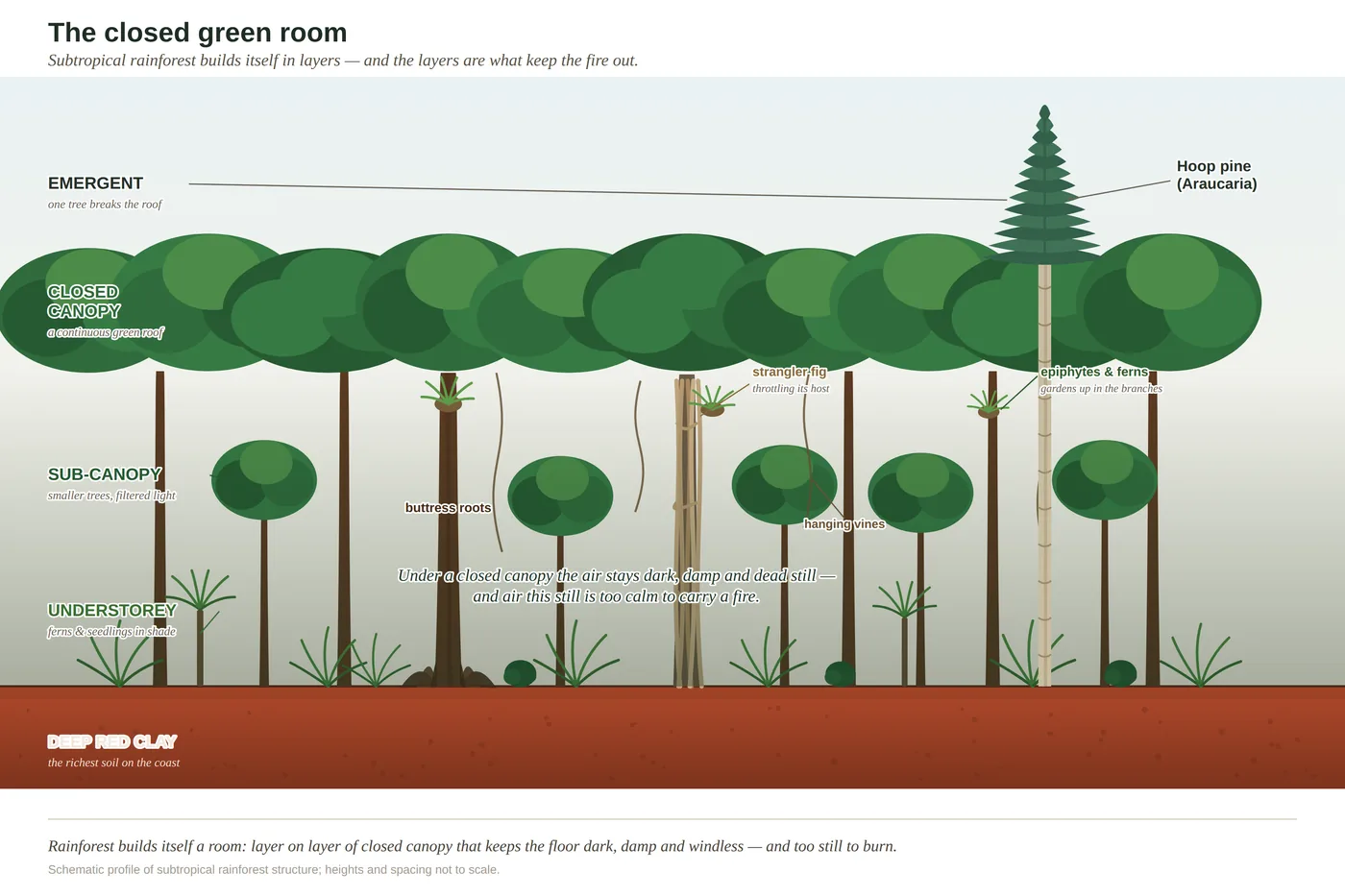
Why it went first. The wood was the prize: tall, straight, soft, richly coloured and easily worked, the "red gold" of the colonial cabinet trade (a qualitative superlative, widely repeated rather than measured, and kept as such). A tree that valuable was always going to be hunted. What turned the hunt into a clearance was the second fact — cedar does not grow in stands but scattered singly through the scrub, a large emergent here and another half a kilometre off through the closed forest (see rainforest-structure). So the cedar-getters could not simply work one rich patch; they had to range across the whole forest to find their trees, pushing in ahead of almost any other settlement, felling the giants with axe and cross-cut saw and floating the logs down the rivers on the floods. Within a few decades of that ranging they had cut out nearly every mature tree in the district. The very qualities that made the cedar precious — prized wood, thinly scattered — are exactly what emptied the forest of it.
What it does, and its absence now. Alone among the mostly animal-planted trees around it, the cedar scatters small winged seed that spins away on the wind and germinates fast in any sunny gap — a gap-coloniser inside a forest whose other giants wait in the shade for their turn. That habit is why a felled forest wasted no time growing back, though rarely back to cedar: the tree recruits in disturbed, sunlit ground, not in the closed forest that eventually reassembles over it. A large red cedar is a rare sight on this coast today, a century and more after the trade that hunted it moved on. It survives as scattered younger trees and in the plant lists of the remnants — at Mary Cairncross, for one, it is still on the record — a reminder of what the whole Blackall Range once carried.
The cedar is the opening act of the region's clearing history. The timber went first; then, because the rainforest grew on the richest basalt soil, the cleared ground was handed to dairy farms, and the big scrub of the range went from closed forest to a scatter of steep-gully remnants inside a single working life. A forest that could shrug off any fire had no answer at all to the axe.
Concepts this teaches — follow a thread
Sources for this guide — followable
- Leiper, G. et al. (2022). Mangroves to Mountains (3rd ed.). Native Plants Queensland. — Toona ciliata: a deciduous SE Qld rainforest tree with small winged, wind-dispersed seed and a fast gap-colonising habit, scattered (not gregarious) through the scrub; the 'red gold' cabinet timber logged out ahead of clearing.
Test yourself →
Big red cedars — once the most valuable timber tree in eastern Australia — are almost gone from the Sunshine Coast's rainforests today. Why?
Two things doomed the cedar, and they were the same two things that made it worth knowing. Its wood was the 'red gold' of the colonial cabinet trade — soft, straight, richly coloured, easily worked — so it was always going to be hunted. And because cedar grows not in stands but scattered singly through the closed forest, a big emergent here and another far off through the trees (rainforest-structure), the cedar-getters had to range across the whole forest to find their trees, pushing in ahead of almost all other settlement and floating the logs out on the rivers. Within a few decades nearly every mature tree was gone; then the rainforest itself, on the rich basalt, was cleared for dairy. It was not a disease, not fire (the cedar is a fast wind-seeding gap-coloniser, not a fire casualty), and not the sea. (Ch 13; Ch 17.)
Cited · traceable Last checked 2026-07. Deep-tier claims rest on, and were checked against, Leiper et al. 2022, Mangroves to Mountains (3rd ed.); Ch 13 (red cedar deciduous, wind-dispersed winged seed, gap-coloniser; on the Mary Cairncross plant list) and Ch 17 (cedar-getting ahead of settlement, scattered distribution, big-scrub clearing) — verified July 2026. 'Red gold' is a qualitative, widely-repeated superlative, held as such. — every source is listed below and followable. Grounded in Same Sky, Different Ground.