A force
Podzolisation — how sand goes bankrupt
The slow leaching that turns coastal sand into a bleached, bottomless podzol — the force that strips phosphorus below the roots and writes the poverty every wallum plant lives by.
- On the gradient
- Acts on the sand-coast band; the force that makes the wallum's ground
- Rock
- Quaternary coastal quartz sand
- Soil
- Podzol — bleached E horizon over illuvial coffee-rock B horizon
- Regional ecosystem
- 12.2.6
Soil is not crushed-up rock; it is rock taken to pieces, chemically rebuilt, and sorted into layers. On the coastal sand masses one particular kind of taking-to-pieces runs the whole show, and it has a name: podzolisation.
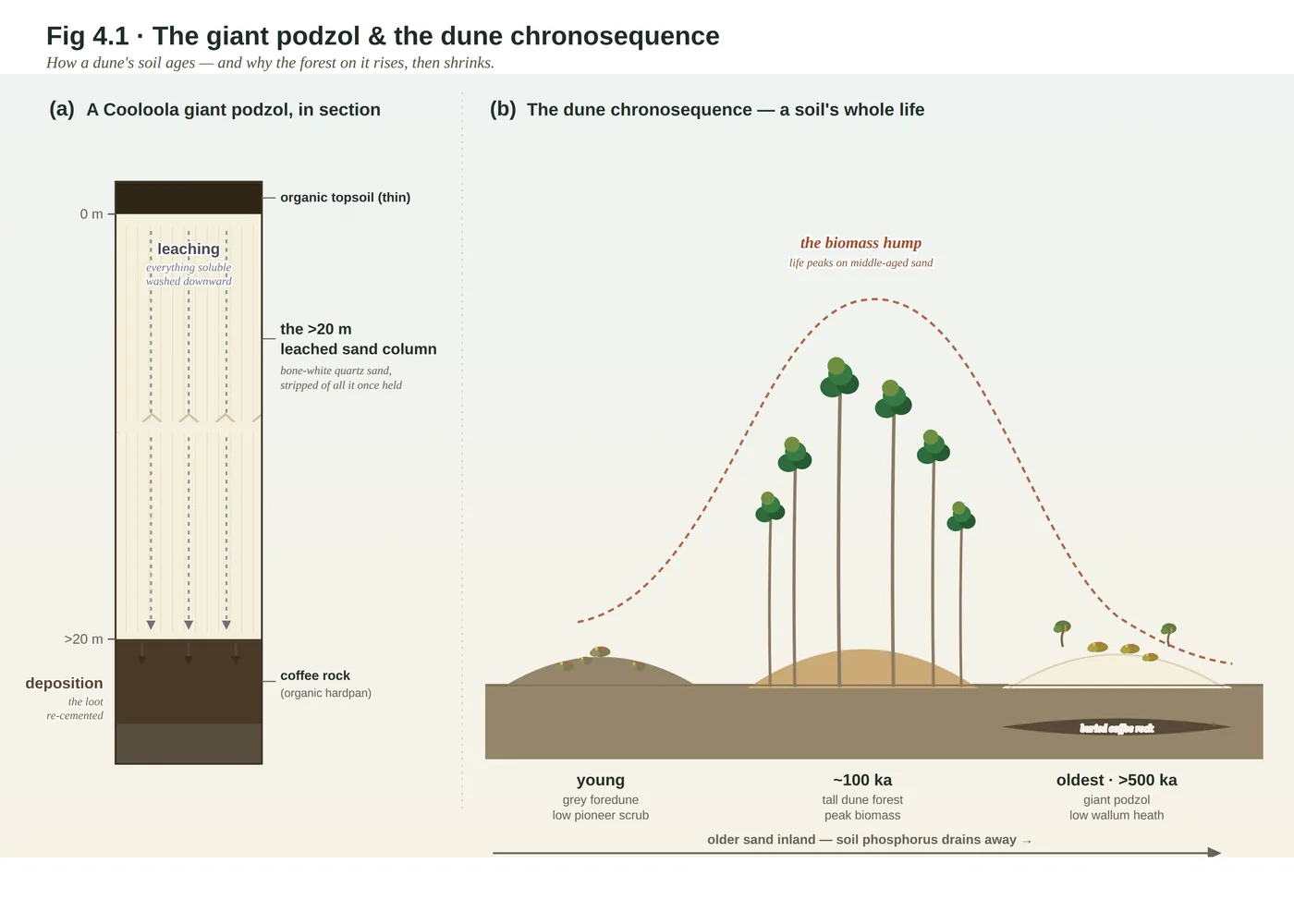
Here is what it does. Rain trickling down through the surface litter picks up organic acids, and those acids go to work like solvent on every grain of sand, stripping off the microscopic coatings of iron and aluminium — and with them the colour — and carrying the loot, along with dissolved organic matter, down into the depths. What is left near the surface is naked quartz, bleached to the bone. The stolen goods are dumped far below as a dark, rusty, sometimes rock-hard layer the locals call coffee rock. On the oldest Cooloola dunes the bleached column plunges more than twenty metres — a six-storey building’s worth of white sand, among the deepest soils of their kind anywhere on Earth.
But the theft that matters most is invisible. Along with the iron and the colour, the water carries off phosphorus — and phosphorus, unlike nitrogen, can never be replaced from the air. So the bleaching is only the surface of it. The real work is impoverishment: slow, permanent, dune by dune, until only a small fraction of the young sand’s modest stock is left. That is why bright white sand is a diagnosis, not a colour. Read it correctly and it tells you the ground is old, leached and profoundly poor — and, wonderfully, that the low heath standing on it is very likely the richest, most crowded garden for miles, because on ground this poor no single plant is ever allowed to win.
In depth — the mechanism
Podzolisation is the pedogenic force that converts free-draining quartz sand into a podzol — a profile with a bleached, eluvial E horizon over a dark, cemented, illuvial B horizon ("coffee rock"). Rainwater percolating through surface litter picks up dissolved organic acids that chelate and mobilise iron, aluminium and the mineral coatings on each grain, translocating them (with dissolved organic carbon) down the profile; naked bleached quartz is left above, the mobilised material re-precipitating below. Run long enough, on the oldest Cooloola dunes, this builds giant podzols exceeding 20 m of bleached sand — among the deepest of their kind on Earth (Thompson 1981, Nature 291:59–61).
The force matters because of what it carries away. Under the N–P asymmetry, nitrogen is renewable (biological fixation) but phosphorus comes only from rock and is never resupplied; podzolisation is the visible mechanism by which that phosphorus is leached below the rooting zone and progressively occluded (Walker & Syers 1976). Measured along the Cooloola chronosequence, total topsoil phosphorus falls roughly 90% from the youngest to the oldest dunes (Chen et al. 2015). This is why bleached white sand is a diagnosis: it reads directly to an old, leached, permanently poor soil — and hence (via poverty→diversity) to the low, species-rich heath that such poverty paradoxically supports.
How we know the ages: the dunes are dated by single-grain optically stimulated luminescence (OSL) — buried quartz accumulates a trapped-charge signal from ambient radiation that sunlight zeroes at deposition, so the luminescence measures time since burial (Rhodes 2011 for the method; Ellerton et al. 2020 for the ~700–800 ka Cooloola ages). The chronosequence is thus a dated natural experiment in soil ageing, not a guess.
Concepts this teaches — follow a thread
Podzolisation (how sand goes bankrupt)The nitrogen–phosphorus asymmetryWhy the poorest ground grows the richest flora
Sources for this guide — followable
- Thompson, C.H. (1981). Podzol chronosequences on coastal dunes of eastern Australia. Nature 291: 59–61. — Giant Cooloola podzols >20 m (Nature 291:59–61).
- Walker, T.W. & Syers, J.K. (1976). The fate of phosphorus during pedogenesis. Geoderma 15: 1–19. — Phosphorus-during-pedogenesis model; why leaching leaves permanent poverty.
- Chen, C.R. et al. (2015). Soil phosphorus fractionation and nutrient dynamics along the Cooloola coastal dune chronosequence, southern Queensland. Geoderma 257–258: 4–13. (The Cooloola P-decline study. Total P in the upper 30 cm falls from ~229–237 kg ha⁻¹ on the youngest dunes to ~24–28 kg ha⁻¹ on the oldest — a ~88–90% (roughly order-of-magnitude) decline. State the ~90% figure for total P, or qualitatively; the precise resin/available-P percentages are in the paywalled full text.) — ~90% decline in total topsoil phosphorus along the Cooloola chronosequence.
- Ellerton, D., Rittenour, T., Shulmeister, J. et al. (2020). An 800-kyr record of dune emplacement in relationship to high sea-level forcing, Cooloola Sand Mass. Geomorphology 354: 106999. (Oldest dunes ~700–800 ka, single-grain OSL.) — Oldest dunes ~700–800 ka, single-grain OSL dating.
- Rhodes (2011). Optically stimulated luminescence (OSL) dating of sediments (review). Annual Review of Earth and Planetary Sciences. (Cited in the Ch 4 "clock made of sand" OSL sidebar; complete author initials/volume/pages before publication.) — OSL dating of sediments — how the dune ages are measured.
Test yourself →
Nitrogen can be topped up from the air by microbes and plants; phosphorus can only ever come from weathering rock. On an ancient soil, hundreds of thousands of years old, which nutrient runs short for good — and what does that mean for the country it can grow?
This is the hinge the whole Cooloola story swings on. Nitrogen-fixing organisms bank nitrogen out of thin air; nothing can do that for phosphorus. Once the original rock's phosphorus has weathered out and washed to sea, there is no resupply — so the oldest soils only ever get poorer, and the tall forest they once carried gives way to low heath. Along the Cooloola dunes, total phosphorus in the topsoil falls by roughly 90% from the youngest to the oldest sand. (Ch 4.)
The wallum grows on some of the poorest soil in Australia, yet it is one of the most species-rich plant communities in the region. Why does such poor ground grow so many *kinds* of plant?
Poverty is a leveller. On rich ground a few fast, greedy growers monopolise the nutrients and shade everyone else out; on starved ground nobody can pull far enough ahead to dominate, so the field falls open to hundreds of specialists, each scratching a living a different way. The poverty is the cause of the richness. (Ch 4; Ch 9.) The strongest test of the strategy-diversity mechanism is Zemunik et al. 2015 (Jurien Bay, WA); the coast's classic chronosequence is Cooloola, and the wallum-diversity claim is kept at the regional level.
Cited · traceable Last checked 2026-07. Deep-tier claims rest on, and were checked against, Thompson 1981, Nature 291:59–61; Walker & Syers 1976, Geoderma 15:1–19; Chen et al. 2015, Geoderma 257–258:4–13; Ellerton et al. 2020, Geomorphology 354 — every source is listed below and followable. Grounded in Same Sky, Different Ground.