The season
Spring wildflowers in the wallum
For a few weeks each spring the wallum heath — the poorest sand on the coast — becomes its richest garden, banksias and peas and boronias and ground orchids all flowering at once. The show is a direct consequence of the poverty of the ground beneath it.
In spring the white-sand heath behind the beaches, which for most of the year looks like scrubby, starved country, breaks into flower all at once: yellow peas, golden wattles, pink boronias, banksia brushes, ground orchids, insect-eating sundews. It is the best few weeks of the botanical year on the coast, and the reason it happens on the poorest soil is the whole point — where the ground is that hungry, no fast grower can take over, so hundreds of small specialists share it out.
For most of the year the wallum keeps its riches to itself. Drive past the sand country in the depth of winter and you see low, grey, hard-leaved scrub on bleached white sand — honest, unspectacular, obviously poor. Then, as the spring days lengthen and warm ahead of the wet, the same starved ground does something that stops botanists in their tracks: it flowers, all of it, all at once.
Walk in during September or October and the heath is a crowd. The banksias hold up their fat nectar-brushes for the honeyeaters; the peas — eggs-and-bacon yellow-and-red, wedge-pea clear gold — smother whole thickets; the wattles haze over in pale gold; the boronias hang out small starry pink flowers you can smell before you find; and down at the level of your boots, if you kneel, the ground orchids and the glistening, insect-eating sundews are doing their own quiet business in the damp sand. Hundreds of species share a patch that looks too poor to feed a lawn. That is not a coincidence sitting on top of the poverty — it is the poverty. Where the ground is this hungry, no single fast grower can seize it and shade the rest into oblivion, so the field falls open to a great many specialists, each scratching a living a slightly different way, and spring is when they all cash it in at once.
Two things to carry outside with you. The show runs on weather, not the date, so a dry or cool spring flowers thin and a good one is worth dropping everything for; and fire moves the best ground around. Many heath plants flower hardest in the year or two after a burn, so the grandest wildflower patch this spring may be one that went up in smoke two winters ago. Ask where it last burnt, and you will often find the flowers. Come at the right few weeks, though, and you get to stand in the plainest proof the book has to offer that on this coast, poverty is the mother of abundance.
In depth — the mechanism
The spring flush is the poverty–diversity paradox made visible on a schedule. Through the year the wallum reads as low, hard-leaved, unspectacular scrub; for a few weeks as the days lengthen and warm ahead of the summer wet, it turns into one of the most species-crowded floral displays in Australia. The timing is ordinary spring phenology — lengthening, warming days cueing flowering before the wet — but the richness is the product of the ground.
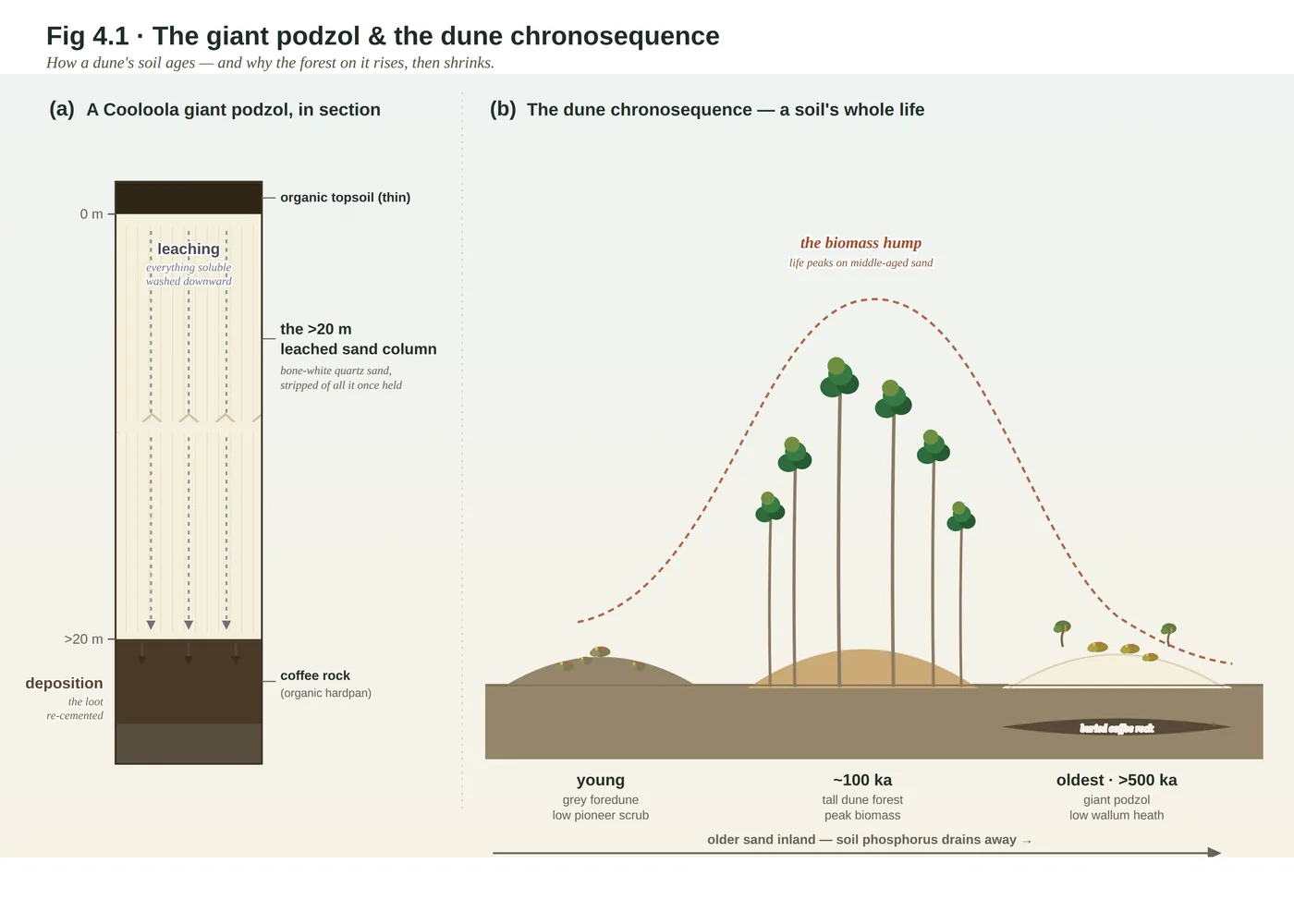
On leached, phosphorus-poor sand (see poverty–diversity), competitive exclusion relaxes: no plant can grow fast enough to overtop and shade out the rest, so the field stays open to a great many species, each making a living a slightly different way. The flowering guilds you see out at once in September and October are those different livings on show — the nectar-rich banksias and grevilleas (Proteaceae, mining phosphorus with cluster roots), the nitrogen- fixing peas and wattles turning whole patches gold, the boronias and wax flowers, the ground orchids, and the glistening sundews trapping insects for their nitrogen. The mechanism — that nutrient-acquisition-strategy diversity rises as phosphorus falls — is demonstrated at Jurien Bay in Western Australia (Zemunik et al. 2015); it is the principle behind the Sunshine Coast pattern, not a Cooloola measurement, and the regional claim is held at that level (the Cooloola giant podzols per Thompson 1981; the phosphorus arc per Walker & Syers 1976).
Two honest qualifiers. First, the display runs on weather: a dry or cool spring flowers thin, and flowering shifts a few weeks between years. Second, fire resets the clock for many species — a good number of heath plants flower most heavily in the year or two after a burn, so a recently burnt patch can out-flower an unburnt one, and the best wildflower ground moves around the country with the fire mosaic.
Concepts this teaches — follow a thread
Sources for this guide — followable
- Zemunik, G., Turner, B.L., Lambers, H. & Laliberté, E. (2015). Diversity of plant nutrient-acquisition strategies increases during long-term ecosystem development. Nature Plants 1: 15050. (Jurien Bay chronosequence, WA — the principle of rising strategy diversity; NOT a Cooloola study. Earlier draft mis-cited as "Laliberté et al., Cooloola".) — Nutrient-acquisition-strategy diversity rises as phosphorus declines — the mechanism behind the flora's richness (Jurien Bay, WA — the principle, not a Cooloola result).
- Walker, T.W. & Syers, J.K. (1976). The fate of phosphorus during pedogenesis. Geoderma 15: 1–19. — The phosphorus arc that makes the sand permanently poor — the precondition for the paradox.
- Thompson, C.H. (1981). Podzol chronosequences on coastal dunes of eastern Australia. Nature 291: 59–61. — The Cooloola giant leached podzols the wallum flowers on.
Cited · traceable Last checked 2026-07. Deep-tier claims rest on, and were checked against, Zemunik et al. 2015, Nature Plants 1:15050 (Jurien Bay, WA — principle); regional-level framing per Ch 9 Notes; flowering guilds per in-flower.html spring record and Ch 9 — every source is listed below and followable. Grounded in Same Sky, Different Ground.