A species
The acid frogs of the wallum
A small club of frogs — the wallum froglet, the wallum and Cooloola sedgefrogs, the wallum rocketfrog — that breed in tea-coloured water too sour for almost anything else, and gain a partial refuge for doing it: the acid limits their enemies, but never quite locks them out.
- On the gradient
- Sand coast — the wet swales, swamps and tea-coloured streams of the wallum
- Rock
- Quaternary coastal sand (dune sand mass)
- Soil
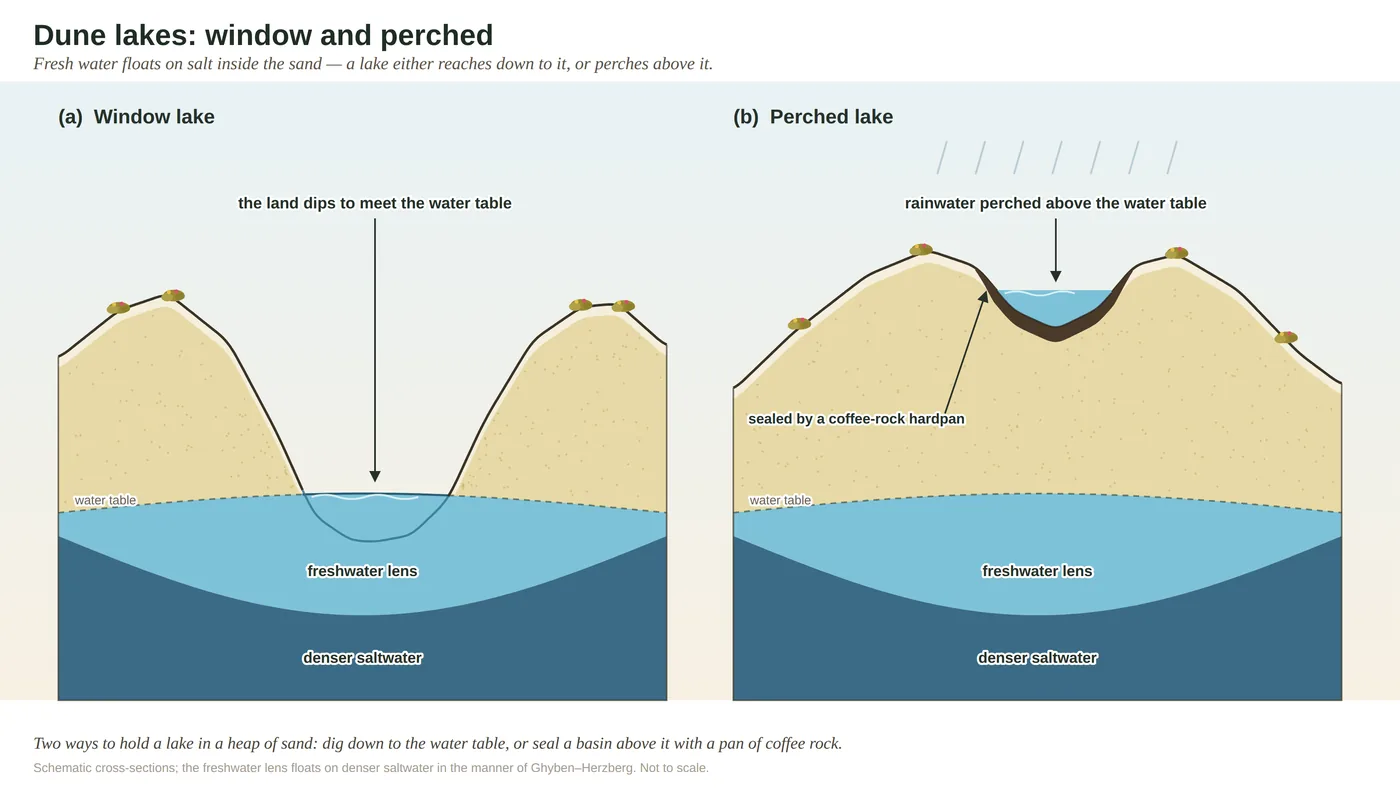
- Leached podzol; acid blackwater in the wet swales and perched swamps
- Regional ecosystem
- 12.2.6
The dark, acidic water of the wallum swamps is close to vinegar, and for most freshwater animals it is simply lethal. A handful of frogs have evolved to breed in it anyway — and that is exactly the point. The sourness that would poison other things keeps most of their predators, competitors and the introduced mosquitofish out, so the frogs get a refuge their enemies struggle to enter. It is only a partial refuge, though: the fish are held back, not shut out entirely, and if the water is sweetened or drained the wall comes down.
Follow a wallum track down into one of the damp swales between the sand ridges and the sand between the sedges glistens with standing water the colour of strong, cold tea. This is acid blackwater, often somewhere around pH 3.5 to 4.5 — closer to vinegar than to a garden pond — and it is where the wallum’s strangest animals make their impossible living. For most freshwater creatures water this sour is simply a death trap; the acid strips the salts out of their bodies and burns delicate tissue. And yet a small, specialised club of frogs lives here, and in some cases only here: the wallum froglet, the wallum and Cooloola sedgefrogs, and the wallum rocketfrog.
Rather than avoiding the poisonous water, they have evolved the plumbing to breed in it, holding onto vital salts where other species would lose them. It is a precise, hard-won adaptation, and it raises the obvious question: why evolve to live somewhere so hostile in the first place? The answer is the deep logic of the wallum, applied to an animal. The acid water is hostile to almost everything, including — crucially — the predators, competitors and introduced fish that would otherwise eat the frogs out of existence. The mosquitofish that have invaded so much of Australia’s fresh water, and that clean out native tadpoles elsewhere, struggle in the sourest wallum waters and are mostly shut out of them. So the water that looks like a death trap is, for the frogs, something close to a refuge: a wall they hide behind rather than a hardship they suffer, exactly as the wallum plants use poverty to escape competition.
It is worth being precise about that wall, though, because the temptation is to call it a fortress and it is not one. The acid limits the mosquitofish; it does not absolutely exclude them. They are held back, not locked out, which is why the people working to save these frogs still go to the trouble of physically excluding the fish rather than trusting the sourness to do it for them. The refuge is real, and it is partial, and — this is the sting — it is fragile in a way a fortress would not be. The frogs cannot fall back on sweeter water, because sweeter water is precisely what kills them. So anything that sweetens or pollutes the blackwater, whether run-off from a new housing estate or a drain that lets ordinary water in, lowers the one door in the wall and lets the fish march through; anything that drops the hidden water table dries the breeding sites out altogether.
Which is why you cannot protect the acid frogs by managing the frogs. Read against what it depends on, each one is staked on a single thing it can neither replace nor carry with it: the strange, sour, nutrient-starved water, and the leached sand and hidden water table that keep it that way. Protect those, and the frogs look after themselves. Fail them, and the sourest water on the coast — the last thing you would expect to have to defend — turns out to be the one thing standing between these frogs and the fish.
In depth — the mechanism
The acid frogs make the oddest bargain on the coast: they depend not on a food or a tree but on a chemistry. The water that gathers in the wallum's swamps, perched lakes and tea-coloured streams — and in the paperbark swamps that share the same sand-country water — is blackwater, stained brown by tannins and driven down to somewhere around pH 3.5–4.5 because the leached sand holds nothing to buffer it (see blackwater-acidity). For most freshwater animals that is lethal: the acid strips salts out of the body and burns delicate tissue. Yet the wallum froglet, the wallum and Cooloola sedgefrogs and the wallum rocketfrog breed here, and some of them almost nowhere else. Detailed work on the Cooloola sedgefrog shows how finely tuned the tolerance is — its larvae hold their salt balance down to about pH 3.5 (Meyer et al. 2020) — and surveys have mapped the narrow, species-specific pH windows within which each frog can and cannot breed (Shuker & Hines 2016).
Why evolve to live somewhere so hostile? Because the hostility is the whole point. The acid water is hostile to almost everything, including the predators and competitors that would otherwise eat the eggs and tadpoles or crowd them out — most tellingly the introduced mosquitofish (Gambusia holbrooki), which devastates native frogs across much of Australia. Low pH stresses and mostly shuts the mosquitofish out of the sourest wallum waters, so the frogs win a refuge their enemies struggle to enter (Filer et al. 2021 on the acoustic side of that low-competition world).
But it is a partial refuge, not a fortress — and the distinction matters. The acid limits Gambusia; it does not absolutely exclude it. Mosquitofish are held back, not locked out, which is precisely why the wallum-frog recovery plan still calls for active mosquitofish exclusion rather than trusting the chemistry to do the whole job. So the sour water is a wall the frogs hide behind rather than a hardship they suffer — but a real wall with a low door in it, and a fragile one. It also depends on things the frogs cannot see: the groundwater table that keeps the breeding sites wet through the dry, and the leached, buffer-free sand that keeps the water sour in the first place. Read the frog against what it needs and the vulnerability is obvious. It cannot retreat to sweeter water, because sweeter water is what kills it. Anything that sweetens or pollutes the blackwater — run-off from a new estate, fertiliser, a drain that lets ordinary water in — lowers the door in the wall and lets the fish through; anything that drops the water table dries the nursery out. To keep these frogs you do not manage the frogs at all. You protect the strange, sour, hungry system that brews the water, which means protecting the wallum whole.
Concepts this teaches — follow a thread
Species dependence (a life is a bundle of needs)Blackwater and acid water (the colour of tea)
Sources for this guide — followable
- Meyer, E.A., Franklin, C.E. & Cramp, R.L. (2020). Acid tolerance in Litoria cooloolensis larvae. J. Comp. Physiol. B 190: 691–706. [PubMed] (Larvae hold salt balance to ~pH 3.5.) — Acid tolerance of Litoria cooloolensis (Cooloola sedgefrog) larvae — salt balance held to ~pH 3.5.
- Shuker, J. & Hines, H. (2016). Wallum frog pH envelopes / breeding-habitat acidity. Ecosphere. — Species-specific pH breeding windows / breeding-habitat acidity for the wallum frogs.
- Filer, A. et al. (2021). Acoustic competition, wallum sedgefrog. Ecology and Evolution. [PubMed] — Acoustic competition in the wallum sedgefrog — the low-competition acid-water community.
Test yourself →
The wallum's acid frogs breed in tea-coloured water sour enough (around pH 3.5–4.5) to kill most freshwater life. How does breeding in such hostile water actually help them?
The hostility is the point. Low pH stresses and mostly shuts out the predators, competitors and — crucially — the introduced mosquitofish (Gambusia holbrooki) that clean out native tadpoles elsewhere, so the frogs, which have evolved to hold their salt balance down to about pH 3.5 (Meyer et al. 2020; species-specific pH windows in Shuker & Hines 2016), win a refuge behind a chemical wall. But the wall is partial, not absolute — the tempting wrong answer. Gambusia is limited by the acid, not locked out, which is why the wallum-frog recovery plan still calls for active mosquitofish exclusion. That partial-refuge framing is the honest one: the water is neither rich in food nor merely 'comfortable', and it is not a fortress. Because the frogs cannot fall back on sweeter water, anything that sweetens, pollutes or drains the blackwater lets the fish through. (Ch 9; Ch 16.)
Cited · traceable Last checked 2026-07. Deep-tier claims rest on, and were checked against, Meyer et al. 2020, J Comp Physiol B 190:691–706; Shuker & Hines 2016, Ecosphere; Filer et al. 2021; Gambusia partial-refuge framing (limited not excluded; recovery plan still calls for active exclusion) per Ch 9 & Ch 16 Notes, verified July 2026 — every source is listed below and followable. Grounded in Same Sky, Different Ground.