The season
Winter whales and cold-season blossom
Through the cool, dry winter the humpback highway runs close past the coast's headlands as the whales stream north to breed; grey nurse sharks hold at Wolf Rock offshore; and on land the ironbarks, swamp mahogany and coast banksia carry the cold-season nectar that feeds the birds through the leanest months.
Winter here is the dry, clear, comfortable end of the year — and the busy one offshore. From about June the humpback whales pass close by the headlands on their way north to breed in the tropics, near enough to watch from a clifftop lookout. On land, while most of the country waits out the cold, the ironbarks, the swamp mahogany and the coast banksia flower, laying on nectar for the honeyeaters and lorikeets at the hungriest time of the year.
Winter on the Sunshine Coast is the season the calendar least prepares you for. It is dry, it is often cloudless, the walking is at its best and safest, and the country on land seems to be holding its breath — and yet it is the season with the most going on out at sea. From about June, if you stand on one of the headlands and give it ten patient minutes, you will see them: the blows first, then the black backs and the great flukes, as humpback whales stream north up the coast toward their tropical breeding grounds. Off Point Cartwright and the Noosa headlands the northward run is close and reliable, one of the surest wildlife spectacles the coast offers, and it needs nothing but a clifftop and a pair of binoculars.
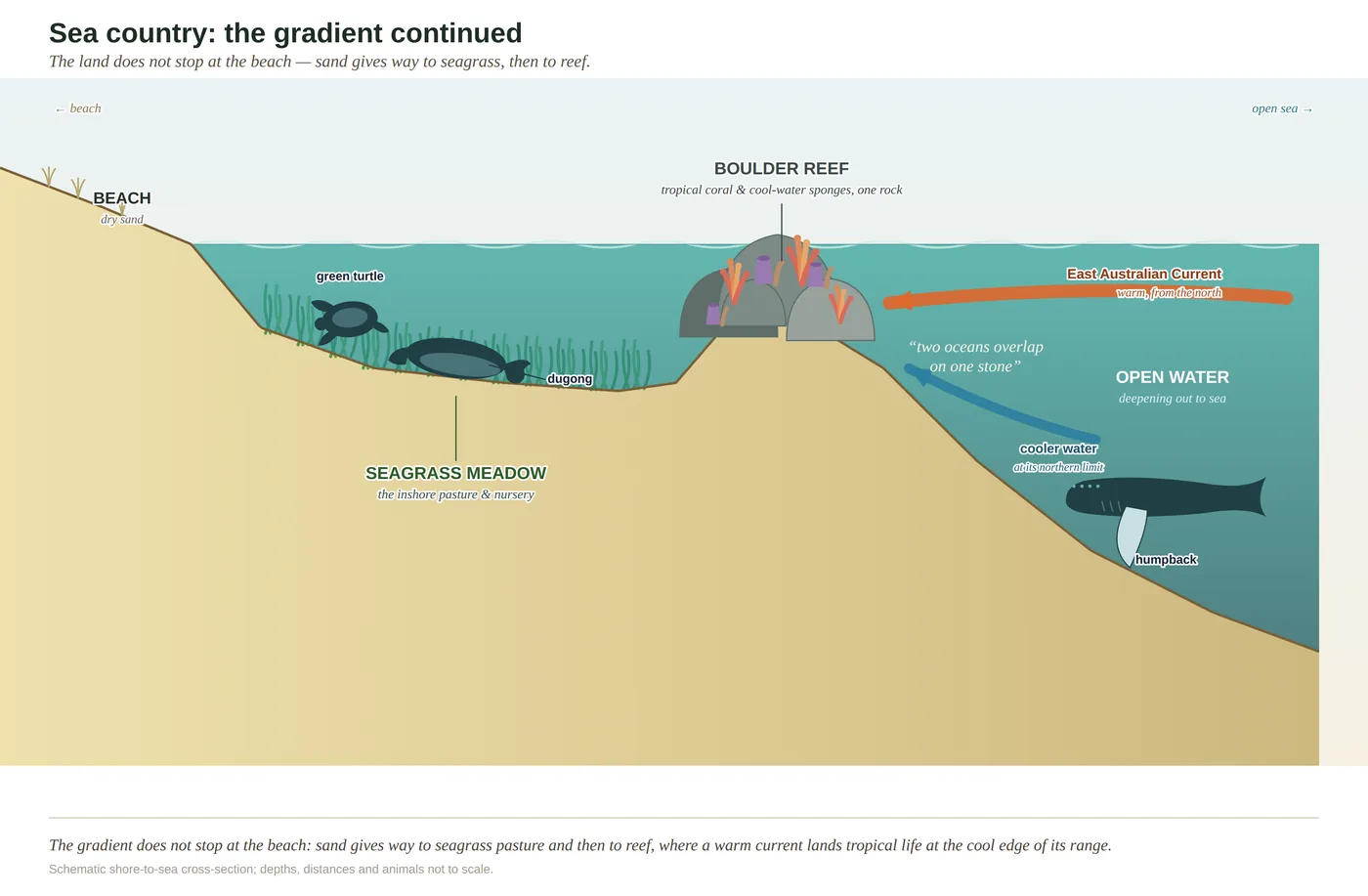
It is worth knowing what you are watching. This eastern-Australian population was very nearly wiped out — hunted down to a few hundred animals by mid-century, the whaling station at Tangalooma on Moreton Island taking thousands before it closed in 1962 — and the crowded highway you now see passing the headlands each winter is the long recovery from that, a population climbed back to tens of thousands. The whales come north to breed through winter and drift south again with their calves through spring, so the reliable close-in show swings from northbound in the cold months to southbound, calves in tow, as the year warms. Further out, off Double Island Point, the grey nurse sharks that gather year-round at Wolf Rock hold through the season too — a reminder that the winter sea is anything but empty.
On land, meanwhile, a quieter winter event keeps the birds alive. Just when you would expect nothing to be flowering, a run of trees comes into blossom against the cold: the ironbarks and spotted gum on the dry ridges, the swamp mahogany around the wetland margins, the coast banksia on the back dunes and headlands. This out-of-season nectar is a genuine lifeline — honeyeaters, lorikeets, gliders and flying-foxes crowd it through the leanest weeks of the year — and it is why a cold, still winter forest can suddenly be loud with birds high in a flowering crown. Look up when you hear the racket, and you will usually find a tree in flower doing the coast a great service in the cold.
Sources for this guide — followable
- Tangalooma whaling station, Moreton Island, 1952–1962 (6,277 humpbacks taken — verified); east-Australian humpback population driven to a few hundred, protected from 1963, since recovered to ~40,000 and now at/above pre-whaling levels (DCCEEW eastern-Australia humpback assessment). — Eastern-Australian humpbacks were hunted to a few hundred (Tangalooma, Moreton Island, closed 1962) and have since recovered — the migration you now watch is that recovery.
Cited · traceable Last checked 2026-07. Deep-tier claims rest on, and were checked against, Ch 19 seasonal calendar (humpback north in winter); this-month.html Jun/Jul/Aug entries (Point Cartwright, Wolf Rock grey nurse, cool-season blossom); DCCEEW eastern-Australia humpback assessment / Tangalooma whaling record — every source is listed below and followable. Grounded in Same Sky, Different Ground.