A place
Cooloola (Great Sandy National Park)
A field of dunes that get older the further inland you walk — a soil's whole life laid out in a row, and the reason the poorest sand grows the richest garden.
- On the gradient
- Sand coast — wallum dune through paperbark swamp to estuary
- Rock
- Quaternary coastal sand (dune sand mass)
- Soil
- Giant podzol (bleached quartz over coffee rock), >20 m on the oldest dunes
- Regional ecosystem
- 12.2.6
- Bright, bleached, bottomless white sand
- Low, hard-leaved heath not much higher than your head
- A spring riot of wildflowers and nectar-feeding honeyeaters
- Still water the colour of cold, strong tea in the hollows
This is some of the oldest, poorest sand in Australia — and that is exactly why, come spring, it grows more kinds of wildflower than the rainforest up on the range behind it.
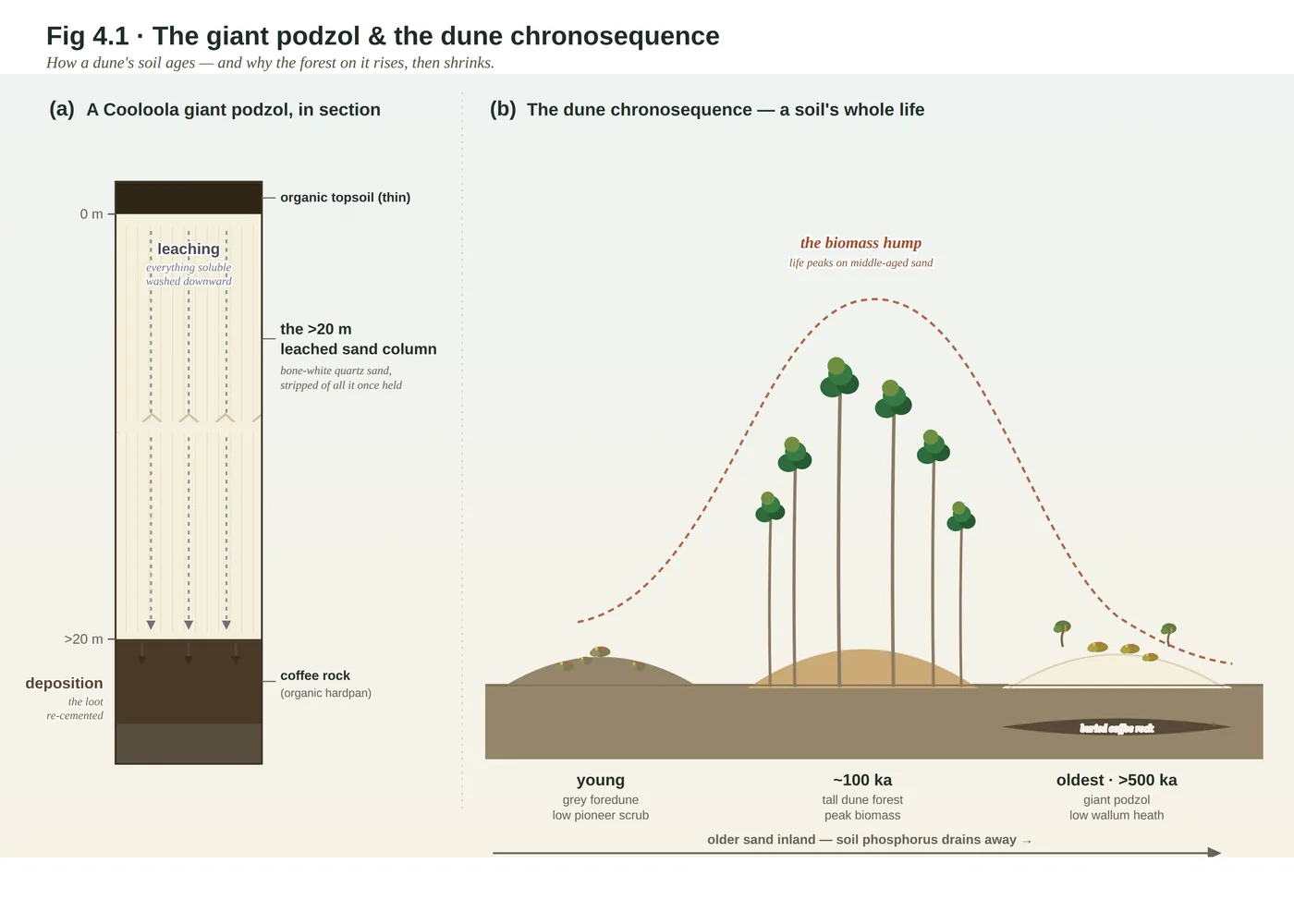
Just north of Noosa, the coast has been quietly building itself out of sand for an extraordinarily long time. Wind and sea threw up dune after dune — and, this is the magical part, they did it in order, like tree-rings laid out flat: the youngest dunes nearest today’s beach, progressively older ones marching inland, the oldest set right back perhaps seven or eight hundred thousand years. Everything else about them barely changes. Same quartz sand, same rainfall, same mild coastal air. The only thing that varies as you walk inland is time.
So walk from the beach toward the hinterland and you walk forward through several hundred thousand years of soil development, reading the entire life story of a soil in a single afternoon’s stroll. On the young grey sand near the beach, low pioneers and quick colonisers; a little further, on the middle-aged dunes, the tallest, densest forest of the whole sequence, high eucalypts on bottomless sand. Then, further back still, watch the forest begin, almost imperceptibly, to come down — the giants thinning and shortening as the last reachable phosphorus leaches away. And at the far end, on the oldest dunes of all, whose bleached podzols plunge more than twenty metres, the forest has given out altogether. What stands there is not forest but low, wiry, hard-leaved heath — the wallum.
It looks, at a glance, like the poorest and most defeated country on the entire walk. It is very nearly the richest. In one stroll you have watched a soil, and the forest riding on it, born, grow up, grow rich, grow old, and run down at last to a low, brilliant, threadbare heath that in spring out-flowers the rainforest on the range. That is the wonder of Cooloola, and it is why scientists keep arriving from the other side of the world to read it like a manuscript.
A practical word, in the book’s own spirit: much of Cooloola is reached only by four-wheel-drive on sand tracks that strand the unwary on a rising tide, and there is no mobile signal across much of it. Check conditions and closures with QPWS, and check the ground in front of you — the country rewards the reading, but it does not forgive the careless.
In depth — the mechanism
Cooloola is a retrogressive dune chronosequence: wind and sea stacked the dunes in age order, youngest near today's beach and oldest set back perhaps 700,000–800,000 years (single-grain OSL dating, Ellerton et al. 2020). Because climate, rainfall and the quartz sand itself barely change across the sequence, the one variable is time — a natural experiment of a kind that has no business existing anywhere on Earth. As podzolisation leaches phosphorus below the rooting zone over hundreds of millennia (the Walker–Syers 1976 model of phosphorus during pedogenesis), the system passes its productivity peak and P becomes the hard limit: total topsoil phosphorus falls roughly 90% from the youngest to the oldest dunes (Chen et al. 2015). On the oldest sand the giant podzols exceed 20 m of bleached quartz — among the deepest of their kind on Earth (Thompson 1981, Nature). Vegetation mass peaks on the middle-aged dunes (tall eucalypt forest) and declines through retrogression to low wallum heath on the oldest, most P-depleted sand, while species variety climbs to its maximum there.
Two honest caveats carried from the book. (1) The species-richness peak on the oldest soils is the general chronosequence pattern, strongest-evidenced at Jurien Bay, WA (Zemunik et al. 2015) — Cooloola is the classic chronosequence and the wallum-diversity claim is kept at the regional level, not asserted as a Cooloola-specific richness measurement. (2) Cooloola's acid, tea-coloured waters shelter specialist frogs (e.g. Litoria cooloolensis, whose larvae hold salt balance down to ~pH 3.5 — Meyer et al. 2020) because low pH stresses and mostly shuts out their enemies, including introduced Gambusia. That is a partial refuge, not a fortress: mosquitofish are limited, not absolutely excluded, and the wallum-frog recovery plan still calls for active exclusion.
Concepts this teaches — follow a thread
Podzolisation (how sand goes bankrupt)Why the poorest ground grows the richest floraThe nitrogen–phosphorus asymmetrySerotiny (banking seed for fire)
Sources for this guide — followable
- Thompson, C.H. (1981). Podzol chronosequences on coastal dunes of eastern Australia. Nature 291: 59–61. — Giant Cooloola podzols >20 m (Nature 291:59–61).
- Ellerton, D., Rittenour, T., Shulmeister, J. et al. (2020). An 800-kyr record of dune emplacement in relationship to high sea-level forcing, Cooloola Sand Mass. Geomorphology 354: 106999. (Oldest dunes ~700–800 ka, single-grain OSL.) — Oldest dunes ~700–800 ka, single-grain OSL dating.
- Chen, C.R. et al. (2015). Soil phosphorus fractionation and nutrient dynamics along the Cooloola coastal dune chronosequence, southern Queensland. Geoderma 257–258: 4–13. (The Cooloola P-decline study. Total P in the upper 30 cm falls from ~229–237 kg ha⁻¹ on the youngest dunes to ~24–28 kg ha⁻¹ on the oldest — a ~88–90% (roughly order-of-magnitude) decline. State the ~90% figure for total P, or qualitatively; the precise resin/available-P percentages are in the paywalled full text.) — ~90% decline in total topsoil phosphorus along the chronosequence.
- Walker, T.W. & Syers, J.K. (1976). The fate of phosphorus during pedogenesis. Geoderma 15: 1–19. — The phosphorus-during-pedogenesis model behind the retrogression.
- Zemunik, G., Turner, B.L., Lambers, H. & Laliberté, E. (2015). Diversity of plant nutrient-acquisition strategies increases during long-term ecosystem development. Nature Plants 1: 15050. (Jurien Bay chronosequence, WA — the principle of rising strategy diversity; NOT a Cooloola study. Earlier draft mis-cited as "Laliberté et al., Cooloola".) — Strategy/species-diversity mechanism (Jurien Bay, WA — the principle, not Cooloola).
- Meyer, E.A., Franklin, C.E. & Cramp, R.L. (2020). Acid tolerance in Litoria cooloolensis larvae. J. Comp. Physiol. B 190: 691–706. [PubMed] (Larvae hold salt balance to ~pH 3.5.) — Acid tolerance of Litoria cooloolensis larvae (~pH 3.5); the partial-refuge basis.
Test yourself →
You're standing on bright, bleached, bottomless white sand behind the beach. The scrub is low and hard-leaved and, in spring, loud with wildflowers and honeyeaters. What country are you reading — and why is the ground so poor?
Cues: Bright, bleached, bottomless white sand · Low, hard-leaved heath not much higher than your head · A spring riot of wildflowers and nectar-feeding honeyeaters · Still water the colour of cold, strong tea in the hollows
White sand is not clean — it is robbed. Rain and organic acids have stripped the iron and nutrients out of the surface grains over tens of thousands of years (podzolisation), leaving bleached quartz over a buried coffee-rock layer. That poverty is the signature of the wallum, and it is the very reason the heath is so species-rich: on ground this poor no single plant can dominate, so hundreds of specialists crowd in. (Ch 4; Ch 9.)
You walk inland across the Cooloola dunes. The dunes get demonstrably older the further back you go; near the beach the sand carries tall eucalypt forest. On the oldest dunes, far inland, what do you predict is growing — and why is it not even taller forest?
Cues: Dunes that get demonstrably older the further inland you walk · Tall eucalypt forest standing on the middle-aged sand · Giant bleached podzols on the oldest dunes, plunging metres deep · The same sand, same rain, same air the whole way — only time changes
This is the gradient rule at the scale of one dune field: substrate, not rainfall, decides. Phosphorus comes only from rock and is never replaced, so on the oldest dunes it has all but leached away and no tall tree can be built. The mass of the vegetation peaks on the middle-aged dunes and falls to low heath on the oldest — while the variety of plants climbs to its maximum there. Same rule, smaller scale. (Ch 4; Ch 7.) Note: the species-richness peak on the oldest soils is the general chronosequence pattern, best-evidenced at Jurien Bay, WA (Zemunik et al. 2015), not a Cooloola-specific measurement.
The wallum banksia holds many of its woody seed-cones clamped shut on the branch for years, releasing the seed only after a fire has swept through. What is this strategy called, and what advantage does it give?
Many wallum banksias and peas bank their seed and hold it against fire (serotiny). The heat cracks the follicles open and the seed falls onto ground swept clear of competitors and briefly enriched by ash — so the plant recruits its next generation into exactly the window fire opens. It is why the spring flower spectacle is often at its most extravagant in the season or two after a burn. (Ch 6; Ch 9.)
Cited · traceable Last checked 2026-07. Deep-tier claims rest on, and were checked against, Thompson 1981, Nature 291:59–61; Ellerton et al. 2020, Geomorphology 354; Chen et al. 2015, Geoderma 257–258; Zemunik et al. 2015, Nature Plants 1:15050 — every source is listed below and followable. Grounded in Same Sky, Different Ground.