A force
Fire — the force that draws the boundaries
Not a disaster the bush survives but a force it is partly made of: fire holds the line between rainforest and sclerophyll, cues seed and flower, and stitches the country into a mosaic — with no single 'right' fire, because each world along the gradient wants a different flame.
- On the gradient
- Runs across the whole gradient — its sharpest line is the rainforest/sclerophyll boundary; its hungriest customer is the wallum
- Rock
- Basalt uplands meeting the softer foothill rock — where the rainforest–sclerophyll boundary is drawn
- Soil
- Deep red basalt clay under the rainforest edge grading to thinner, drier foothill soils under the eucalypts
- Blackened trunks in fibrous, stringy bark
- Grass-trees throwing up tall flower spikes
- An even-aged shrubby regrowth, as if it all started at once
- A sharp edge where dense green rainforest stops against the scrub
Across most of the coast, fire is not the enemy of the bush but part of how it lives. It keeps the rainforest penned in the wet gullies, opens the wildflower heath, and cracks woody seed-cases so new plants can start. There is no one 'right' fire, though — the flame that suits the heath is the wrong flame for the rainforest edge.
The instinct is to file fire under disaster — an accident that befalls the bush now and then and that the bush survives in spite of itself. Across most of the Sunshine Coast that instinct is almost exactly wrong. Fire is one of the things the vegetation is made of, as much a part of how these plants live as rain or sunlight, and a great deal of what grows here would simply vanish without it. The eucalypt is not fire’s victim; with its oily leaves, its heaps of slow-rotting litter and its wicking bark, it is closer to an arsonist, making itself flammable on purpose because fire clears away its softer competitors and leaves it holding the ground.
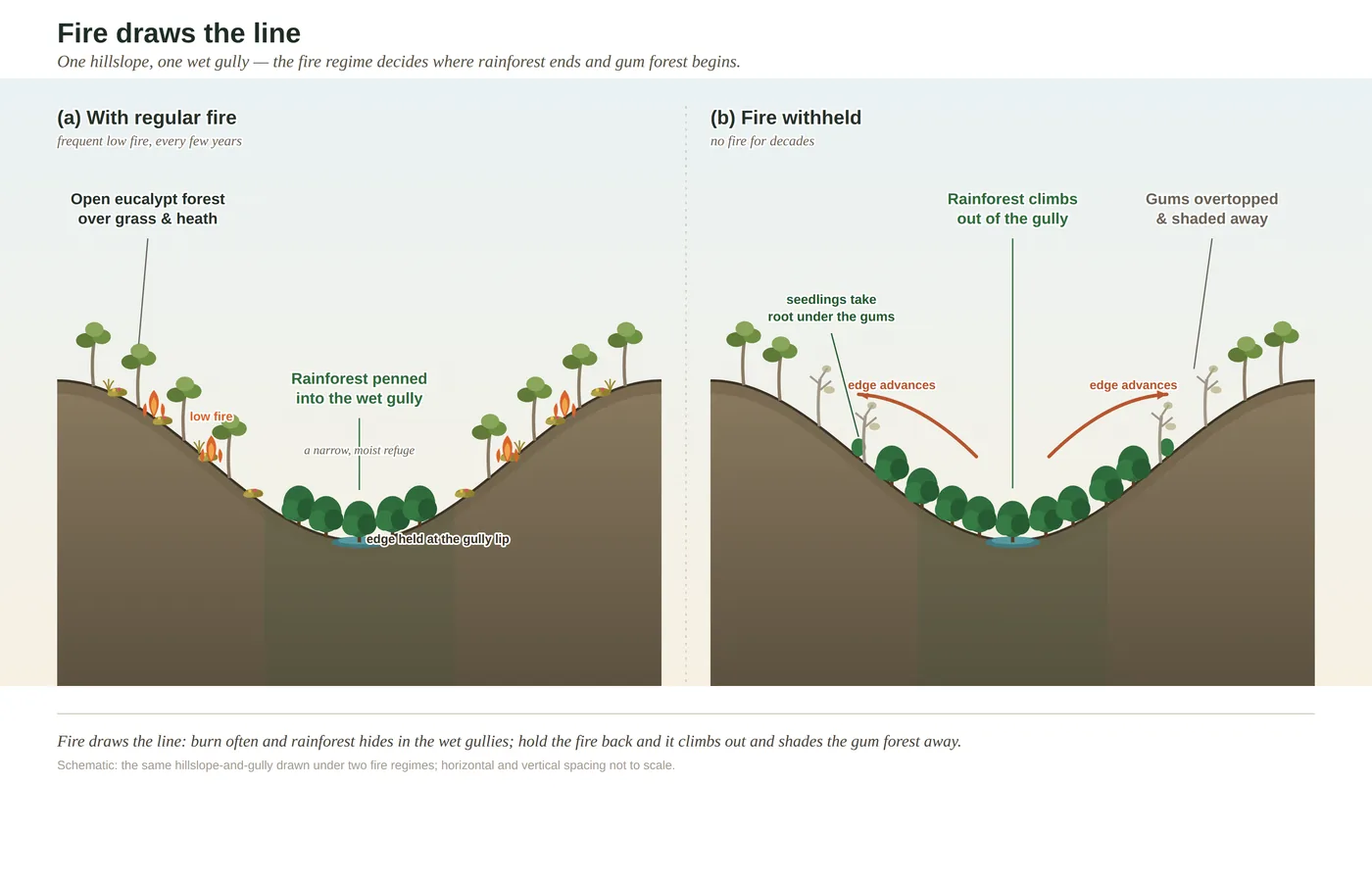
Fire’s deepest work, though, is drawing a line. The rainforest and the eucalypt forest want opposite things: one promotes fire and thrives on it, the other defends itself by staying too wet to burn, keeping its floor dark and damp so a fire approaching from the dry forest outside runs out of fuel at the green wall. So the boundary between them, which looks fixed on a map, is nothing of the sort. Burn often and the rainforest stays penned in the gullies; withdraw the fire for long enough and it creeps out, shades the grass away, and quietly smothers the eucalypts in the gloom of their own usurped forest. The rainforest never has to defeat the gums. It only needs the fires to stop, and time.
And there is no single right amount of fire, because the coast is not one place. The rainforest wants none; the wet forests want the occasional burn; the dry foothill woodlands want a light fire every few years; and the wallum heath, hungriest of all, positively depends on it — many of its banksias and peas lock their seed in hard woody fruit and hand it over only to a fire’s heat, dropping it onto a cleared, ash-fertilised bed with the competition burnt away. Leave that heath unburnt too long and it stops being a wildflower garden; it grows leggy and tired and the diversity drains out of it. Match the fire to the ground and you keep every world along the gradient; get it wrong in either direction and you lose one.
What that means for reading the country is that the question is never simply was there fire but what fire, and how often. A patch of straight gums over open grass has been lightly and recently burnt; a wall of green rainforest in a gully is fire’s refuge; a heath blazing with spring flowers is answering a burn with everything it has. But where woody scrub is closing over what was open woodland, or rainforest pioneers are stealing into the eucalypts, you are looking at country that has gone too long without the flame it was built around — a very old conversation, lapsed.
In depth — the mechanism
Fire is the force that draws lines the map pretends are fixed. Its deepest work on the Sunshine Coast is the border between rainforest and sclerophyll — the fire boundary. Sclerophyll eucalypt forest promotes fire (oily leaves, slow- rotting litter, fibrous bark that wicks flame into the crown) and profits from it; rainforest defends itself by denying fire a start, keeping its interior dark, damp and slow to ignite so an approaching fire falters at the green wall. Where fire comes often, the eucalypts and heath hold the ground and rainforest is penned into gullies too wet to burn; withdraw fire for long enough and rainforest pioneers creep out, shade the grassy understorey, and the eucalypts — unable to regenerate in the gloom — are quietly shaded out. The boundary is a truce, renegotiated in the only language both forests understand.
There is no single correct regime, because the coast is the gradient and each band wants a different flame: rainforest none, wet eucalypt forest the occasional burn, dry woodland a light fire every few years, and the wallum heath the most fire-hungry of all — many of its banksias and peas are serotinous or fire- germinated, holding seed in hard woody fruit until a fire's heat cracks it onto a cleared, ash-fertilised bed, its competitors burnt away and its moment chosen for it (grass-trees often throw their tallest flower spike the season after a burn). The result, tended for tens of thousands of years by Aboriginal burning (Bowman 1998; Gammage 2011, from the published record only), is a fine-grained mosaic of recently burnt and longer-unburnt ground.
What a given fire actually does turns on the fire-behaviour triangle — fuel, weather and slope — which is why a cool burn and a catastrophic one are the same fire in name only: skip the small fires and you do not avoid fire, you store it. The long-term Peachester burning experiment (Dooley et al. 2023) confirms in hard local data what the gradient implies — fire frequency is a master switch on understorey diversity (at a topsoil-carbon cost), and no single setting suits everything. So the reader's cue is not "was there fire?" but "what fire, how often?": woody scrub closing over open woodland, or rainforest stealing into the gums, both say an old conversation has lapsed.
Concepts this teaches — follow a thread
The fire mosaic (no single right fire)The fire boundary (how flame draws the line)Serotiny (banking seed for fire)
Sources for this guide — followable
- Dooley, M., Lewis, T. & Schmidt, S. (2023). Fire frequency has a contrasting effect on vegetation and topsoil in subcoastal heathland, woodland and forest ecosystems, south-east Queensland. Austral Ecology 48(8). (Long-term Peachester burning experiment; regular fire maintains understorey diversity, with a topsoil-carbon cost. First author Madeline Dooley — initial confirmed "M." against the paper, July 2026.) — Peachester long-term burning experiment — fire frequency as a master switch on heath/woodland diversity.
- Bowman, D.M.J.S. (1998). The impact of Aboriginal landscape burning on the Australian biota. New Phytologist 140: 385–410. — Aboriginal landscape burning in shaping Australian vegetation (framework, published record).
- Gammage, B. (2011). The Biggest Estate on Earth. Allen & Unwin. — The worked, fire-tended pre-colonial landscape — published record; note the scholarly debate.
- Leiper, G. et al. (2022). Mangroves to Mountains (3rd ed.). Native Plants Queensland. — Regional reference for plant fire-adaptations (serotiny, resprouting, post-fire flowering).
Test yourself →
You are standing in low, scrubby bush. The tree trunks around you are blackened and wrapped in fibrous, stringy bark; grass-trees are throwing up tall flower spikes; the shrubs are short and strikingly even in age, as though they all started together; and a short walk away there is a sharp edge where the scrub stops dead against a wall of dense green rainforest. What are you most likely looking at?
Cues: Blackened trunks in fibrous, stringy bark · Grass-trees throwing up tall flower spikes · An even-aged shrubby regrowth, as if it all started at once · A sharp edge where dense green rainforest stops against the scrub
Every cue points one way. Blackened, fibrous-barked trunks are fire-adapted eucalypts whose bark chars while the tree survives; grass-trees (Xanthorrhoea) famously throw their tallest flower spikes in the season after a burn; an even-aged shrubby regrowth means a whole cohort started together after fire cleared the ground — the signature of serotinous and fire-germinated plants releasing seed onto a fresh ash-bed. The sharp edge where dense rainforest stops is the fire boundary itself: fire-promoting sclerophyll on one side, fire-excluding rainforest holding its damp line on the other. Together they read as sclerophyll country recently burnt — not unburnt rainforest, not farm regrowth, not a drying wetland (Bowman 1998; Dooley et al. 2023; Leiper et al. 2022).
Cited · traceable Last checked 2026-07. Deep-tier claims rest on, and were checked against, Dooley et al. 2023, Austral Ecology 48(8) (Peachester experiment); Bowman 1998, New Phytologist 140:385–410; Gammage 2011, The Biggest Estate on Earth; Ch 6 Notes — every source is listed below and followable. Grounded in Same Sky, Different Ground.