An ecosystem
The wallum
Low, hard-leaved heath on bleached, acidic sand — the poorest ground on the coast and one of its richest gardens, running on four scarcities at once: poverty, acid, fire and a hidden water table.
- On the gradient
- Sand coast — heath and low woodland on the older, stable dunes
- Rock
- Quaternary coastal sand
- Soil
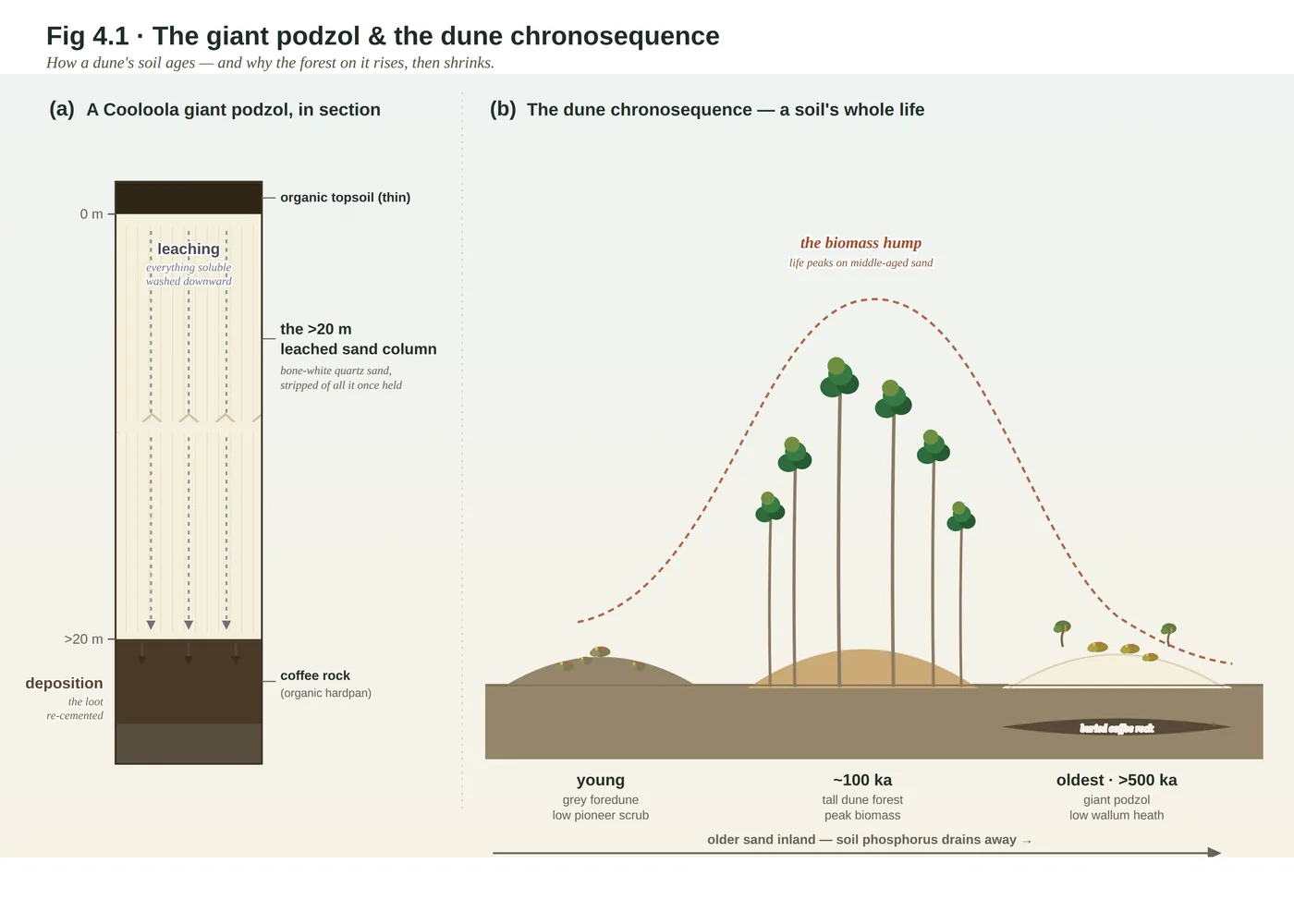
- Leached podzol; bleached quartz sand over coffee rock
- Regional ecosystem
- 12.2.6
- Bright, bleached, bottomless white sand
- Low, hard-leaved heath not much higher than your head
- A spring riot of wildflowers and nectar-feeding honeyeaters
- Still water the colour of cold, strong tea in the hollows
The white sand under the wallum is some of the poorest soil in Australia — there's almost nothing in it for a plant to eat. You'd expect bare ground. Instead, in spring, it's one of the most crowded flower gardens on the coast, because when the soil is that poor no single plant can take over and shade the rest out.
The wallum looks like the poorest country on the whole coast, and it is: bleached, bottomless sand behind the beaches, leached so hard that barely a trace of nutrient survives. It is also one of the richest gardens in Australia — hundreds of species packed where you would expect almost nothing — and the second fact is true because of the first. Its water is acidic enough to kill most things, and that acidity is the very reason a handful of frogs found nowhere else on Earth can breed in it.
Walk in during spring and the starved white sand grows a low, scrubby heath that erupts into flower: banksias and grevilleas, peas and wattles, boronias and wax flowers, ground orchids, lilies, and the glittering, insect-eating sundews. Each plant is a different answer to the same brutal exam question — how do you live on nothing? Some strike deals with fungi; some mine the soil by chemistry with dense brushes of cluster roots; some trap and digest insects for their nitrogen; some rent nitrogen-fixing bacteria. And almost every leaf in sight is hard, tough and long-lived — the sclerophyll leaf of plants too poor to afford a soft one. The astonishing diversity of the wallum is really the diversity of those answers.
Follow the track down into a damp swale and the sand between the sedges glistens with standing water the colour of strong, cold tea. This is acid blackwater, stained brown by the slow leaching of the peaty ground, and it is where the wallum’s strangest animals make their living: the acid frogs, which have evolved the physiology to breed in water closer to vinegar than to a garden pond. The sour water is hostile to almost everything — including, crucially, most of the predators and competitors that would otherwise eat their eggs. It is a wall the frogs hide behind rather than a hardship they suffer. But it is only ever a partial wall, and a fragile one: introduced fish are limited by the acid, not entirely locked out, and anything that sweetens the water or drops the water table lets them march in.
Two forces keep it all running, both easy to overlook. One is water — the hidden freshwater sponge inside the sand, which supplies the steady, acid, nutrient-poor water the whole community is tuned to, and which is stripped away by extraction or drainage without anything visibly changing at the surface until it is too late. The other is fire: the wallum is the most fire-hungry country on the gradient, and its plants want neither fire excluded nor fire constantly, but the particular rhythm they evolved with. Pull any one of these threads — sweeten the sand, drop the water table, shut out the fire or burn too often — and the rest unravel. It is the most elaborate thing Australia builds out of nothing at all, and it is exactly why you cannot dig one up and rebuild it somewhere more convenient.
In depth — the mechanism
The wallum is the ecosystem in which the region's keystone soil ideas cash out as living pattern. On leached, phosphorus-poor sand (see podzolisation and the N–P asymmetry), competitive exclusion relaxes and species partition scarcity through a proliferation of nutrient-acquisition strategies — mycorrhizal symbioses, cluster roots in the Proteaceae (banksias, grevilleas, hakeas) that exude carboxylates to mobilise sorbed phosphorus, carnivory in sundews (Drosera) and bladderworts (Utricularia) for nitrogen, and N-fixation in the many peas and wattles. The strategy-diversity → species- diversity link is the principle demonstrated at Jurien Bay, WA (Zemunik et al. 2015); the Sunshine Coast claim is held at the regional level. Sclerophylly — tough, long-lived, defended leaves — is the economy that scarce phosphorus forces on nearly every plant here.
Two further forces are load-bearing. Fire: many banksias and peas are serotinous or fire-germinated, so recruitment is coupled to the fire regime; the heath needs a particular interval — too little and it goes rank, too much and the seed bank is stripped. Water: the community leans on an unseen, groundwater-fed water table that keeps its swamps and tea-coloured streams alive through the dry (Dyring et al. 2025, on the Cooloola sand mass's groundwater-dependent ecosystems). That water is acid blackwater, often ~pH 3.5–4.5, and it shelters specialist acid frogs whose larvae tolerate low pH (Meyer et al. 2020, Litoria cooloolensis to ~pH 3.5; species-specific pH breeding windows in Shuker & Hines 2016).
The acid refuge is partial, not absolute. Low pH stresses and mostly shuts out predators and competitors — crucially introduced mosquitofish (Gambusia holbrooki) — but it does not absolutely exclude them; Gambusia is limited, not locked out, and the wallum-frog recovery plan still calls for active exclusion. So the sour water is a wall the frogs hide behind, not a guaranteed barrier — and a fragile one: sweeten or pollute it, or drop the water table, and the wall comes down. You cannot move or offset a wallum: its richness is the product of a hundred-thousand-year-old podzol, a particular water table, a particular acidity and a particular fire rhythm, all interlocking.
Concepts this teaches — follow a thread
Why the poorest ground grows the richest floraThe nitrogen–phosphorus asymmetryPodzolisation (how sand goes bankrupt)Sclerophylly (the tough-leaf economy)Serotiny (banking seed for fire)
Sources for this guide — followable
- Walker, T.W. & Syers, J.K. (1976). The fate of phosphorus during pedogenesis. Geoderma 15: 1–19. — The phosphorus arc that makes the ground permanently poor.
- Zemunik, G., Turner, B.L., Lambers, H. & Laliberté, E. (2015). Diversity of plant nutrient-acquisition strategies increases during long-term ecosystem development. Nature Plants 1: 15050. (Jurien Bay chronosequence, WA — the principle of rising strategy diversity; NOT a Cooloola study. Earlier draft mis-cited as "Laliberté et al., Cooloola".) — Strategy-diversity mechanism behind the flora richness (Jurien Bay, WA — the principle).
- Thompson, C.H. (1981). Podzol chronosequences on coastal dunes of eastern Australia. Nature 291: 59–61. — The giant leached podzols the wallum grows on.
- Meyer, E.A., Franklin, C.E. & Cramp, R.L. (2020). Acid tolerance in Litoria cooloolensis larvae. J. Comp. Physiol. B 190: 691–706. [PubMed] (Larvae hold salt balance to ~pH 3.5.) — Acid tolerance of Litoria cooloolensis larvae (~pH 3.5).
- Shuker, J. & Hines, H. (2016). Wallum frog pH envelopes / breeding-habitat acidity. Ecosphere. — Species-specific pH breeding windows for wallum frogs.
- Dyring, M. et al. (2025). A hydrogeochemical approach to coastal groundwater-dependent ecosystem conservation: the Cooloola Sand Mass. Science of the Total Environment 958: 177892. [PubMed 39647209] (The GDE dependence-mapping paper — e-pub 7 Dec 2024, vol 958 carries a 2025 date; cite as 2025. A separate Dyring et al. 2024, Groundwater 62(2), doi:10.1111/gwat.13352 covers GDE policy gaps — do not conflate.) — Groundwater-dependent ecosystems of the Cooloola sand mass.
Test yourself →
You're standing on bright, bleached, bottomless white sand behind the beach. The scrub is low and hard-leaved and, in spring, loud with wildflowers and honeyeaters. What country are you reading — and why is the ground so poor?
Cues: Bright, bleached, bottomless white sand · Low, hard-leaved heath not much higher than your head · A spring riot of wildflowers and nectar-feeding honeyeaters · Still water the colour of cold, strong tea in the hollows
White sand is not clean — it is robbed. Rain and organic acids have stripped the iron and nutrients out of the surface grains over tens of thousands of years (podzolisation), leaving bleached quartz over a buried coffee-rock layer. That poverty is the signature of the wallum, and it is the very reason the heath is so species-rich: on ground this poor no single plant can dominate, so hundreds of specialists crowd in. (Ch 4; Ch 9.)
The wallum grows on some of the poorest soil in Australia, yet it is one of the most species-rich plant communities in the region. Why does such poor ground grow so many *kinds* of plant?
Poverty is a leveller. On rich ground a few fast, greedy growers monopolise the nutrients and shade everyone else out; on starved ground nobody can pull far enough ahead to dominate, so the field falls open to hundreds of specialists, each scratching a living a different way. The poverty is the cause of the richness. (Ch 4; Ch 9.) The strongest test of the strategy-diversity mechanism is Zemunik et al. 2015 (Jurien Bay, WA); the coast's classic chronosequence is Cooloola, and the wallum-diversity claim is kept at the regional level.
On the oldest Cooloola sand, phosphorus has all but leached away. Predict: are the leaves of the plants growing here likely to be soft and short-lived, or tough and long-lived — and why?
Sclerophylly is an economy forced by scarcity. Because phosphorus is near-irreplaceable, a leaf built with it is too expensive to discard each season, so the plant makes it tough, defends it against being eaten, and keeps it for years. Hard, stiff, defended leaves are the visible fingerprint of an impoverished soil — read the leaf and you have read the ground. (Ch 4; Ch 9.)
Cited · traceable Last checked 2026-07. Deep-tier claims rest on, and were checked against, Zemunik et al. 2015, Nature Plants 1:15050; Meyer et al. 2020, J Comp Physiol B 190:691–706; Gambusia partial-refuge framing per Ch 9 Notes (verified June 2026) — every source is listed below and followable. Grounded in Same Sky, Different Ground.