A force
Water — the force that sorts the country
Water is the thief and the connector both: it rinses the sand poor, stains the swamps acid and tea-dark, hides a freshwater sponge under the driest dunes, pulses the wetlands wet and dry, and turns salt at the coast — sorting the same rain into separate worlds.
- On the gradient
- Acts along the whole gradient — hardest to see, and most decisive, on the sand coast and its wetlands
- Rock
- Quaternary coastal quartz sand over the freshwater lens; coffee-rock (organic hardpan) seals the perched lakes
- Soil
- Leached podzol; bleached sand fed from below by groundwater seepage
The same rain falls on the whole coast. What splits it into different worlds is the road it takes afterwards — soaking into deep basalt clay, running off the thin foothills, or sinking into the sand to sit for years underground. Follow the water and you can read, in advance, what is allowed to live there.
Water arrives with a bad reputation, and it half deserves it. It is the thief of the sand country: the agent that trickles down through the dunes, picks the pocket of every grain — its iron, its colour, its phosphorus — and makes off with the lot, leaving the bleached poverty the wallum is built on. But larceny is only one line on a very long résumé. Water is also the great connector, the medium the whole reef-to-range gradient is dissolved in and shunted about, and it sorts the same rainfall into separate worlds depending only on the road it takes down.
Watch where it goes. On the basalt range it soaks into deep clay that holds it like a sponge and releases it slowly, which is why the hinterland stays green through the dry. On the thin foothills it runs off fast and the country hardens between rains. On the coastal sand it sinks straight down and vanishes into the body of the dune, where it may wander underground for years before it troubles a stream. Learn where the water goes, and you have already read what is allowed to live there.
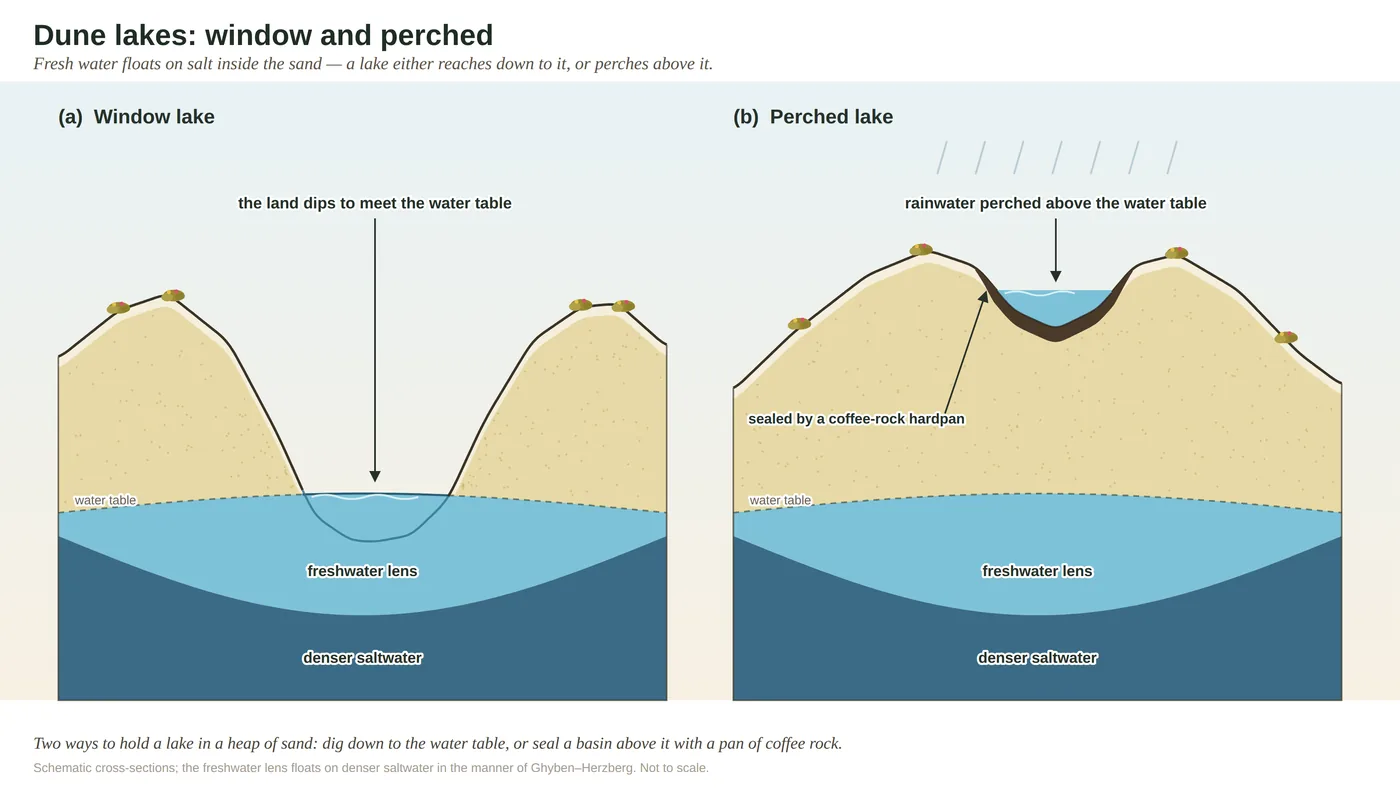
The sand hides the strangest of these waters. Stand on a dazzling dune in a drought and you are standing on the lid of an enormous freshwater store — a lens held in the sand, floating on the saltwater below, so slow that a raindrop may take decades to work through it. That hidden sponge is why the heath never quite dies, and it makes the region’s two kinds of lake: a window lake, which is simply the water table showing through where the land dips into it, and a perched lake, stranger and lovelier, cupped high in the dunes on a seal of coffee rock and filled by nothing but rain. And where the litter steeps in that slow water it turns it tea-dark and sour — blackwater, clean as anything and acid as orange juice, hostile enough to shelter a handful of frogs found nowhere else.
Down on the flats, water works by pulse rather than by trickle. The rivers here are short and steep and flood hard, and the flood, for anyone not living on it, is not the disaster it looks — it is the floodplain’s renewal, spreading nutrient across the flat, refilling the swamps, and telling the fish and waterbirds it is time to breed. Then, at the very bottom, the fresh water hands itself to the sea, turns brackish and then salt, and the sorting carries on by saltiness instead of by nutrient, right out into the estuary. The rain that fell on the whole coast is one rain. What breaks it into all these worlds is never the rain. It is the route.
In depth — the mechanism
Water is the force that redistributes everything the other forces make. Its first job is theft: rain percolating through coastal sand carries off iron, colour and — the loss that matters — phosphorus, leaving the bleached, permanently poor podzol the wallum lives on (this is weathering seen as a moving front). Its second job is chemistry. With almost no clay or carbonate in the sand to buffer anything, tannins leached from litter pile up and the organic acids run unchecked, driving wallum streams and swamps to roughly pH 3.5–4.5 — blackwater, clean but sour, a partial refuge that shelters specialist acid frogs while mostly (never absolutely) excluding their predators and competitors (Shuker & Hines 2016 for the pH envelopes; Meyer et al. 2020 for larval acid tolerance in Litoria cooloolensis).
Its third job is storage. A coastal sand mass behaves like a colossal sponge: a lens of fresh groundwater floats on denser saltwater, with residence times of decades — tritium mean ages of 37 to >150 years on comparable sand masses (Hofmann et al. 2020). That hidden store is why the heath does not die each dry season, and it defines the two kinds of dune lake: a window lake cuts down into the water table and rises and falls with it; a perched lake sits above the table on an organic coffee-rock seal, filled by nothing but rain (Lake Poona is the classic Cooloola example). The whole community leans on this unseen supply — Dyring et al. (2025) map how tightly Cooloola's wetlands, lakes and perennial streams are bound to the groundwater level, and how easily drawing it down or fouling it undoes them with nothing changing at the surface.
Its fourth job is the pulse. Short, steep, flashy catchments flood hard, and on the floodplain the flood is not the catastrophe but the point: overbank flooding delivers nutrient and sediment, reconnects off-channel wetlands, and cues floodplain fish and waterbirds to breed — the flood-pulse concept — so the zonation of the swamps is set by how long each band stays wet. Finally, at the coast, freshwater hands itself to the sea and the sorting continues by saltiness: the estuary's gradient of salt sorts life into zones as sharply as altitude sorts it up the range. Same rain, five fates — poor, acid, stored, pulsed, salt — and the route, not the rainfall, decides which.
Concepts this teaches — follow a thread
Blackwater and acid water (the colour of tea)Dune lakes (perched and window)Wetland zonation (the swamp reads like a tide-gauge)Weathering — how rock becomes soil
Sources for this guide — followable
- Dyring, M. et al. (2025). A hydrogeochemical approach to coastal groundwater-dependent ecosystem conservation: the Cooloola Sand Mass. Science of the Total Environment 958: 177892. [PubMed 39647209] (The GDE dependence-mapping paper — e-pub 7 Dec 2024, vol 958 carries a 2025 date; cite as 2025. A separate Dyring et al. 2024, Groundwater 62(2), doi:10.1111/gwat.13352 covers GDE policy gaps — do not conflate.) — Groundwater-dependent ecosystems of the Cooloola sand mass — wetland/lake/stream dependence on the water table.
- Hofmann et al. (2020). Groundwater residence times in coastal sand masses (Minjerribah / North Stradbroke Island) — tritium mean residence times 37 to >150 yr, ¹⁴C up to ~5,000 yr. Hydrology and Earth System Sciences 24: 1293. (Cited in Ch 5; complete authors/title before publication.) — Freshwater lens on saline groundwater; decadal-plus residence times in coastal sand masses.
- Shuker, J. & Hines, H. (2016). Wallum frog pH envelopes / breeding-habitat acidity. Ecosphere. — Wallum/acid-frog water pH envelopes — the acidity of blackwater.
- Meyer, E.A., Franklin, C.E. & Cramp, R.L. (2020). Acid tolerance in Litoria cooloolensis larvae. J. Comp. Physiol. B 190: 691–706. [PubMed] (Larvae hold salt balance to ~pH 3.5.) — Larval acid tolerance in Litoria cooloolensis (~pH 3.5) — who can live in the sour water.
Cited · traceable Last checked 2026-07. Deep-tier claims rest on, and were checked against, Dyring et al. 2025 (Cooloola GDEs); Hofmann et al. 2020, HESS 24:1293; Shuker & Hines 2016; Meyer et al. 2020, J Comp Physiol B 190:691–706 — every source is listed below and followable. Grounded in Same Sky, Different Ground.