The season
Wildflower season in the sand country
For a few weeks from late winter into spring the wallum heath stages the coast's biggest wildflower event — building in August, peaking September–October across the sand-country reserves. It is worth planning a trip around, and it peaks on the poorest, whitest ground because that is where no plant can dominate the rest.
The wallum's spring flowering is the coast's biggest wildflower event, and it is worth timing a trip to catch. It builds in August as the first banksias and early peas open, then peaks in September and October with the whole heath in flower at once — banksias, peas, wattles, boronias, grevilleas, ground orchids and sundews. Head for the sand-country reserves (Cooloola, the Noosa National Park heath), and make for the poorest, whitest ground, because that is where the show is richest.
The wallum keeps its best to itself for most of the year, and then, for a handful of weeks, it throws the whole lot open at once — which is exactly why it is worth watching the calendar for. The event builds quietly. Through August the first banksias fatten their brushes and the earliest peas begin to open, a scattering of colour across ground that still looks grey and starved. Then September and October arrive, the days lengthening and warming ahead of the wet, and the same sand ignites: banksias and grevilleas holding up nectar for the honeyeaters, whole thickets of eggs-and-bacon peas gone yellow-and-red, wattles hazing gold, pink starry boronias you can smell before you find, and, down at boot level, the ground orchids and the glistening sundews. Come at the peak and hundreds of species share a patch that looks too poor to feed a lawn.
The trick to finding the best of it runs against instinct: make for the poorest ground. The wildflower show is not something that happens despite the hungry white sand — it happens because of it. Where the soil is this leached and phosphorus-starved, no single fast grower can seize the ground and shade the rest into oblivion, so the field falls open to a great crowd of specialists, and spring is when they all cash in together. So walk the whitest, most bleached sand you can find, in the sand-country reserves — Cooloola, the Noosa National Park heath — and you will walk into the richest flowering, not the thinnest. It is why the spring wildflower walks and festivals that celebrate this country cluster into these few weeks, and why a well-timed visit is one of the surest botanical outings on the coast.
Carry two things outside with you, though, because both will move the show. It runs on the weather, not the date — a dry or cool spring flowers thin, and a great one is worth dropping everything for — and fire moves the best ground around. Many heath plants flower hardest in the year or two after a burn, and the grass-trees will spear a whole recently burnt hillside into bloom the following spring, so the grandest wildflower patch this year may be one that burned two winters ago. Ask a ranger where it last went through, and more often than not you will be asking where to find the flowers.
In depth — the mechanism
The wildflower season is the poverty–diversity paradox turned into an event you can put in a diary. Through most of the year the wallum reads as low, grey, hard-leaved scrub; for a few weeks as the days lengthen and warm ahead of the summer wet, the same starved sand becomes one of the most species-crowded floral displays in Australia. The timing is ordinary spring phenology, but the richness — and the fact that it is richest on the poorest ground — is the point.
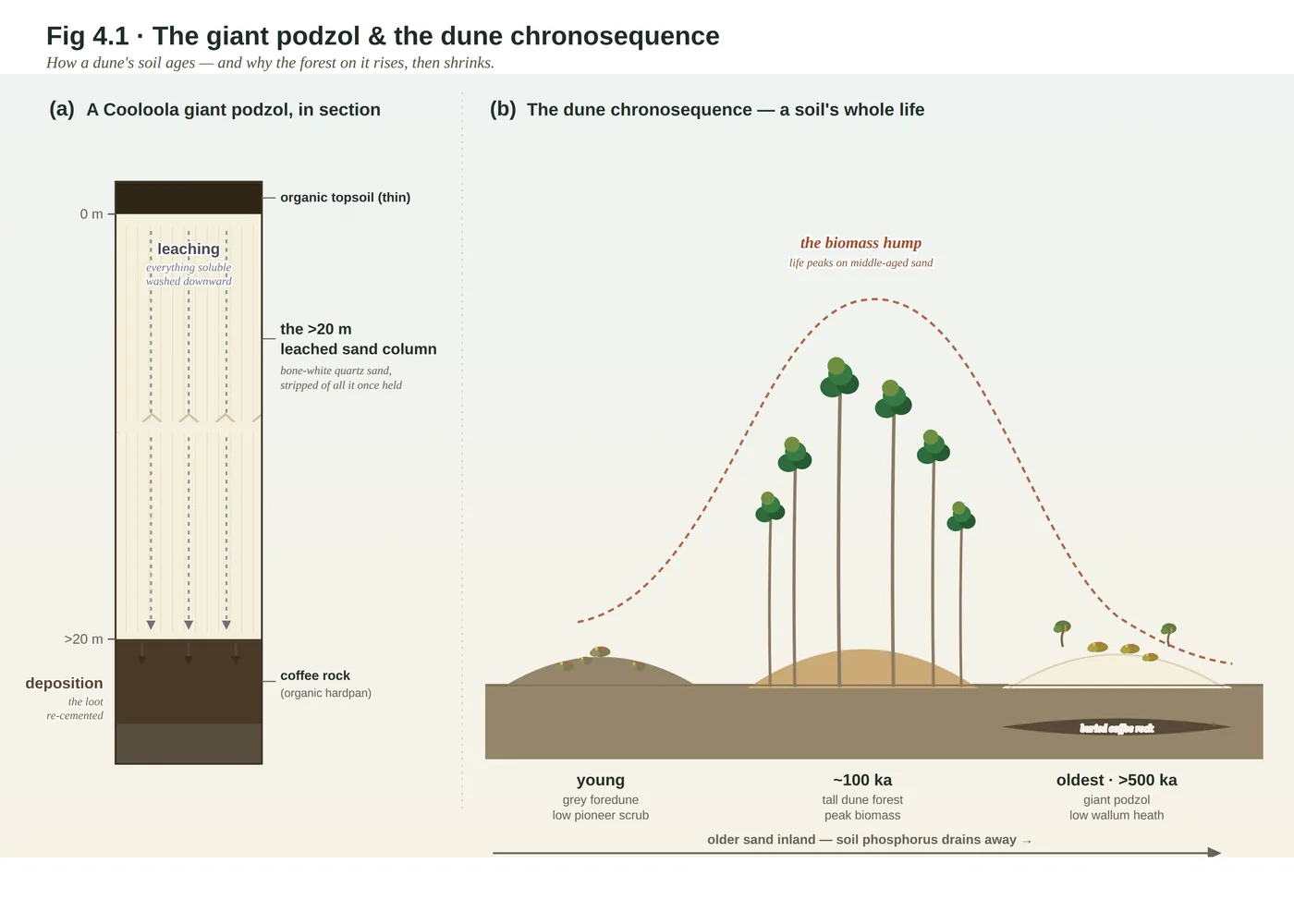
On leached, phosphorus-poor sand, competitive exclusion relaxes: no plant can grow fast enough to overtop and shade out the rest, so the field stays open to a great many specialists, each making a living a slightly different way (see the wallum ecosystem and the wallum-banksia, one of the richest nectar bars in the heath). The mechanism — that the number of distinct nutrient-acquisition strategies rises as phosphorus falls — is demonstrated on the Jurien Bay chronosequence in Western Australia (Zemunik et al. 2015); it is the principle behind the Sunshine Coast pattern, not a Cooloola measurement, and the regional claim is held at that level (the phosphorus arc per Walker & Syers 1976; the Cooloola giant podzols per Thompson 1981). This is why the advice for the wildflower-hunter is counter-intuitive but reliable: walk the whitest, hungriest-looking sand, not the greenest ground, and you walk into the best of the flowering.
As an event it unfolds on a rough schedule. August brings the first banksias and early peas — the first hint of the flush. September and October are the peak, the heath loud with honeyeaters working the banksias; October adds the grass-trees spearing into flower on recently burnt slopes. It is why the spring wildflower walks and festivals that celebrate the sand country cluster in these months. Two honest caveats travel with the timing (this is the companion to the spring-wildflowers season, which reads the same event on the ground). First, it runs on the weather, not the date: a dry or cool spring flowers thin, and the peak shifts a few weeks between years. Second, fire moves the best ground around — many heath plants flower most heavily in the year or two after a burn, so the grandest patch this spring may be one that went up in smoke two winters ago. Ask where it last burnt, and you will often find the flowers.
Concepts this teaches — follow a thread
Sources for this guide — followable
- Zemunik, G., Turner, B.L., Lambers, H. & Laliberté, E. (2015). Diversity of plant nutrient-acquisition strategies increases during long-term ecosystem development. Nature Plants 1: 15050. (Jurien Bay chronosequence, WA — the principle of rising strategy diversity; NOT a Cooloola study. Earlier draft mis-cited as "Laliberté et al., Cooloola".) — Nutrient-acquisition-strategy diversity rises as phosphorus declines — the mechanism behind the flora's richness (Jurien Bay, WA — the principle, not a Cooloola result).
- Walker, T.W. & Syers, J.K. (1976). The fate of phosphorus during pedogenesis. Geoderma 15: 1–19. — The phosphorus arc that makes the sand permanently poor — the precondition for the paradox.
- Thompson, C.H. (1981). Podzol chronosequences on coastal dunes of eastern Australia. Nature 291: 59–61. — The Cooloola giant leached podzols the wildflower heath grows on.
Cited · traceable Last checked 2026-07. Deep-tier claims rest on, and were checked against, Zemunik et al. 2015, Nature Plants 1:15050 (Jurien Bay, WA — principle); regional-level framing per Ch 9 Notes; flowering schedule and localities per in-flower.html (Aug–Oct wallum record) and this-month.html Aug–Oct entries — every source is listed below and followable. Grounded in Same Sky, Different Ground.