A species
Hoop pine
The pale, straight conifer that spears clear above the rainforest canopy — an emergent giant, a relic of the Gondwanan forests, and a living signature that the forest below it is very old. Logged hard, after the cedar, for the same reason it stands out: its timber.
The hoop pine is the tall, pale, ramrod-straight tree that pokes up above the rainforest like a mast above a green sea, bare of branches for most of its height and topped with a dark, domed crown. It is a conifer — a relative of pines, not of the gums and figs around it — and its rough bark is ringed like the hoops of a barrel, which is where the name comes from. A wild hoop pine standing head and shoulders above a real rainforest is a badge of great age: its kind was here long before the flowering trees, and where one still towers, the forest below is old, whole and worth keeping.
Every so often, as you walk in the hinterland rainforest, a pale straight column punches clear above the green canopy — bare of branches for most of its height, topped with a dark, domed, faintly bristly crown, standing like a mast above a swell. That is a hoop pine, Araucaria cunninghamii, named for the rings of rough bark that circle the trunk like the hoops of a barrel. It is a conifer, a cousin of the pines and a stranger among the broad-leaved gums and figs and palms it towers over, and its presence up there is a badge of great antiquity: the araucarias are survivors of the Gondwanan forests that covered this part of the world long before the flowering trees rose and crowded the old conifers out.
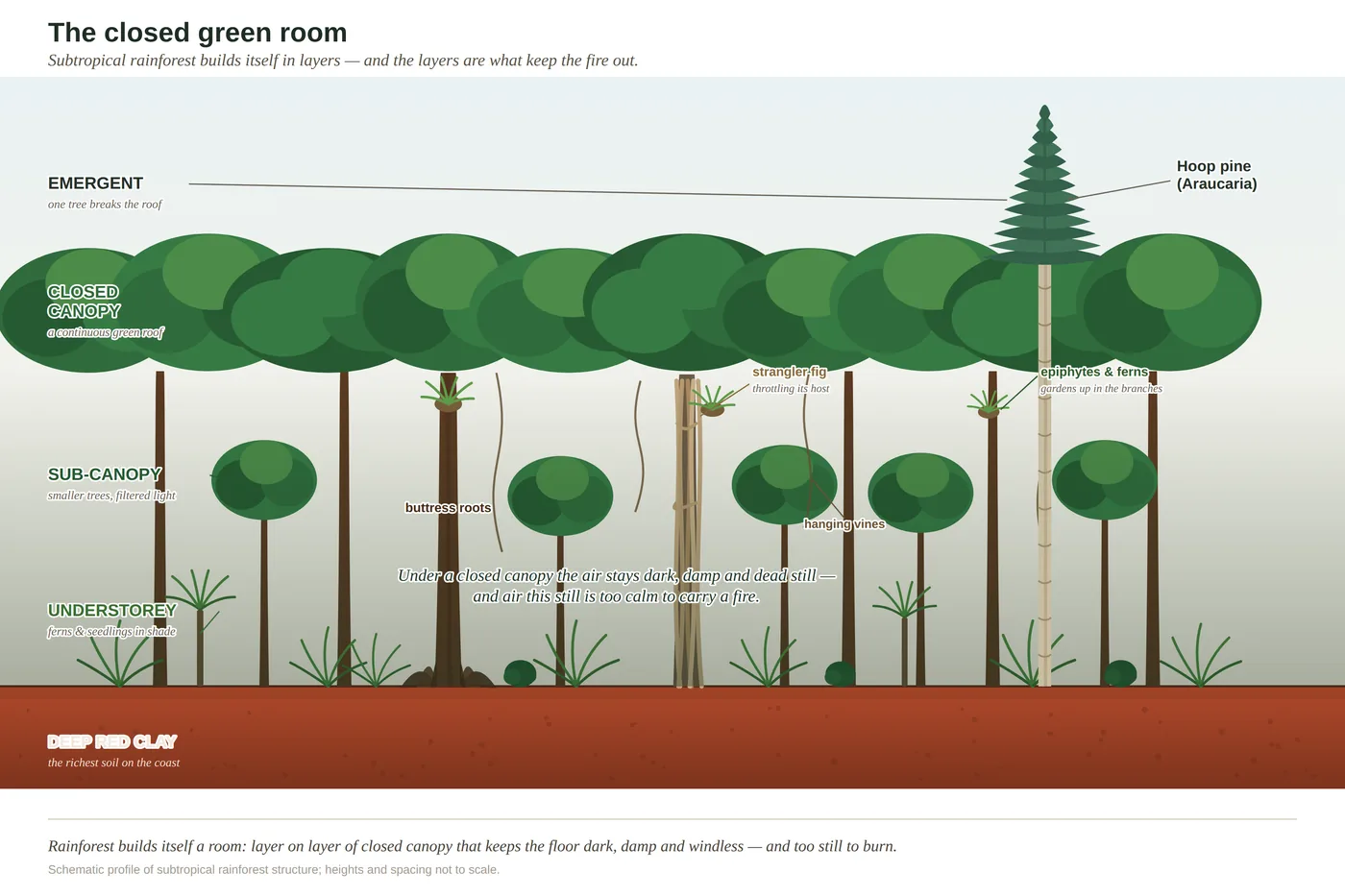
That habit of standing head and shoulders above everything else is worth reading, because it is not just showing off. A rainforest is built in tiers — a closed canopy, a sub-canopy beneath it, a dim floor beneath that — and the hoop pine is the tree that breaks the pattern by spearing straight through the roof to stand alone as an emergent, the tallest thing for a long way. When you see one from a distance, riding clear above the green, you are being told at a glance that the forest under it is old, whole and structured, the real thing rather than young regrowth. It is worth knowing, too, that the same tree grown in ruler-straight, even-aged rows on cleared ground elsewhere on the coast is a timber plantation; a hoop pine standing wild and alone above a genuine rainforest canopy is a very different and much older thing.
That same visibility cost it dearly. These forests were logged before they were cleared, and once the cedar-getters had stripped out the red cedar — the first and most valuable prize — the hoop pine became one of Queensland’s great softwood timbers, and the tall wild emergents were cut in their turn. So a big wild hoop pine still standing over a gully today is a survivor twice over: of an ancient line of conifers, and of a forest that mostly went to the axe. Where it still spears above the canopy, take it as a sign that the country beneath it held on — and as a reason to make sure it keeps doing so.
In depth — the mechanism
Araucaria cunninghamii is one of the araucarias, an ancient line of conifers that clothed the southern supercontinent of Gondwana long before the flowering trees rose to crowd them out, and it wears its antiquity where you can see it: a pale, columnar trunk, hoop-ringed bark, and a dark, faintly bristly dome held clear above everything around it. In a subtropical rainforest that reads as structure. The forest stacks in tiers — a closed canopy over a sub-canopy over a shaded floor (see rainforest-structure) — and every so often a single hoop pine punches straight through the roof of it to stand as an emergent, forty or fifty metres up, the tallest thing for a long way. That habit is the point: the hoop pine is the spire that tells you, at a glance and from a distance, that you are looking at old, intact rainforest and not at regrowth or plantation. A hoop pine grown in ruler-straight, even-aged rows on cleared ground is a timber crop; a hoop pine standing wild and alone above a real canopy is a far older thing, a survivor of a world that predates the gum and the fig.
The same conspicuousness that makes it a signature made it a target. The rainforests of this coast were logged for their timber before they were cleared for their soil, and after the red cedar — the first and most prized prize — had been cut out, the hoop pine became one of the great softwood timbers of Queensland, and the tall wild emergents were felled in their turn. So a big wild hoop pine standing over a hinterland gully today is doubly a relic: of an ancient lineage, and of a forest that mostly went under the axe. Where it still spears above the green, the country below it kept its structure — and that is exactly why it is worth reading, and worth protecting.
Concepts this teaches — follow a thread
Sources for this guide — followable
- Leiper, G. et al. (2022). Mangroves to Mountains (3rd ed.). Native Plants Queensland. — Araucaria cunninghamii: native emergent rainforest conifer of SE Qld, hoop-ringed bark, co-occurring with bunya in Blackall Range rainforest; also grown in plantation.
Cited · traceable Last checked 2026-07. Deep-tier claims rest on, and were checked against, Leiper et al. 2022, Mangroves to Mountains (3rd ed.); Ch 13 walk and Notes (hoop pine as pale hoop-barked emergent 50–60 m, Araucariaceae as a Gondwanan-relict lineage, plantation vs wild distinction), verified July 2026. The timber history — hoop pine logged as a major softwood after the red cedar — is standard regional environmental history (Ch 13/Ch 17), grounded in the chapters rather than a standalone author-year key. — every source is listed below and followable. Grounded in Same Sky, Different Ground.