A species
The grey mangrove
Avicennia marina, the dominant mangrove of this coast — a tree that has cracked salt water and airless mud at once, filtering salt at the root, sweating it out through its leaves, and breathing through a bed of snorkels standing up out of the tide.
- On the gradient
- The mangrove band of the estuary — the middle of the three tidal zones, between saltmarsh above and seagrass below
- Rock
- Intertidal soft mud of the Maroochy River estuary and the coast's tidal flats
- Soil
- Waterlogged, saline, airless (anoxic) estuarine mud
The grey mangrove is the common mangrove of this coast's tidal flats, and it lives where almost nothing else can — rooted in salt water and black, airless mud, both of which would kill an ordinary tree. It handles the salt at both ends: its roots strain most of it out before it enters, and glands on its leaves push out what slips through, so on a still day the leaves are faintly crusted with salt. For air, it sends up thousands of slender pencil-roots that stand straight out of the mud like snorkels, taking in air at low tide and piping it down to the drowned roots below. And it germinates its seed while it is still on the tree, so its young hit the mud already growing.
By every ordinary botanical reckoning, nothing should grow on a tidal flat at all. The ground is flooded and drained twice a day; the mud goes black and airless a few centimetres down; and the water is salt, which for most plants is simply poison, pulling the moisture out of their tissues as fast as their roots can take it in. It is the coastal version of trying to farm ground that is on fire half the day and frozen the rest. And yet a handful of unrelated trees have each, separately, cracked the problem — which tells you how large the prize is for anything that manages it — and on this coast the tree that dominates the tidal forest is the grey mangrove, the most widespread mangrove in Australia.
Consider the salt first, because the grey mangrove fights it at both ends. Its roots strain most of the salt out of the water before it ever enters the tree, an extraordinary filter that lets the plant drink seawater and keep the salt mostly out of its sap. Whatever slips through is pushed back out through glands on the leaves, so that on a hot, still day the foliage is faintly crusted with its own exuded salt. The tree is, quite literally, sweating out the sea. Then the airless mud: because there is no oxygen to be had below, the grey mangrove does not try to breathe through the mud at all. It sends up thousands of slender, pencil-like roots that stand straight out of the ground all around the trunk, like a bed of nails pointing at the sky. These are snorkels — pneumatophores — and at low tide they take air from the atmosphere and pipe it down to the drowned roots below. Wade out through the forest at low water and you are walking through a woodland breathing through its ankles.
There is one more trick, and it is the strangest. The grey mangrove does not trust its seed to the tide as a naked gamble; it germinates the embryo while the fruit is still on the branch, so the young plant is already growing when it drops — a habit called cryptovivipary. Its stilt-rooted cousins the red mangroves go further still, the seedling bursting through the fruit and hanging from the branch as a long green spear before it falls. Either way the tree launches its young pre-grown, ready to root in the first patch of mud they lodge against, which on ground that is underwater half the time is a decisive head start.
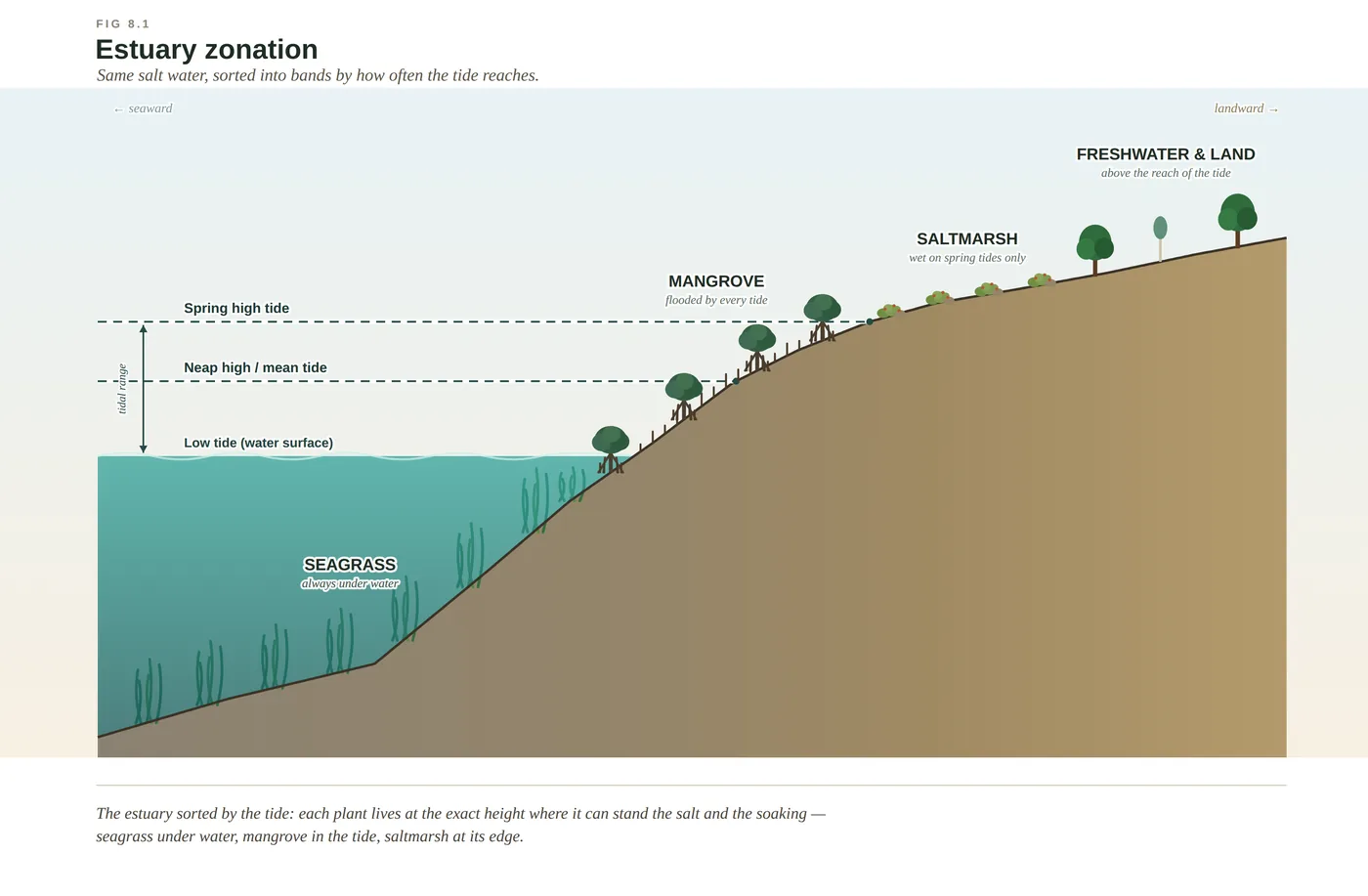
Put the three together and you do not simply have a tree that endures the tidal zone; you have one that builds it, holding the middle band of the estuary between the saltmarsh above and the seagrass below. Its thicket of breathing roots slows every incoming tide until the water drops its silt, so the forest traps sediment and creeps seaward, making new coast out of muddy water, while the same tangle blunts storms and floods, filters the water and shelters the young fish and prawns the fishery lives on. It is easy to walk the boardwalk and see nothing but a dark, muddy thicket. Read it instead for what it is doing — filtering salt, sweating brine, breathing through a thousand snorkels and sending its young into the world already grown — and it becomes one of the most accomplished plants on the whole coast, doing the work of a sea wall, a nursery and a water filter at once, and sending nobody the bill.
In depth — the mechanism
By every ordinary botanical reckoning, nothing should grow on a tidal flat at all. The ground is flooded and drained twice a day; the mud is so waterlogged that it holds almost no oxygen, going black and sulphurous a few centimetres down; and the water is salt, which for most plants is simply poison, dragging moisture out of their tissues as fast as the roots take it in. It is the coastal equivalent of trying to farm ground that is on fire half the day and frozen the rest. And yet a small guild of unrelated trees has cracked the problem independently — which tells you how large the reward is for anything that manages it — and on this coast the one that dominates the tidal forest is the grey mangrove, Avicennia marina, the most widespread mangrove in Australia.
Take the salt first, because the grey mangrove fights it at both ends. Its roots are a filter, excluding most of the salt from the water before it ever enters the tree — a remarkable piece of plumbing that lets the plant drink seawater and keep most of the salt out of its sap. Whatever slips past is dealt with at the other end: glands on the leaves excrete the excess, pushing it out onto the leaf surface, so that on a hot still day the foliage can be faintly crusted with its own exuded salt. The tree is, quite literally, sweating out the sea. That double strategy — keep most of the salt out at the root, sweat the rest out through the leaf — is the heart of how the mangrove survives its impossible water (see mangrove-salt-strategies).
Then the air, or the lack of it. Because the mud is suffocatingly airless, the grey mangrove does not even try to breathe through it. Instead it sends up thousands of slender, pencil-like roots — pneumatophores — that stand vertically out of the mud all around the trunk, like a bed of nails pointing at the sky. These are snorkels. At low tide, when the flat drains, they take air directly from the atmosphere through pores in their surface and pipe it down to the drowned root system below. Wade out through a grey-mangrove forest at low water and you are walking through a forest breathing through its ankles — a whole drowned woodland respiring through a thousand upright straws.
And then the seed, which is stranger still. Mangroves do not gamble their young on the tide as a naked seed the way most trees do; the grey mangrove germinates its embryo while the fruit is still attached to the parent, the embryo sprouting inside the fruit and waiting there until the fruit falls — a habit botanists call cryptovivipary. (Its stilt-rooted relatives, the red mangroves, go further, the seedling bursting clean through the fruit and dangling from the branch as a long green spear before it drops: true vivipary.) Either way the tree sends its young into the world already growing rather than as a helpless seed, primed to root in the first patch of mud it lodges against. For a plant colonising a surface that is underwater half the time, that is a decisive head start.
Put the three tricks together and you do not simply have a tree that survives the tidal zone; you have one that builds it, holding the middle band of the estuary between the saltmarsh above and the seagrass below (see estuarine-zonation). The wall of breathing roots slows every incoming tide, dropping its load of silt, so the forest traps sediment and reaches steadily seaward, making new land out of muddy water; the same tangle absorbs the punch of storms and floods, filters the water, and shelters the juvenile fish and prawns the coast's fisheries are built on. It is easy to walk the boardwalk and see a dark, muddy, unlovely thicket. Read it instead as one of the most accomplished plants on the coast — filtering salt, sweating brine, breathing through snorkels and launching its young pre-grown — and doing, for nothing, the work of a sea wall, a nursery and a water filter at once (Leiper et al. 2022; McPhee 2017).
Concepts this teaches — follow a thread
How a mangrove beats salt and mudEstuarine zonation (the tide sorts the bands)
Sources for this guide — followable
- Leiper, G. et al. (2022). Mangroves to Mountains (3rd ed.). Native Plants Queensland. — Grey mangrove Avicennia marina — regional dominant; dual salt exclusion/excretion, pneumatophores, cryptovivipary.
- McPhee, D. (2017). Environmental History and Ecology of Moreton Bay. CSIRO Publishing. — Bay-region mangrove ecology — the salt- and waterlogging-tolerance mechanisms and the mangrove band's role in the estuary.
Test yourself →
The grey mangrove lives rooted in salt water and airless mud — two conditions that should each kill an ordinary tree. On a still day its leaves are faintly crusted with salt, and thousands of slender pencil roots stand up out of the mud around it. How is the tree actually coping with the salt and the airless mud?
Two problems, two solutions, and the cues name both. The faint salt crust is not spray — it is salt the tree has pushed back out through glands on its leaves, the second half of a double strategy whose first half is root filtering that keeps most salt out to begin with. And the pencil roots are not anchors: they are pneumatophores, breathing roots that stand clear of the airless, sulphurous mud and pipe atmospheric air down to the drowned roots at low tide. The tempting misreadings — dried spray, plain anchoring roots, tolerating seawater unchanged — each explain one cue away instead of reading what the tree is doing to survive two lethal conditions at once. (Ch 8.)
Cited · traceable Last checked 2026-07. Deep-tier claims rest on, and were checked against, Leiper et al. 2022, Mangroves to Mountains (3rd ed.); McPhee 2017, Environmental History and Ecology of Moreton Bay; Ch 8 body + Notes (Avicennia marina the dominant SEQ mangrove; root salt-exclusion + leaf-gland excretion; pneumatophores as snorkels for airless mud; cryptovivipary — embryo germinates within the fruit but does not pierce it, vs truly viviparous Rhizophora — verified July 2026, AIMS Field Guide / Qld species profiles). — every source is listed below and followable. Grounded in Same Sky, Different Ground.