A species
The migratory shorebirds
The travellers of the flats — the bar-tailed godwit above all — that fly in from the Arctic each year to feed on this coast's mudflats, a link in a hemisphere-spanning flyway that cannot be replaced if it is paved.
- On the gradient
- The intertidal flats at the foot of the gradient — the tidal feeding band between mangrove and open water
- Rock
- Intertidal mud and sand flats of the estuaries and the wider Moreton Bay (EAAF / Ramsar shorebird ground)
- Soil
- Fine estuarine mud and sand, dense with buried worms, crabs and molluscs
Every year, birds like the bar-tailed godwit fly in from their Arctic breeding grounds to spend the rest of the year feeding on the mudflats of this coast. Some make part of the trip in astonishing non-stop flights of many days over open ocean — one tracked godwit flew from Alaska to Tasmania, more than 13,000 kilometres, in about eleven days without landing. The mud they probe looks empty to us and is packed with buried worms and crabs. It is the fuel stop that makes the whole journey possible, which is why the wider Moreton Bay is protected as an internationally important wetland — and why you cannot simply pave one flat and expect the birds to feed elsewhere.
Twice a year a stretch of this coast’s mud turns into one of the most important petrol stations on Earth. The flats laid bare at every low tide look, to us, like the very picture of emptiness — grey, wet, apparently lifeless — and are in truth crowded with buried life: worms, crabs and molluscs, the rich harvest of all the sediment and rotting leaf the estuary traps. That buried larder is why, every year, a crowd of travellers arrives from the far side of the world to work it. They are the migratory shorebirds, and the one that beggars belief is the bar-tailed godwit.
The godwit breeds in the short Arctic summer of Alaska and Siberia, then flies south to spend the rest of the year feeding on flats like these — and it makes part of that trip in a way that sounds made up. It flies non-stop, out over open ocean, for many days and many thousands of kilometres, never once landing to rest, drink or feed. The verified records are hard to read with a straight face: tagged godwits have flown well over eleven thousand kilometres in a single unbroken flight, and one young bird tracked in 2022 crossed from Alaska to Tasmania — some thirteen and a half thousand kilometres — in about eleven days without setting down once. It is the longest non-stop flight known of any bird: an animal the weight of a small parcel, burning its own body for fuel over an ocean with nowhere to land.
And this is exactly where the mud stops being scenery. A flight like that only works if the bird can gorge itself beforehand and refuel hard at the other end — a godwit finishes its crossing burnt down to almost nothing and has to eat its way back to strength before it can breed again. The flyway it rides, the East Asian–Australasian Flyway, is a chain of such fuel stops strung down the planet from the Arctic to Australasia, and the flats of this coast and the wider Moreton Bay are one of its links. That is not a turn of phrase. A migrant on a journey of that scale cannot just feed somewhere else; the good flats are rare, they are far apart, and each is a rung the bird is fuelled and timed to reach. Take out one rung and you have not inconvenienced a bird — you have broken a chain that stretches halfway around the globe.
So the wider Moreton Bay is recognised internationally as a Ramsar wetland, listed in 1993, largely for exactly these birds, and the ordinary-looking mud they probe is, to a godwit, the thing that makes the impossible possible. The chain is already shedding links: as the flats of Asia and Australia are drained, walled and built over, the birds that lean on them are sliding — the largest of them, the eastern curlew, all the way to critically endangered, one reclaimed estuary at a time. Every flat left standing on this coast is a piece of a lifeline, and its worth has nothing to do with how it looks at low tide and everything to do with where it sits in a chain that runs to the Arctic.
In depth — the mechanism
Twice a year a piece of this coast's mud becomes one of the most important petrol stations on Earth. The mudflats and sandflats laid bare at every low tide look, to us, like the very definition of empty — grey, glistening, lifeless — and are in fact dense with buried life: worms, crabs, molluscs, the harvest of all the sediment and rotting leaf the estuary traps. That buried food is why, every year, a crowd of travellers arrives from the far side of the planet to work it. They are the migratory shorebirds, and the greatest of them, for sheer disbelief, is the bar-tailed godwit.
The godwit breeds in the brief Arctic summer of Alaska and Siberia, then flies south to spend the rest of the year on flats like these — and it makes part of that journey in a way that ought not to be possible. It flies non-stop, over open ocean, for many days and many thousands of kilometres, without once landing to rest, drink or feed. The verified records are almost hard to read with a straight face: individual satellite-tagged godwits have flown well over 11,000 kilometres in a single unbroken flight, and one young bird tracked in 2022 crossed from Alaska to Tasmania — about 13,560 kilometres — in roughly eleven days without setting down once. It is the longest known non-stop flight of any bird, an animal the weight of a small parcel burning its own body as fuel over an ocean with no islands to fall back on.
Here is where the flats stop being scenery and become a matter of life and death, and where this reads as a lesson in dependence (see species-dependence). A flight like that is only survivable if the bird can fatten enormously beforehand and refuel hard at the far end — a godwit arrives at its wintering grounds burnt down to almost nothing and must eat its way back to strength before it can breed again. The flyway it travels, the East Asian–Australasian Flyway, is a chain of such refuelling stations strung down the globe from the Arctic to Australasia, and the intertidal flats of this coast and the wider Moreton Bay are one of its links. That is not a figure of speech. A migrant on a journey of that scale cannot simply feed "somewhere else"; the productive flats are rare, they are far apart, and each one is a rung the bird is timed and fuelled to reach. Pull out a rung and you do not inconvenience a bird — you break a chain strung halfway around the planet, and the birds that depended on that link arrive at an empty tank with nowhere to fill it.
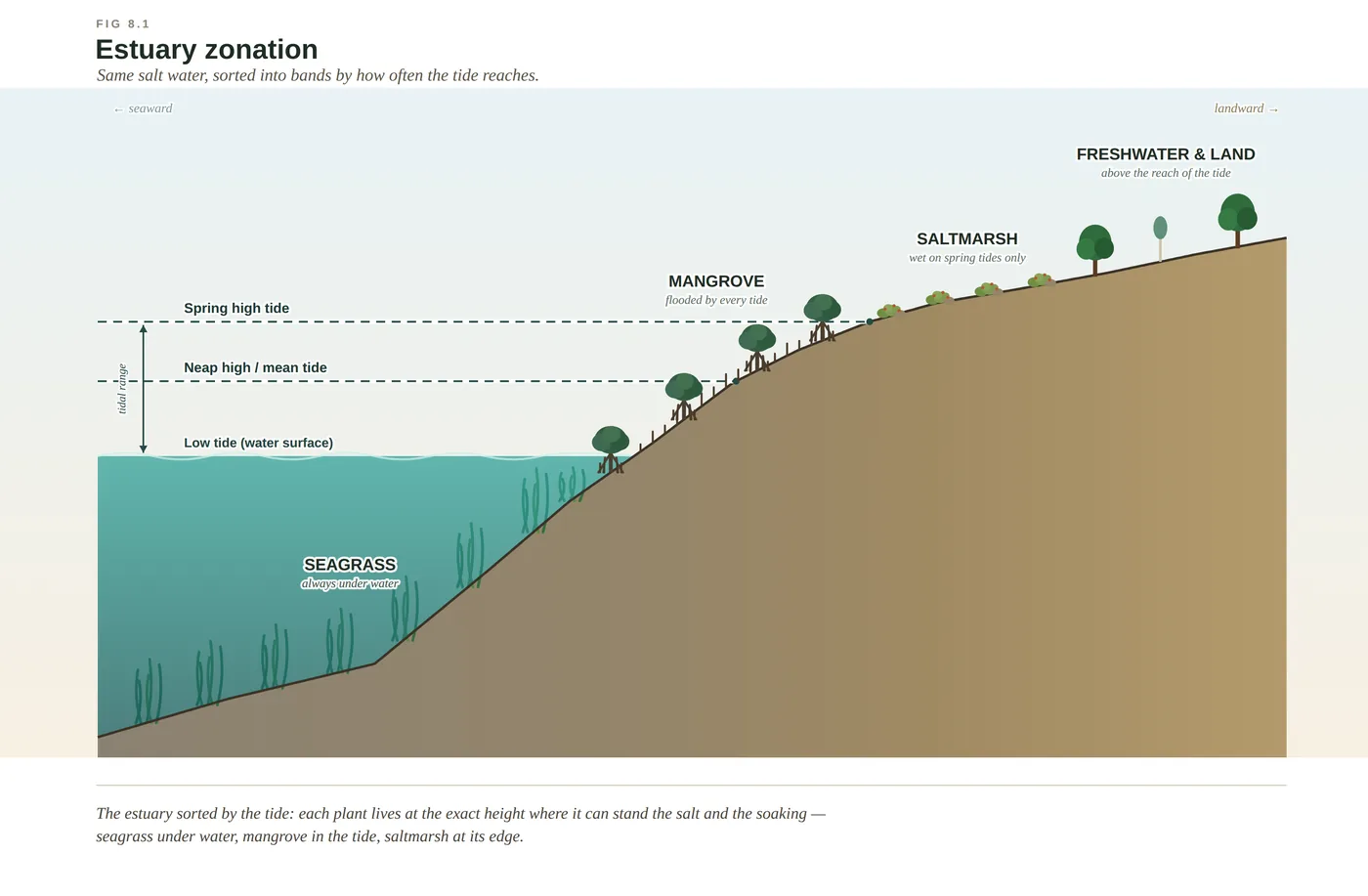
This is exactly why the flats are read the way the rest of the estuary is read (see estuarine-zonation): as a band that does specific, irreplaceable work, not as spare ground waiting to be improved. It is also why the wider Moreton Bay is recognised internationally as a Ramsar wetland — listed in 1993 — precisely for its migratory shorebirds. The unremarkable-looking mud is, to a godwit, the thing that makes the impossible journey possible. And the flyway is already losing links: as the flats of Asia and Australia are drained, walled and built over, the birds that lean on them are sliding, the largest of them, the eastern curlew, all the way to critically endangered. Every flat left standing on this coast is a piece of a lifeline, and its value is set not by how it looks at low tide but by where it sits in a chain that reaches to the Arctic.
Concepts this teaches — follow a thread
Estuarine zonation (the tide sorts the bands)Species dependence (a life is a bundle of needs)
Test yourself →
A stretch of intertidal flat on this coast, one that migrating bar-tailed godwits are known to feed on each year, is reclaimed and hardened — filled, walled and built over. The birds still pass through the region on the East Asian–Australasian Flyway. Predict the effect on the flyway birds, and explain why.
The near-miss is 'they'll just feed somewhere else,' and it is wrong for a reason worth reading carefully. A godwit's migration is only survivable because it can gorge and refuel at each stop on the flyway; the productive intertidal flats that let it do so are rare, far apart, and timed into the journey — each is a rung the bird is fuelled to reach, not an interchangeable patch of mud. Harden one flat and the birds that leaned on it arrive with nowhere to fill the tank at the moment they most need to, so the loss bites far harder than the map suggests: a link removed from a chain strung from the Arctic to Australasia. 'Feed somewhere else' assumes surplus flats and spare capacity that a refuelling chain does not have; feeding in parks or farmland is wrong (the food is the buried marine life of the flats, found nowhere inland); and being unaffected mistakes the very feat — the long non-stop flight — for independence from feeding, when it is precisely what makes refuelling non-negotiable. (Ch 8; Ch 14.)
Cited · traceable Last checked 2026-07. Deep-tier claims rest on, and were checked against, Ch 8 Notes (Moreton Bay Ramsar listing 22 Oct 1993, Site 631; East Asian–Australasian Flyway; bar-tailed godwit non-stop migration, verified 2022 record 13,560 km Alaska→Tasmania; >11,000 km single-flight records; eastern curlew EPBC Critically Endangered 2015) and Ch 14 Notes (flats as flyway refuelling grounds) — verified July 2026. No standalone author-year key for the godwit migration record; grounded in the chapters, sources left empty. — every source is listed below and followable. Grounded in Same Sky, Different Ground.