A species
She-oak
Allocasuarina and Casuarina — the whistling, needle-foliaged she-oaks: hardy generalists that fertilise the poor ground they colonise with nitrogen-fixing Frankia, and whose woody cones are the one food the fussy glossy black-cockatoo cannot do without.
She-oaks are the trees with the fine, drooping, needle-like foliage that sighs in the wind like distant surf. Those 'needles' are really green branchlets; the true leaves have shrunk to tiny scales. They are tough colonisers of hard, poor ground, and they quietly fertilise it, pulling nitrogen from the air through bacteria in their roots. Their small woody cones are the near-exclusive food of the glossy black-cockatoo, which depends on them almost completely.
Look down before you look up. If the ground beneath a slender, dark, weeping-foliaged tree is scattered with little cones chewed and splintered to shreds, like cracked pistachio shells, then the tree is a she-oak and you have found the dinner table of the glossy black-cockatoo. Look closer and the tree has more to show. Those drooping “needles” are not leaves at all but green branchlets, jointed like bamboo, with the true leaves shrunk to a ring of tiny scale-teeth at each joint — and they are why a she-oak in any breeze gives off that soft, continuous sighing, a sound like distant surf.
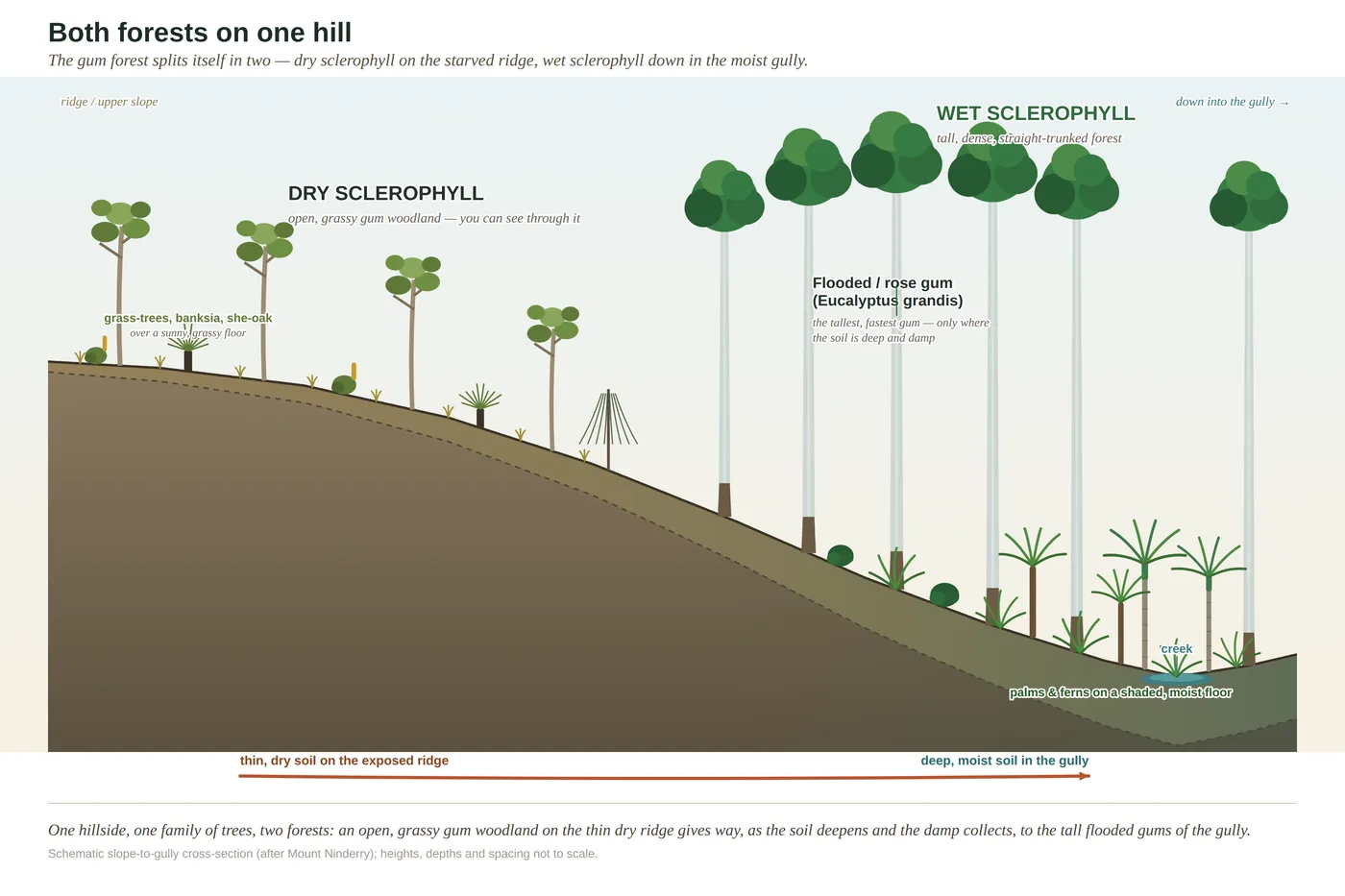
The she-oak is a hardy generalist of hard country. The black she-oak holds the dry, poor ridges; the swamp oak suckers across the salt mud where the freshwater turns brackish; between them the family colonises the kind of ground that defeats fussier trees. Part of the secret is underground: the she-oak’s roots carry nodules of a bacterium, Frankia, that pulls nitrogen from the air, so the tree fertilises the poor soil it stands on and gains a foothold where there is nothing to feed on yet. The trees are male or female, never both — in autumn the males flush rusty orange with pollen, while the females carry crimson-styled flowers that harden into the small woody cones the cockatoo wants.
And that is where the tough generalist becomes indispensable to a fussy specialist. The glossy black-cockatoo eats almost nothing but she-oak seed, returning to the same favoured trees year after year and working each cone slowly for a small, hard-won meal. One fact about the she-oak matters more than all the rest: a hot fire kills it outright, and it takes the best part of a decade to grow back to cone-bearing size, so a single bad burn switches off the cockatoo’s larder for ten years or more. A bird’s whole living, hung on one slow-growing tree and the fires that pass through it.
In depth — the mechanism
The she-oaks (Allocasuarina and Casuarina) are the coast's great generalists of hard ground: the black she-oak (A. littoralis) on dry, poor ridges, the forest oak (A. torulosa) on the slopes, the swamp oak (C. glauca) suckering across brackish estuarine mud. What lets one family colonise ridge, slope and salt fringe alike is a pair of tricks. The first is the foliage: those fine, drooping "needles" are not leaves at all but green branchlets (cladodes), jointed like bamboo, with the true leaves reduced to a ring of tiny scale-teeth at each joint — a low-surface, drought-thrifty way to photosynthesise on poor, dry country, and the reason a she-oak in any breeze gives off that soft, continuous sighing, a sound like distant surf. The second is underground: the roots carry nodules of an actinorhizal bacterium, Frankia, that fixes nitrogen straight out of the air (see plant-partnerships), so the tree quietly fertilises the poor ground it stands on and gains a foothold where there is nothing yet to feed on.
She-oaks are dioecious, male and female flowers on separate trees: in autumn the males flush rusty orange with pollen while the females carry crimson-styled flowers that harden into the small, woody cones. And those cones are where the tough generalist becomes the linchpin of a fussy specialist. The glossy black-cockatoo (Calyptorhynchus lathami) eats almost nothing else — a near-obligate she-oak seed feeder that returns to the same favoured trees year after year, ignoring perfectly good ones next door, working each cone slowly for a small, hard-won meal (listed Vulnerable, 2022). One fact about the she-oak decides the bird's fortunes: a hot fire kills the tree outright, and it takes the best part of a decade to grow back to cone-bearing size, so a single bad burn switches off the cockatoo's larder for ten years or more. The cockatoo depends on the she-oak twice over, in fact, because it also needs a large tree-hollow to nest in — so an intact she-oak stand and the old hollow-bearing trees around it are the whole of its living.
There is a mirror-image to the she-oak's toughness worth naming honestly. On the dry ridges the black she-oak is also the most persistent of the woody shrubs that thicken up and shade out the grassy, flowering floor when fire is withheld too long — the same hardy, ground-holding vigour that makes it a good coloniser makes it, in the absence of fire, a crowder-out of the open woodland's diversity. A generalist, in other words, that both feeds a rare specialist and, left unchecked, can smother the very country it grows in.
Concepts this teaches — follow a thread
Sources for this guide — followable
- Leiper, G. et al. (2022). Mangroves to Mountains (3rd ed.). Native Plants Queensland. — Allocasuarina/Casuarina she-oaks: photosynthetic cladodes with reduced scale-leaves; dioecious pollen flush and woody cones; actinorhizal Frankia nitrogen fixation.
- Glossy black-cockatoo: south-eastern subspecies Calyptorhynchus lathami lathami listed Vulnerable under the EPBC Act, effective 10 August 2022; near-obligate Allocasuarina/Casuarina (she-oak) seed feeder and large-hollow nester (SPRAT taxon 67036). — Glossy black-cockatoo (Calyptorhynchus lathami lathami): near-obligate she-oak seed feeder and large-hollow nester, listed Vulnerable (2022).
Cited · traceable Last checked 2026-07. Deep-tier claims rest on, and were checked against, Leiper et al. 2022, Mangroves to Mountains (3rd ed.); glossy black-cockatoo EPBC/SPRAT dependence (Calyptorhynchus lathami lathami, Vulnerable 2022); Ch 11 (she-oak cladodes/whistling foliage, Frankia N-fixation, dioecy; glossy black-cockatoo tree fidelity and ~decade regrowth to cone-bearing; black she-oak as the persistent woody-thickening species when fire is withheld) — verified July 2026. — every source is listed below and followable. Grounded in Same Sky, Different Ground.