A species
Strangler fig
The fig that starts life high in another tree's fork, lets roots down to the ground, and slowly sheathes and kills its host — leaving a hollow woven cylinder where a tree used to be. A rainforest keystone whose fruit feeds half the forest.
A strangler fig is the rainforest tree that begins as a murderer. Its seed is dropped by a pigeon high in the fork of another tree, sprouts up there, and sends roots creeping down to the soil. Once they reach the ground the fig thickens into a cage of its own roots, slowly shading and squeezing its host until the host dies and rots away inside — leaving the fig standing as a hollow lattice. When it fruits, it feeds much of the forest at once.
The first thing to learn in a rainforest is a tree that does not start as a tree. A strangler fig — on the Blackall Range most often the Watkins’ fig, Ficus watkinsiana — begins life as a seed wiped from a pigeon’s gut onto a high fork of some other tree. There is a reason for the odd address. The floor of a closed rainforest is one of the darkest places in nature, and a seedling that starts down there faces years of waiting for a gap in the canopy; the fig, by starting high, is standing in the light from the first day. It germinates up in the fork, in a little pocket of trapped leaf litter, and lets down slender roots that feel their way down the host’s trunk toward the soil far below.
The moment those roots touch the ground, the fig changes gear. It thickens, branches, and fuses into a lattice, slowly wrapping its host in a living cage of its own roots that tightens and shades a little more each year, until the original tree — starved of light above and squeezed at the trunk below — dies and rots away inside. What is left is a strangler fig standing as a hollow woven cylinder, a tree-shaped absence where another tree used to be. It is a patient killing, and it can take a hundred years.
For all the drama, the fig cannot manage any of it alone. It needs an animal to place its seed in the first place, because a fig seed that falls to the ground has begun in the wrong place entirely; and it needs its own particular wasp, because each species of fig is pollinated by one species of tiny wasp and no other, in a contract so tight that neither can breed without the other. What the forest gets back for hosting so ruthless a tenant is a larder. A big fig in fruit feeds fruit-doves, topknot pigeons, bowerbirds and flying-foxes all at once, and because different figs bear at different times, a forest with its figs intact almost always has something in fruit. That is why a tree that begins by killing another is counted among the most valuable in the forest: it is the one that keeps the rest of it fed.
In depth — the mechanism
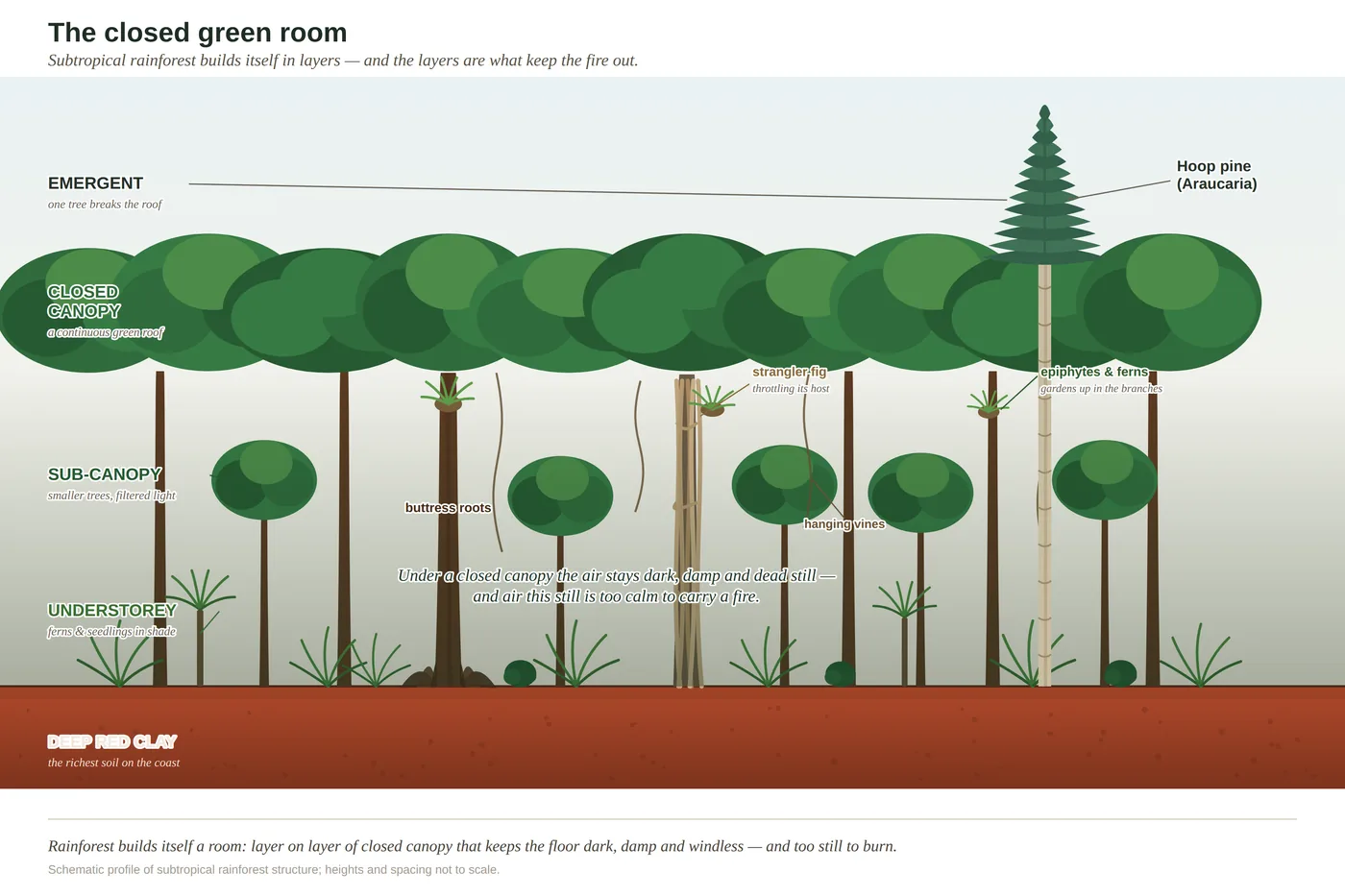
A strangler fig — in the Blackall Range rainforest most often Ficus watkinsiana — is a hemi-epiphyte that has solved the hardest problem in the forest by cheating at it. On the floor of a closed rainforest almost no light reaches the ground (see rainforest-structure), so a seedling starting there faces decades in the dark. The strangler skips the wait. Its seed, wiped from a fruit-pigeon's gut onto a high fork of some other tree, germinates up in the canopy where the light already is, in a pocket of trapped leaf litter, and lets slender roots down the host's trunk toward the soil far below. The moment those roots reach the ground the fig changes gear: it thickens, branches and fuses into a lattice, sheathing its host in a living cage that tightens and shades year on year until the original tree, starved of light and girdled at the trunk, dies and rots away inside — leaving the fig standing as a hollow woven cylinder where another tree used to be. It is a patient killing that can take a century.
So the fig depends, first, on animals to place its seed: without a frugivore to carry it up into a fork, the strangler has no way to begin. And it depends, second, on its own private pollinator — each fig species is pollinated by one species of tiny wasp and no other, an obligate contract tens of millions of years old (see plant-partnerships), so no wasp means no seed, and no fig means no wasp.
Its role in return is outsized. A big fig in fruit is one of the most important larders in the rainforest, feeding fruit-doves, topknot pigeons, bowerbirds, flying-foxes and much of the canopy at once; and because different figs fruit at different times, a forest with its figs intact rarely has a month when nothing is bearing. That steady, out-of-season fruit is why the strangler fig is treated as a keystone: lose it and the animals that move the whole forest's seed lose a mainstay they cannot easily replace.
Concepts this teaches — follow a thread
Rainforest structure (the layered forest)Plant partnerships (the deals for poor ground)
Sources for this guide — followable
- Leiper, G. et al. (2022). Mangroves to Mountains (3rd ed.). Native Plants Queensland. — Strangler figs (Ficus spp.) of SE Qld subtropical rainforest: hemi-epiphytic strangling habit and their keystone role as an asynchronously fruiting food resource.
- Male, T.D. & Roberts, G.E. (2005). Host associations of the strangler fig Ficus watkinsiana in a subtropical Queensland rain forest. Austral Ecology 30(2): 229–236. (Study site = Cooloola NP; F. watkinsiana favours large, rough-barked hosts — the strangler-fig host biology, Ch 13.) — Host associations of Ficus watkinsiana in a Cooloola NP rainforest — favours large, rough-barked host trees for its hemi-epiphytic start.
Test yourself →
A strangler fig ends up as a hollow cylinder of woven roots standing where a large tree used to be. How did it get there — how does a strangler fig actually grow?
A strangler fig begins as a seed dropped by a fruit-eating bird into a high fork, where it germinates in trapped litter — up in the light, skipping the years a floor seedling would spend in the deep shade of a closed rainforest (rainforest-structure). It lets roots down the host's trunk to the soil, then thickens and fuses them into a cage that shades and girdles the host until it dies and rots away inside, leaving the fig as a hollow woven cylinder. It is not a floor seedling, not a rootless sap-parasite, and it does not climb up from the ground — it grows down to it. (Ch 13.)
Cited · traceable Last checked 2026-07. Deep-tier claims rest on, and were checked against, Leiper et al. 2022, Mangroves to Mountains (3rd ed.); Male & Roberts 2005, Austral Ecology 30(2):229–236 (Ficus watkinsiana host associations, Cooloola NP); Ch 13 walk (hemi-epiphytic start in a high fork; hollow-lattice; keystone asynchronous fruiting — verified July 2026) — every source is listed below and followable. Grounded in Same Sky, Different Ground.