A species
The grey nurse shark
The heavy, snaggle-toothed, wholly placid shark of the headland pinnacles — hunted almost to nothing on its fearsome looks, now critically endangered on the east coast, and staked on a handful of aggregation sites like Wolf Rock off Double Island Point.
- On the gradient
- The marine pole of the gradient — offshore rocky pinnacles in the warm current, at the north of the coast
- Rock
- Volcanic pinnacles rising from sand off Double Island Point (Wolf Rock)
- Soil
- Rocky reef with sheltered sand gutters — hard substrate offshore
The grey nurse shark looks like everyone's nightmare of a shark — heavy-bodied, its mouth fixed in a permanent grin of needle teeth — and is one of the most harmless sharks in the sea, a slow fish-eater that hangs almost motionless over a reef and wants nothing to do with a diver. That fearsome face nearly finished it: for decades it was speared as a 'man-eater,' until the east-coast population collapsed to a remnant now listed critically endangered. It gathers at only a handful of places — chief among them Wolf Rock, off Double Island Point at the north end of this coast — and because so much of the population leans on so few sites, losing even one is a blow a slow-breeding shark can barely absorb.
Get the word “shark” out of your head for a moment and just look at the animal. The grey nurse is big and heavy through the shoulders, with a blunt snout and a mouth that never quite shuts over a bristle of long, thin, needle teeth, so that it seems to grin at you with a mouthful of ragged spikes. It is the shark of every bad dream, and it is one of the gentlest fish in the sea — a slow, unhurried hunter of other fish that spends its days hanging almost motionless above a reef, kept neatly weightless by a bellyful of air it gulps at the surface. Divers queue up to swim with it precisely because it does not care that they are there. For most of the last century, though, hardly anyone bothered to look past the grin, and the grin very nearly killed it off: it was speared and hunted as a man-eater on the strength of its face alone, until the east-coast population had been reduced to a scattered few and the species was listed, as it still is, critically endangered.
What keeps a grey nurse alive is not a particular food but a particular set of places. All year round the sharks gather at a small number of well-known aggregation sites — rocky reefs and old volcanic pinnacles with sheltered, sandy-floored gutters where they can hang out of the current in loose, hovering company. The best of them on this coast is up at its northern end: Wolf Rock, a knot of pinnacles standing out of deep water off Double Island Point, which is not just a gathering place but the only spot on the whole east coast where pregnant females are known to see out their pregnancies. So a large share of the breeding population funnels into one small patch of sea — which is exactly what makes the animal so easy to lose. Damage or fish out a single site like that and you have not taken a handful of sharks; you have taken a chunk of the future breeding stock in one go, which is why Wolf Rock is now closed to fishing outright.
And the grey nurse can spare nothing, because it breeds more slowly than almost any shark alive. Inside the mother the strongest embryo eats its brothers and sisters, so a female produces just one or two big, well-started pups, and only every second year — a trickle that takes decades to refill a population once it has been drawn down. Read against what it actually needs, the lesson of the grey nurse is the coast’s lesson in miniature, transposed underwater: here is a harmless, slow, place-loving animal whose survival now hangs not on its own ferocity but on whether we can leave a few reefs alone. The monster, it turns out, was never the shark.
In depth — the mechanism
The grey nurse shark (Carcharias taurus) is a study in how badly a face can mislead. It is big and heavily built, with a blunt snout and a mouth that will not quite close over a tangle of long, thin, backward-curved teeth, so that it wears a permanent, ragged grin — the very picture of the shark of nightmares. It is also almost absurdly placid: a slow-cruising, mostly nocturnal hunter of fish and rays that spends its days hovering in near-stillness over the reef, trimmed to neutral buoyancy by gulping air at the surface and holding it in its stomach. It has no quarrel with a diver, and the divers who visit it know that. For most of the twentieth century almost nobody else did, and the grin cost it everything: it was hunted hard, speared for sport and killed as a supposed man-eater on exactly the reputation its looks invited, until the east-coast population had been cut to a remnant. Today it is listed Critically Endangered — among the most imperilled sharks in Australian waters — with the mature east-coast animals numbering only in the low hundreds.
What it depends on is not a food but a set of places. The grey nurse gathers, reliably and year after year, at a small number of specific aggregation sites: rocky reefs and volcanic pinnacles with sheltered, sandy-floored gutters and overhangs where the sharks can hang out of the current in loose company. The most important of them on this coast lies just to the north — Wolf Rock, a cluster of pinnacles rising from deep water off Double Island Point at the seaward end of Cooloola — which is not merely an aggregation site but the only known gestation site for pregnant females on the entire east coast, drawing a large share of the population's mature females into one small patch of sea. That concentration is the whole vulnerability. A shark tied to a handful of gutters is exposed in the same way the koala tied to a handful of feed trees is exposed: disturb, fish out or degrade even one aggregation site and you do not lose a few individuals, you hit a big fraction of the breeding stock at a stroke. It is why Wolf Rock is now closed to fishing as a no-take green zone within the Great Sandy Marine Park.
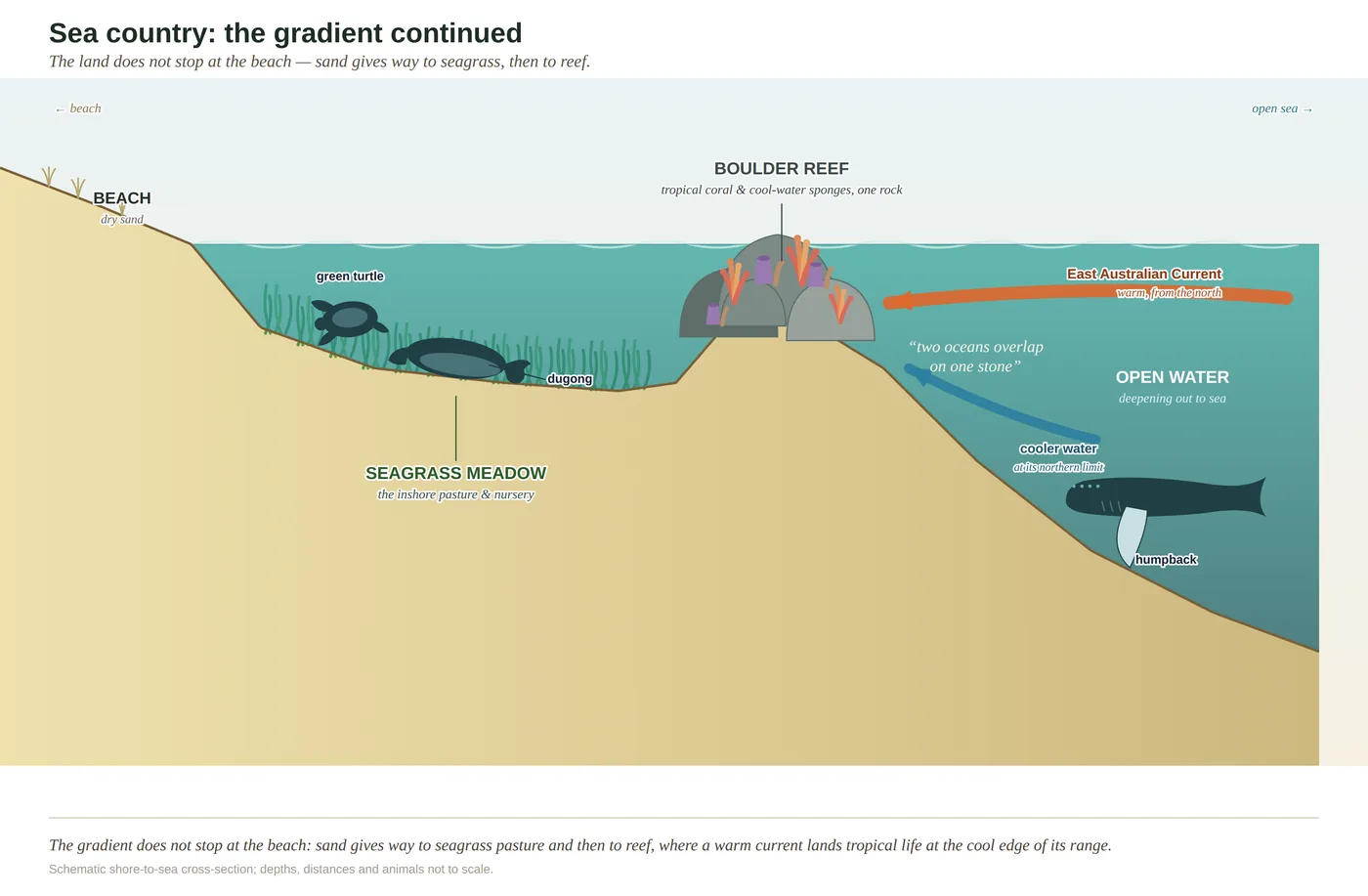
The bill is made worse by the arithmetic of grey-nurse reproduction, which is about as slow as a shark's gets. In the womb the strongest embryo eats its siblings, so a female delivers just one or two well-grown pups, and only every second year — a rate that makes the population glacially slow to rebuild once knocked down, and unforgiving of any loss of adults to netting, hooks or disturbance. That the aggregation reefs sit where they do is no accident either: these current-swept pinnacles lie in the warm flow of the East Australian Current, on the same stretch of coast where tropical and temperate life share one rock (see two-oceans-overlap) — productive, structured water that draws large predators as much as it draws the mingled reef fauna. Read the grey nurse, then, not as a monster but as a dependence made visible: a docile, slowly-breeding animal whose survival now rests on our protecting a few square kilometres of reef it cannot do without (see species-dependence).
Concepts this teaches — follow a thread
Species dependence (a life is a bundle of needs)Two oceans on one rock (the tropical–temperate overlap)
Sources for this guide — followable
- McPhee, D. (2017). Environmental History and Ecology of Moreton Bay. CSIRO Publishing. — Regional marine ecology and history — reef fauna, shark biology and the aggregation reefs of the SE Queensland coast.
- Davie, P. (1998). Wild Guide to Moreton Bay. Queensland Museum. — Regional marine natural history — rocky-reef fauna and the current-driven communities off this coast.
Test yourself →
The grey nurse shark is a fish-eating shark of the headland reefs, critically endangered on the east coast. What most limits it locally — what does it most depend on?
The grey nurse does not depend on a particular food but on particular places: a small number of aggregation sites — rocky reefs and volcanic pinnacles with sheltered sandy gutters — where the sharks gather year after year. Wolf Rock, off Double Island Point, is the only known east-coast gestation site for pregnant females, so a large share of the breeding population funnels into one small patch of sea. Concentrate that much of a slow-breeding, critically endangered population on so few sites and losing or disturbing even one is a heavy blow — which is why Wolf Rock is now a no-take zone (Ch 14 Notes; east-coast Carcharias taurus listed Critically Endangered, EPBC). The distractors are other animals' dependencies wearing a shark costume: seagrass grazing belongs to the dugong and green turtle, tree hollows to the glossy black-cockatoo and gliders, and the grey nurse actually favours the warm-current reefs rather than being driven out by them. Read what this animal needs — the sites, plus a punishingly slow reproductive rate — and its fragility follows. (Ch 14.)
Cited · traceable Last checked 2026-07. Deep-tier claims rest on, and were checked against, McPhee 2017; Davie 1998; Ch 14 sea-country Notes — Wolf Rock (four pinnacles ~2 km off Double Island Point; the only known east-coast gestation site for pregnant grey nurse), east-coast Carcharias taurus population Critically Endangered (EPBC; low hundreds of mature animals), no-take green zone in Great Sandy Marine Park; standard grey-nurse reproductive biology (intrauterine cannibalism, 1–2 pups biennially), verified July 2026 — every source is listed below and followable. Grounded in Same Sky, Different Ground.