A place
Wolf Rock (Double Island Point)
A cluster of volcanic pinnacles rising from deep water off Double Island Point — a two-oceans overlap reef, and one of the very few places grey nurse sharks gather all year round.
- On the gradient
- The marine end of the gradient — offshore pinnacle reef in the two-oceans overlap
- Rock
- Volcanic pinnacles rising from deep water off Double Island Point
- Soil
- Rock reef (no soil); sheltered sandy waters of the wider region carry seagrass
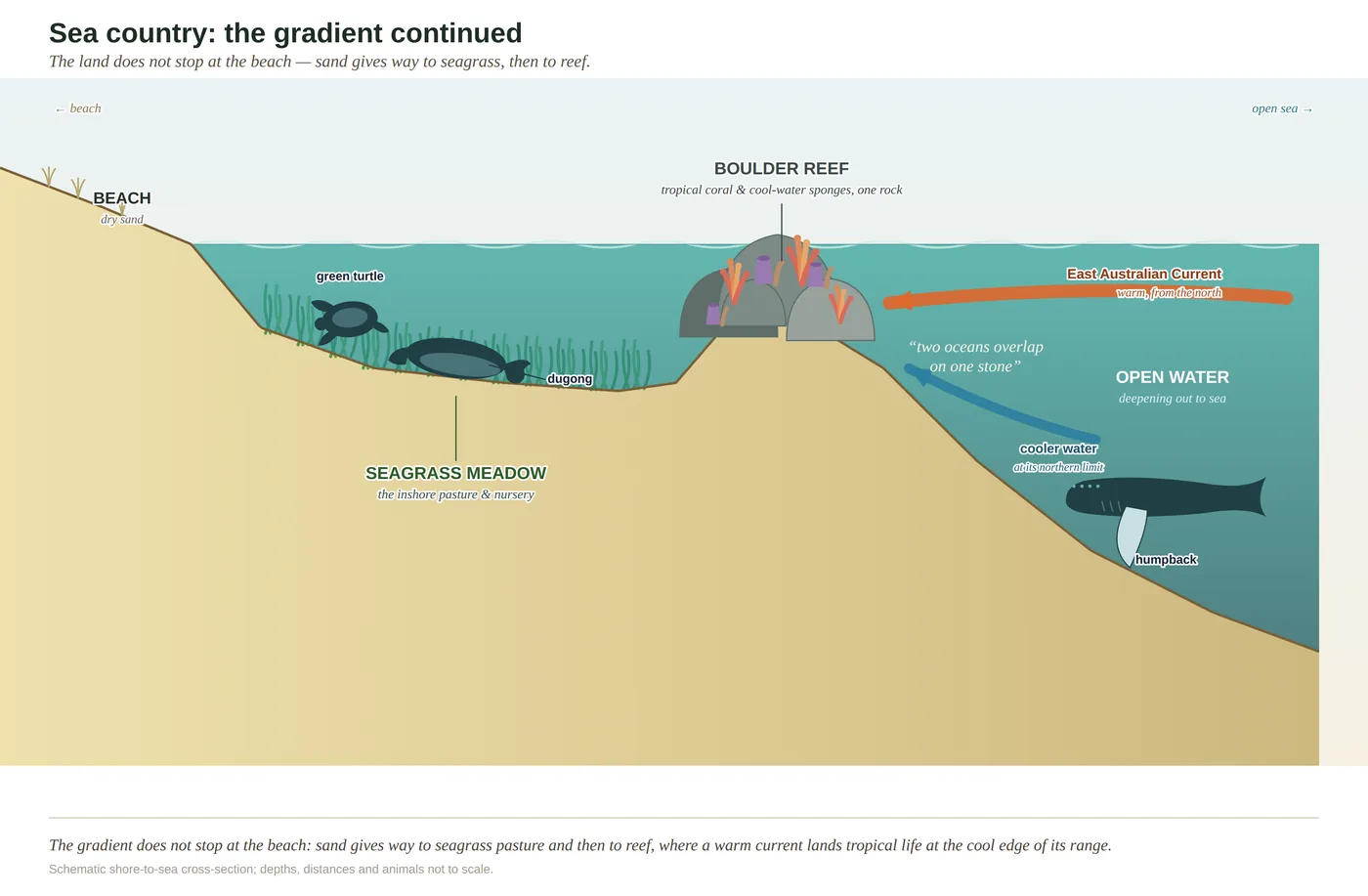
Wolf Rock is a group of volcanic pinnacles that rise from deep water off Double Island Point, at the northern edge of the coast. The warm current runs tropical animals down onto the rock, where they meet cool-water species from the south, so it is a two-oceans reef. It is also one of the most important shark sites in eastern Australia — one of the very few places the grey nurse shark gathers all year round, including pregnant females, which is why it is closed to fishing.
Some of the best country on this coast is underwater, and one of the finest pieces of it stands a couple of kilometres off Double Island Point, where a set of volcanic pinnacles rises out of deep water like the top of a drowned mountain. Wolf Rock is where the two-oceans reef of this coast reaches one of its sharpest expressions. The East Australian Current — the warm southbound flow made briefly famous by a cartoon turtle — pours tropical water and the drifting young of tropical fish and corals down onto the rock, and they settle here at the very southern edge of where warm-water animals can live, sharing the stone with the sponges and seaweeds of the cool south. Two oceans meet on one pinnacle, each near the limit of what it can bear.
But the animal that makes Wolf Rock famous has a bad face and a gentle nature. The grey nurse shark looks like everyone’s nightmare — heavy-bodied, snaggle-toothed, its mouth fixed in a permanent grin of needle teeth — and is in truth a slow, placid fish that eats other fish and wants nothing to do with a diver. That fearsome look nearly finished it: for decades it was hunted as a “man-eater” on the strength of its appearance alone, until the east-coast population crashed to a remnant. Today it is critically endangered, and Wolf Rock, one of the very few places these sharks gather all year round — pregnant females among them — is closed to fishing precisely because so few are left. Leopard sharks lie harmless on the sand nearby, and in the warm months manta rays soar in to hang above the pinnacle while little fish clean their skin.
It is worth reading Wolf Rock as one face of a single sea country. The pinnacle is bare rock — hard-bottom reef, and no place for a meadow — but swing in behind Double Island Point, into the sheltered sandy waters of the wider Great Sandy region, and the same sea grows seagrass, the underwater pasture that feeds the dugong and the turtle. Reef and meadow are two halves of one whole, and the reef is the sensitive half: a community living at the edge of its members’ tolerances feels every warming of the water first. Read from a boat it is a dive site; read as country it is a gauge — of how fast the sea is changing, and of whether we can leave a rare and gentle thing alone long enough for it to recover.
In depth — the mechanism
Wolf Rock is the marine end of the gradient made vertical: a cluster of volcanic pinnacles rising from deep water off Double Island Point, at the seaward end of the Cooloola sand mass. Like the Noosa headland reef further south, it sits in the two-oceans overlap (see two-oceans-overlap). The East Australian Current runs warm tropical water and tropical larvae down the coast, and here they settle near the southern edge of where they can live, sharing the rock with the cool-water sponges, seaweeds and fish of the temperate south (McPhee 2017; Davie 1998). Read the temperate element as sponge-and-algae, not the dense kelp of cooler NSW reefs — kelp is marginal this far north.
The reason Wolf Rock matters most is a shark. It is one of the very few places on the east coast where the grey nurse shark gathers year-round, including pregnant females — a heavy-bodied, snaggle-toothed fish with a permanent grin of needle teeth, and an almost absurdly placid disposition, that was hunted for decades as a wrongly feared "man-eater" until the east-coast population collapsed. It is now listed as critically endangered, and the pinnacles are closed to fishing precisely because so few of these harmless-looking animals are left. Leopard sharks (harmless bottom-dwellers) and, through the warmer months, plankton-feeding manta rays gathering at cleaning stations use the same rock.
Two honest calibrations. (1) The grey-nurse specifics — the year-round aggregation, the pregnant females, the critically endangered east-coast status — are carried from the book's Ch 14, which flags them as verified against DCCEEW and Qld Parks; kept qualitative here rather than pinned to a precise count. (2) Seagrass does not grow on the pinnacle — bare rock reef has none — but the concept belongs to this sea country: the sheltered sandy waters of the wider Great Sandy region behind Double Island Point carry the seagrass meadows that graze dugong and turtle (see seagrass-meadows). Reef and meadow are two faces of one sea, and Wolf Rock is the hard-bottom face of it — a gauge, like every overlap reef, of how fast a warming sea is changing.
Concepts this teaches — follow a thread
Two oceans on one rock (the tropical–temperate overlap)Seagrass meadows (the inshore pasture and nursery)
Sources for this guide — followable
- McPhee, D. (2017). Environmental History and Ecology of Moreton Bay. CSIRO Publishing. — EAC-driven tropical–temperate overlap on the SE Queensland coast; sharks and rays of the offshore reefs; temperate element = sponges/seaweeds, not kelp.
- Davie, P. (1998). Wild Guide to Moreton Bay. Queensland Museum. — Regional marine natural history of the offshore reefs and their fauna.
Test yourself →
The grey nurse shark is a fish-eating shark of the headland reefs, critically endangered on the east coast. What most limits it locally — what does it most depend on?
The grey nurse does not depend on a particular food but on particular places: a small number of aggregation sites — rocky reefs and volcanic pinnacles with sheltered sandy gutters — where the sharks gather year after year. Wolf Rock, off Double Island Point, is the only known east-coast gestation site for pregnant females, so a large share of the breeding population funnels into one small patch of sea. Concentrate that much of a slow-breeding, critically endangered population on so few sites and losing or disturbing even one is a heavy blow — which is why Wolf Rock is now a no-take zone (Ch 14 Notes; east-coast Carcharias taurus listed Critically Endangered, EPBC). The distractors are other animals' dependencies wearing a shark costume: seagrass grazing belongs to the dugong and green turtle, tree hollows to the glossy black-cockatoo and gliders, and the grey nurse actually favours the warm-current reefs rather than being driven out by them. Read what this animal needs — the sites, plus a punishingly slow reproductive rate — and its fragility follows. (Ch 14.)
Cited · traceable Last checked 2026-07. Deep-tier claims rest on, and were checked against, McPhee 2017, Environmental History and Ecology of Moreton Bay; Davie 1998, Wild Guide to Moreton Bay; Ch 14 sea-country Notes (Wolf Rock volcanic pinnacles ~2 km off Double Island Point; year-round grey nurse aggregation incl. pregnant females; critically endangered east-coast status; no-take zone; EAC two-oceans overlap; temperate element sponges/algae not kelp — verified July 2026) — every source is listed below and followable. Grounded in Same Sky, Different Ground.