A species
The humpback whale
The winter travellers of the humpback highway — hunted along this coast almost to oblivion, protected in 1963, and back now from a few hundred animals to tens of thousands; the best conservation news on the coast, passing in plain sight.
Every winter the humpback whales of eastern Australia migrate north past this coast to breed in the warm tropics, and every spring they stream back south, often with calves. They pass close because the coast's headlands and narrow shelf bring the highway near the shore. Within living memory whaling drove them to a few hundred animals; protected since 1963, they have climbed back into the tens of thousands. All they needed was to stop being killed.
Twice a year the best conservation news on this coast swims past in plain sight. Every winter the humpback whales of eastern Australia migrate north along this coastline to their breeding grounds in the warm tropics, and every spring they stream back south again, often with calves, a procession of great animals so close and so reliable that watching them has become one of the region’s finest spectacles. They pass near the shore for a simple reason of geography: the land’s slope continues down a narrow shelf, and the headlands of this coast push the migratory lane close enough that the whole highway can be read from a clifftop.
What the whale depends on is not the kind of thing you can point to on a map. It is a journey. The humpback fattens through the summer in the cold, krill-thick water near Antarctica, breeds and calves in the tropics far to the north, and needs the long coastal road between the two kept open and unharried. That is the opposite of the koala’s bargain, or the acid frog’s: those animals are undone by the loss of one narrow thing in one place, while the migrant is exposed along the entire length of its route. And within living memory the humpback was undone by the crudest pressure of all. The whaling station at Tangalooma, on nearby Moreton Island, killed more than six thousand of them between 1952 and 1962, before the whales simply ran out and it closed — and by then the eastern population had been driven down to a few hundred animals hanging on.
Then it turned around. Protected from whaling from 1963, the population climbed, decade on decade, back into the tens of thousands — recent assessments put it at something like forty thousand, at or above where it stood before the whaling began. A few hundred animals to forty thousand: you cannot argue with a graph like that. It is the rare case on this coast where the reading is entirely hopeful, and the reason is worth holding onto. The humpback did not need a vaccine, or a fragile habitat mended thread by thread. It needed one thing to stop happening to it. Lift the single fatal pressure, and a great animal that was all but gone will, given a few decades, fill the water again.
In depth — the mechanism
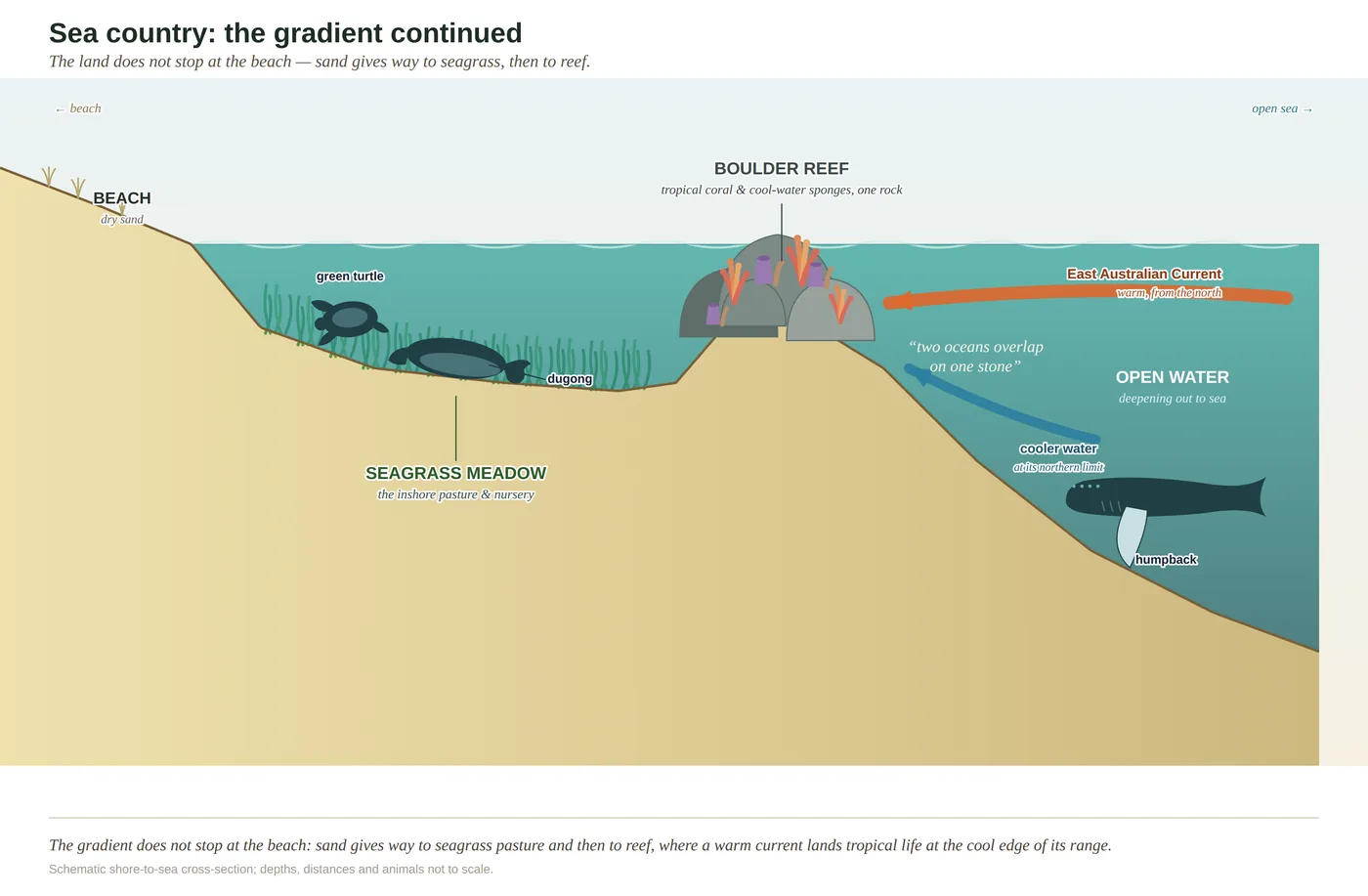
Twice a year the best conservation news on the coast swims past in plain sight. The humpbacks of eastern Australia spend the southern summer feeding in the cold, krill-rich waters near Antarctica, then in winter migrate thousands of kilometres north along the Queensland coast to breed and calve in the warm tropics, streaming south again in spring — often with calves in tow — on one of the longest and most reliable animal migrations anywhere. Off the Sunshine Coast the procession runs close inshore. The land's gradient does not stop at the beach; it carries on down a relatively narrow continental shelf, and the coast's headlands push the migratory lane near enough to the rock that the "humpback highway" can be watched from a clifftop — one reason this stretch has become one of the region's finest wildlife spectacles.
What the humpback depends on is not a single food or a single place but a journey — a corridor connecting two worlds spread across a hemisphere: the Southern Ocean feeding grounds where it fattens, the tropical breeding grounds where it calves, and unbroken, unharried passage along the coast between them. That kind of dependence is the mirror image of the koala's or the acid frog's: where the specialist is undone by the loss of one narrow thing, the migrant is exposed along the whole length of its route, to entanglement, vessel strike, noise and a warming ocean. And within living memory it was undone by the simplest thing of all — being killed. The whaling station at Tangalooma, on nearby Moreton Island, took 6,277 humpbacks between 1952 and 1962 before the whales ran out and it closed, by which time the entire eastern-Australian population had been driven to a few hundred animals clinging on (Tangalooma records, 1952–1962).
Then it turned around. Protected from whaling from 1963, the population climbed decade on decade, back into the tens of thousands — recent assessments put it at roughly forty thousand, at or above its estimated pre-whaling level — and the highway off this coast is once again one of the densest gatherings of great whales on Earth (regional marine syntheses, e.g. McPhee 2017). Read as a dependence, the lesson is unusually clean. This animal did not need a clever intervention or a delicate habitat repair. It needed the one thing removed that had been removing it. A few hundred to forty thousand: you cannot argue with a graph like that, and it is worth remembering, on a coast where most of the news runs the other way, that recovery on this scale is possible when the single fatal pressure is simply lifted.
Concepts this teaches — follow a thread
Sources for this guide — followable
- Tangalooma whaling station, Moreton Island, 1952–1962 (6,277 humpbacks taken — verified); east-Australian humpback population driven to a few hundred, protected from 1963, since recovered to ~40,000 and now at/above pre-whaling levels (DCCEEW eastern-Australia humpback assessment). — Tangalooma whaling station (Moreton Island, 1952–1962): 6,277 humpbacks taken; eastern population driven to a few hundred, protected from 1963, since recovered to ~40,000 (at/above pre-whaling levels).
- McPhee, D. (2017). Environmental History and Ecology of Moreton Bay. CSIRO Publishing. — Regional marine ecology and history — the eastern-Australian humpback migration and recovery off this coast.
Cited · traceable Last checked 2026-07. Deep-tier claims rest on, and were checked against, Tangalooma whaling figures 1952–1962 (6,277 taken); protection from 1963; recovery to ~40,000 at/above pre-whaling levels (DCCEEW eastern-Australia humpback assessment) per Ch 14 Notes; McPhee 2017, Environmental History and Ecology of Moreton Bay, verified July 2026 — every source is listed below and followable. Grounded in Same Sky, Different Ground.