A place
The Noosa Everglades (Upper Noosa River)
The still, tea-dark reaches of the upper Noosa above Lake Cootharaba — a low, sand-bound catchment where clear, tannin-stained, acid blackwater drifts so slowly through lake, channel and swamp that the paperbarks hang upside down in it like a mirror.
- On the gradient
- Wet lowland — freshwater blackwater above the brackish, tidal Lake Cootharaba
- Rock
- Quaternary coastal sand plain and alluvium (Cooloola sand mass)
- Soil
- Peaty sand over leached quartz; blackwater draining wallum peat
- Tea-coloured but clear, mirror-still water
- Pale, papery-barked paperbarks standing with wet feet
- Sedges in the shallows, not reeds
- White sand banks
- Very low flow — the water barely moves
Put a canoe on the upper Noosa River and paddle up into the Cooloola sand country and the river slows almost to a standstill, the dark water turning to glass and holding the paperbarks and the sky perfectly upside down. The water is the colour of strong tea — clean, but stained and sour — and it is fed, all year, by the huge freshwater store hidden inside the surrounding sand.
Put a canoe on the upper Noosa River, above the broad, shallow sheet of Lake Cootharaba, and paddle north into the Cooloola section of Great Sandy National Park, and the river slows almost to a standstill. On a windless morning the water turns to dark glass, holding the paperbarks and the sky so perfectly upside down that it is hard to tell bank from reflection. This mirror-stillness is how the reach earned its tourist name, the River of Mirrors — and, if you like, one of only two everglade systems in the world.
Both are lovely things to put on a postcard, and both are worth a moment’s scepticism, because there is no scientific definition of an “everglade” at all. Treat it as an evocative label rather than a fact. What is true is plainer, and no less remarkable: this is a low, sand-bound catchment where clear, tannin-dark water drifts so slowly through lake, channel and swamp that few places on Earth match it, whatever we agree to call it.
The water is the colour of strong tea, and the colour is the first thing to read. It is dissolved tannin, leached from the peaty, acidic sand of the wallum all around — the same blackwater chemistry gathered into a river — and because the sand holds nothing to buffer it, the water is sour as well as stained, acidic enough to kill most freshwater life elsewhere in Australia. Not all of it, gratifyingly: this is exactly the chemistry that a small club of specialists have made their sanctuary, the acid frogs and the tiny, threatened honey blue-eye and Oxleyan pygmy perch, largely safe here in water too sour for most of their competitors and their enemies.
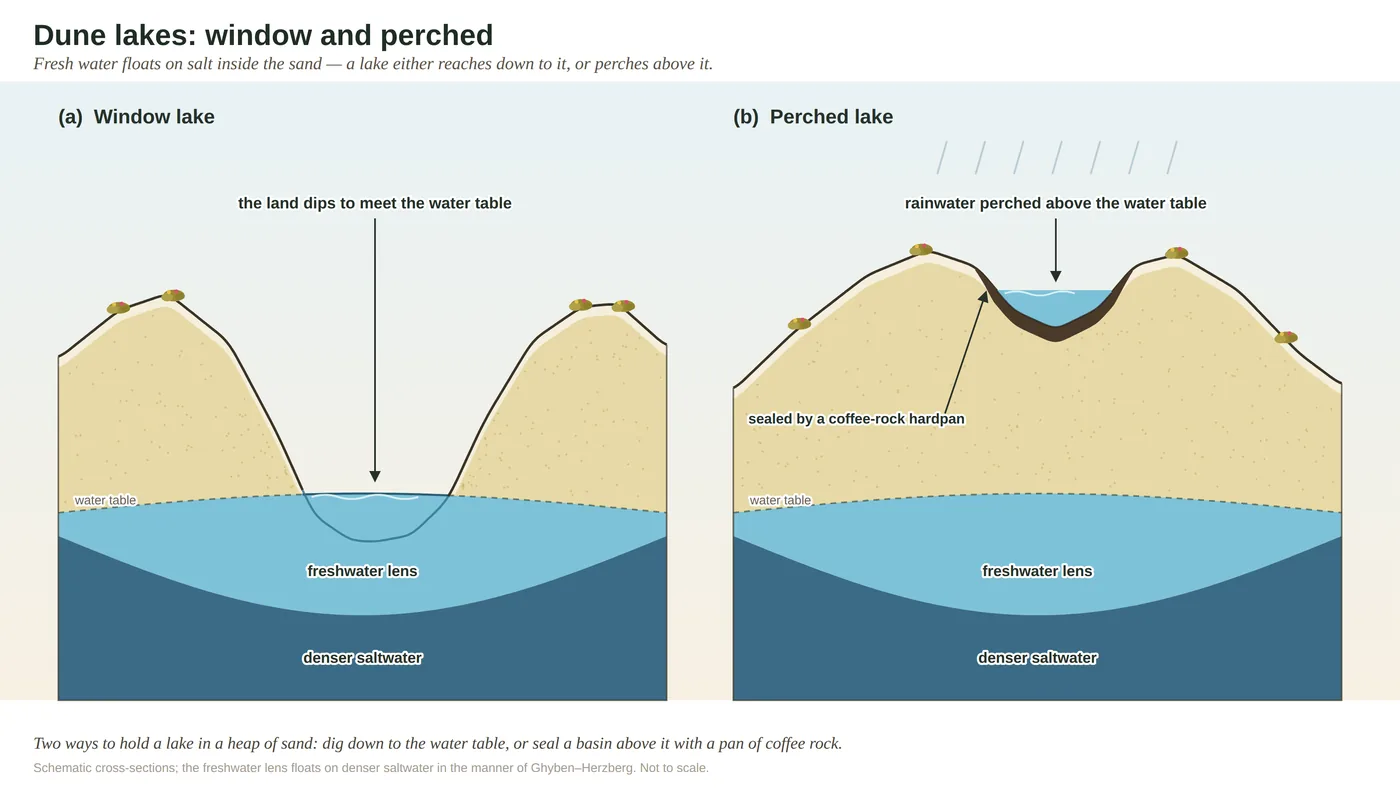
And it does not pack up and dry when the rain stops, because it is fed from below. Beneath the surrounding sand lies an enormous, slow freshwater store, and the everglade is simply that store surfacing — a window onto the aquifer that seeps out steadily, all year, and keeps the dark water moving through the driest months. That is the quiet miracle of the place, and its quiet fragility: everything here leans on a hidden water table you cannot see from the canoe, and lower it, or foul it, and the mirror goes with it.
In depth — the mechanism
The upper Noosa River, above the broad shallow sheet of Lake Cootharaba, is the grandest expanse of blackwater on the coast — the reach the tourist brochures call the Noosa Everglades or the River of Mirrors. The mirror-stillness is the first thing to read: this is a low, flat, sand-bound catchment where clear, tannin-dark water drifts so slowly through lake, channel and swamp that on a windless morning it is genuinely hard to tell bank from reflection.
Two honest caveats carried from the book. (1) You will hear this called "one of only two everglade systems in the world," the other being Florida's. Treat it as an evocative tourism label, not a scientific fact: there is no scientific definition of an "everglade" at all. What is true is plainer and no less remarkable — few places on Earth move clear, tannin-stained water this slowly through this much sand. (2) The freshwater everglade is the reach above Cootharaba. Lake Cootharaba itself is barely a metre and a half deep across its whole expanse and, fed by tides from the estuary below, faintly brackish; the true freshwater blackwater is upstream, where the sand country drains in clean and slow.
Why it is tea-coloured, and why that matters. The colour is dissolved tannin leached from the peaty, acidic litter of the wallum and paperbark swamps all around — the same blackwater chemistry gathered into a river (see blackwater-acidity). Because the sand holds almost no clay or carbonate to buffer anything, the water is also acid, down to somewhere around pH 3.5–4.5, and that sourness is a habitat in its own right: it shelters acid-water specialists found almost nowhere else, among them the honey blue-eye and the Oxleyan pygmy perch, in exactly the chemistry that keeps competitors and introduced fish largely at bay.
It is plumbed to the aquifer. The everglade does not dry up when the rain stops because it is fed from below, by groundwater seeping steadily out of the Cooloola sand mass — a groundwater-dependent ecosystem bound tightly to the level and quality of the water table beneath it (Dyring et al. 2025). That is also its vulnerability: draw the table down or foul it, and the everglade can be undone with nothing whatsoever changing at the surface until it is too late.
Concepts this teaches — follow a thread
Blackwater and acid water (the colour of tea)Dune lakes (perched and window)
Sources for this guide — followable
- Dyring, M. et al. (2025). A hydrogeochemical approach to coastal groundwater-dependent ecosystem conservation: the Cooloola Sand Mass. Science of the Total Environment 958: 177892. [PubMed 39647209] (The GDE dependence-mapping paper — e-pub 7 Dec 2024, vol 958 carries a 2025 date; cite as 2025. A separate Dyring et al. 2024, Groundwater 62(2), doi:10.1111/gwat.13352 covers GDE policy gaps — do not conflate.) — Groundwater-dependent ecosystems of the Cooloola sand mass — the water table that feeds the everglade all year.
- Meyer, E.A., Franklin, C.E. & Cramp, R.L. (2020). Acid tolerance in Litoria cooloolensis larvae. J. Comp. Physiol. B 190: 691–706. [PubMed] (Larvae hold salt balance to ~pH 3.5.) — Frog-larva acid tolerance: wallum sedge-frog larvae (Litoria cooloolensis) hold salt balance down to ~pH 3.5 — how an acid-water specialist endures the blackwater's sourness.
- Willmott, W. (2007). Rocks and Landscapes of the Sunshine Coast (2nd ed.). Geological Society of Australia. (Local basement = Amamoor & Booloumba Beds; North Arm Volcanics; Landsborough Sandstone. NB: Neranleigh–Fernvale Beds are the Gold Coast/Brisbane equivalent, not the Sunshine Coast basement.) — Regional sand-mass and drainage context for the Noosa/Cooloola catchment.
Test yourself →
You paddle into a low, flat reach of sand country and the river slows almost to a standstill. The water is clear but stained the colour of strong cold tea, so still it holds the pale, papery-barked trees upside down like a mirror; the banks are white sand, sedges stand in the shallows, and there is barely any flow. What are you reading — and why is the water this colour?
Cues: Tea-coloured but clear, mirror-still water · Pale, papery-barked paperbarks standing with wet feet · Sedges in the shallows, not reeds · White sand banks · Very low flow — the water barely moves
The tell is that the water is stained yet clear, and dead still. Muddy floodplain water is brown because it is carrying suspended clay; blackwater is brown because it is carrying dissolved tannin, leached from the peaty litter of the wallum and paperbark swamps, over sand too poor in clay and carbonate to soak it up or buffer it. That same lack of buffering leaves the water acid (around pH 3.5–4.5). Paperbarks with wet feet, sedge (not reed) in the shallows, white sand and near-zero flow all point the same way: a groundwater-fed blackwater swamp on poor sand — the Noosa Everglades being the grandest example. (Ch 5; Ch 10.)
The still water of the wallum and the Noosa Everglades is stained the colour of strong tea and is also strongly acidic (around pH 3.5–4.5). What makes it both brown and sour?
Blackwater is clean, not dirty. The brown is dissolved tannin — the same compound that browns tea — leached out of the dead leaves of the wallum and paperbark swamps as water steeps slowly through the litter. The sourness comes from the same poverty: because the leached sand holds almost no clay or carbonate to neutralise anything, the organic acids from the litter (and from the leaching sand itself) accumulate unopposed and drop the pH to around 3.5–4.5. Brown is not mud (that would be turbid, suspended clay), and the acidity is natural, not pollution. That harsh chemistry is a habitat in its own right — it shelters the acid frogs and acid-water fish that cannot live where their predators can. (Ch 5.)
Cited · traceable Last checked 2026-07. Deep-tier claims rest on, and were checked against, Dyring et al. 2025, Cooloola groundwater-dependent ecosystems; 'everglades' label and Cootharaba-brackish corrections per Ch 10 Notes (verified June 2026) — every source is listed below and followable. Grounded in Same Sky, Different Ground.